
Every December the same line comes up at the dinner table: Coca-Cola dressed Santa in red to match its logo. It has the appeal of being simple and a little cynical. It also has the drawback of being false, and Coca-Cola says so on its own website: “Coca‑Cola did not create the legend of Santa Claus.”
To settle it, our archivists did what we always do at the North Pole: pull the documents and check the dates. A magazine cover from 1902, a New York Times article from 1927, soft drink ads, Civil War engravings. Every one of them predates 1931.
Where does the idea that Coca-Cola invented Santa come from?
The reasoning fits on one line: Santa is red and white, so is Coca-Cola, so one copied the other. Phil Mooney, a Coca-Cola archivist, took the question on in the Atlanta Journal-Constitution. Red is indeed the company's color, and a campaign with a red Santa was a natural fit. But the company did not create the suit.
The goal in 1931 was commercial and very concrete. Winter was then a slow season for soft drinks, and Coca-Cola wanted a reason to sell a cold drink in December. Santa, already known to every American child, made the perfect spokesman.
The fact-checking site Snopes rates the claim that the modern Santa Claus was created by Coca-Cola as false. Its founder, David Mikkelson, points out that the character is a hybrid, shaped by Washington Irving, Clement Clarke Moore, John Pintard and Thomas Nast long before the first ad ran. We tell their parts in the true story of Santa Claus.
The brand itself hedges its own legend. On its history page, it says that before 1931 Santa was shown in every possible way, from a tall, gaunt man to a spooky-looking elf. That holds for the 19th century. It holds much less for the 1920s, as the documents below show.
What did Santa look like before 1931?
The poem “A Visit from St. Nicholas,” published in 1823, describes a small figure dressed in fur, chubby and laughing, and never mentions the color of his clothes. Red came from the illustrators. The St. Nicholas Center cites an illustration by Robert Walter Weir, dated between 1836 and 1838, that already shows Saint Nicholas in red.
- 1863Thomas Nast publishes his first Santa in Harper's Weekly. The magazine is printed in black and white.
- 1868A candy advertisement shows Santa in a red suit, according to the Scottish fact-checking site The Ferret.
- 1870sLouis Prang's printed holiday cards popularize the red suit.
- 1881Nast publishes “Merry Old Santa Claus,” a round, bearded Santa with a pipe.
- 1902Puck cover of December 3: Santa in red trimmed with white, signed by Frank A. Nankivell.
- 1927The New York Times describes a “standardized” Santa in red garments.
Nast's 1881 Santa is no advertising mascot. The American Battlefield Trust describes a figure still shaped by the war: a soldier's knapsack on his back, a dress sword and a U.S. belt buckle. He already has the beard, the belly, the pipe and the toys. All he lacks is the color, which Harper's Weekly could not print.
The Puck cover deserves a closer look. Issue 1344 of the New York humor magazine, dated December 3, 1902, shows Santa seated under a sprig of mistletoe, kissed by two young women. He wears a red suit with gold buttons and white fur trim, red mittens, and his sack spills over with a drum, a doll and a trumpet. The print is held by the Library of Congress. Coca-Cola would not take on this role for another twenty-nine years.
Snopes also reproduces illustrations from 1906, 1908 and 1925 showing the same Santa: full beard, red suit, hat trimmed in white, wide black belt. Where that color came from is the subject of our article Why does Santa wear red?.

Was Santa already “standardized” before Coca-Cola?
Yes, and a newspaper said so in print. Snopes cites a New York Times article of November 17, 1927, four years before Haddon Sundblom's first ad, headlined “A Standardized Santa Claus Appears to New York Children.”
As Snopes summarizes it, the reporter found that the height, weight and build of the city's Santas had become almost uniform, and so had the red clothes, the hood and the white whiskers.
The article also counts the pack full of toys, the ruddy cheeks and nose, the bushy eyebrows and the jolly, paunchy look among the required parts of the outfit. In other words, in New York in 1927, everything people now credit to Coca-Cola was already part of the uniform.
One detail amuses our archivists: Coca-Cola dates Moore's poem to 1822 on one page and 1823 on another. Both can be defended. The text passed among people close to its author before it was printed, unsigned, in the Troy Sentinel of December 23, 1823. It was that poem, not an ad agency brainstorm, that Sundblom reread in 1931 to build his character.
Coca-Cola was already running Christmas ads in the 1920s, in shopping-themed magazine pages, including in The Saturday Evening Post. In December 1930, the same magazine carried an illustration by Fred Mizen: a department store Santa drinking a Coke at the world's largest soda fountain, at Famous Barr in St. Louis.
Did another brand use Santa before Coca-Cola?
Yes. White Rock, an American mineral water and soda brand, says it ran ads featuring Santa well before 1931. On its website, the company lists two black-and-white ads from 1915 and 1916, then three color ads from 1923, 1924 and 1925. It says the Santa in those later ads is nearly identical to Coca-Cola's in 1930 and 1931.
Read those dates with care: they come from a brand with every reason to put itself first, and collectors do not always agree on which product each ad promoted. But they line up with what Puck and The New York Times show. Santa was already selling drinks, candy and magazines before Coca-Cola hired him. The 1868 candy ad flagged by The Ferret is a good reminder: merchants had seen the commercial pull of a cheerful gift-bringer more than sixty years before the first Sundblom canvas.
What did Haddon Sundblom really do for Coca-Cola?
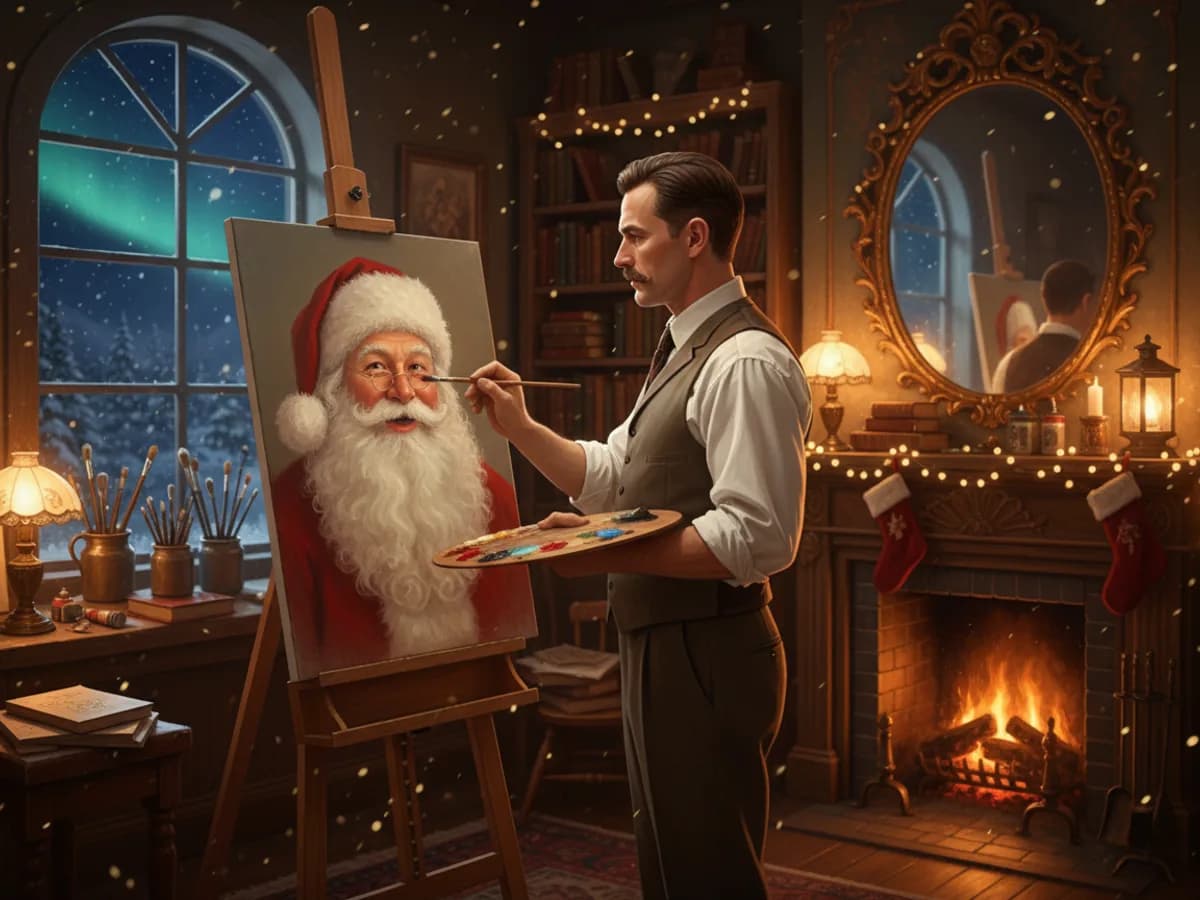
Haddon Sundblom was born on June 22, 1899, in Muskegon, Michigan, to a father from the Swedish-speaking Åland Islands of Finland and a Swedish mother. In 1931, Archie Lee of the D'Arcy Advertising Agency wanted a wholesome Santa for the brand's ads, and Coca-Cola commissioned Sundblom to paint one. His first Santa appeared that year in The Saturday Evening Post.
Sundblom drew on the 1823 poem. He first painted from a friend, Lou Prentiss, a retired salesman. After Prentiss died, he used himself as the model, painting from a mirror, and later worked from photographs. His Santa is warm and smiling, with human features, rosy cheeks and a white beard. He delivers toys, reads letters and takes a break with a bottle. Where Nast's Santa was an engraving seen in black and white, Sundblom's was a full-color painting reprinted every year in national magazines, and that repetition is what made it stick.
The series ran from 1931 to 1964, the year of his final version. In that 1964 painting, the dog is a neighborhood florist's gray poodle, which Sundblom painted black so it would stand out. In 1942 he also created Sprite Boy, an elfin character who appeared alongside Santa in ads through the 1940s and 1950s. According to Coca-Cola, his canvases have been shown at the Louvre, the Royal Ontario Museum in Toronto and the Museum of Science and Industry in Chicago.
Sundblom painted more than Santa. In 1957 he updated the face of the Quaker Oats man, which stayed on the boxes until 1969. His last assignment, in 1972, was a cover for the Christmas issue of Playboy. He died in Chicago on March 10, 1976. His encyclopedia entry notes that he is often wrongly credited with creating the modern image of Santa Claus.
Why won't the Coca-Cola Santa myth die?
Because Sundblom's Santa was seen everywhere, for a very long time. Snopes points out that before television, before color movies were common and before newspapers printed in color, Coca-Cola's magazine pages, billboards and store displays were many Americans' main exposure to this Santa. Phil Mooney adds that the paintings stayed in American homes for decades, which is exactly why the myth persists. A child who grew up with those ads on the wall had no reason to go looking for an 1881 engraving in Harper's Weekly.
In France, the myth rests on a real memory. The magazine-style Père Noël spread after the Second World War, alongside American products. In December 1951, part of the clergy in Dijon burned his effigy in front of the cathedral, and in 1952 the anthropologist Claude Lévi-Strauss published “Le Père Noël supplicié,” tying that spread to American influence. It was tempting to conclude that an American brand had invented the whole thing.
Here is what existed before Sundblom's first painting, with the date of the oldest trace we found:
- the name Santa Claus, in print in New York in 1773;
- the Christmas Eve visit and a sleigh pulled by a reindeer, in 1821;
- the eight reindeer and the trip down the chimney, in 1823;
- the round build, the beard and the pipe, drawn by Thomas Nast in 1881;
- the red suit trimmed with white, on the cover of Puck in 1902.
The last word goes to Phil Mooney, who summed it up this way: sometimes you get credit for things you don't do, and sometimes you don't get credit for things you actually do. Coca-Cola did not invent Santa Claus. It helped freeze his portrait for more than thirty years.
Sources
- The Coca-Cola Company, Haddon Sundblom and the Coca-Cola Santas
- Coca-Cola, Did Coca-Cola create Santa Claus?
- Snopes, Did Coca-Cola Invent the Modern Image of Santa Claus?, David Mikkelson
- Atlanta Journal-Constitution, Did Coke invent the modern-day Santa Claus?
- Wikimedia Commons (Library of Congress ppmsca.25693), Puck, December 3, 1902, cover by Frank A. Nankivell
- The Ferret, No, Santa Claus was not first dressed in red by Coca-Cola
- American Battlefield Trust, The Man Behind Merry Old Santa Claus
- St. Nicholas Center, Origin of Santa Claus
- White Rock Beverages, Ho Ho Ho, setting the facts straight
- Wikipedia, Haddon Sundblom
- Bernard Quaritch, Lévi-Strauss, Le Père Noël supplicié, 1952