Ask a child to draw Santa Claus and the red crayon comes out almost every time. Yet in 1864 an American novelist still described him in a “long brown robe” speckled with white, and an English Christmas card from the late 1800s shows him in a green felt coat, deep in conversation with a robin.
Red did not arrive overnight one December. It settled in slowly, between the icons of a fourth-century bishop, a poem printed in Troy, New York, in 1823, the engravings of Thomas Nast and the magazine covers of the early 1900s. The North Pole Archives have gathered the evidence, from the beard down to the boots.
Did Saint Nicholas wear red?
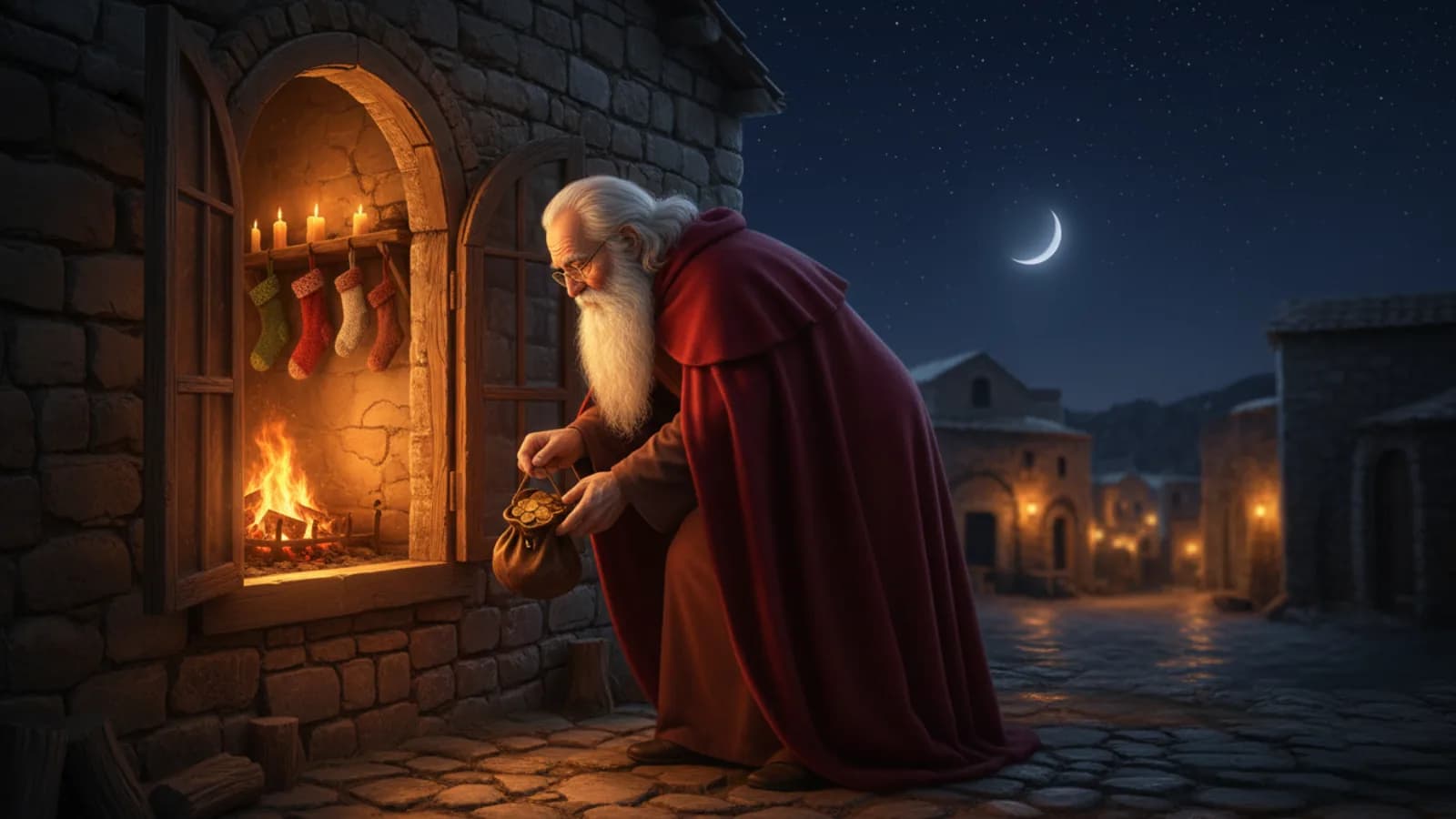
Santa's distant model is Nicholas, a fourth-century bishop of Myra in Lycia, whose life we follow in the story of Santa. For more than a thousand years, icon painters showed him the same way: an old man with a balding head and a rounded beard, dressed in a bishop's vestments.
An icon painted on Crete in the early 1500s, now at the Icon Museum and Study Center in Clinton, Massachusetts, shows him in a pink chasuble with a white omophorion, the long stole of Eastern bishops, marked with large black crosses. The Greek inscription naming him is painted in red, and so is the frame. Red is present, but it surrounds the saint more than it dresses him.
The Children's Museum of Indianapolis notes that tradition gives the saint red and white robes, while adding that some historians believe he wore other colors. The careful version fits in one sentence: church vestments varied by era and by tradition, and a bishop's red is only one of the threads that lead to the modern suit.
In Lorraine, in eastern France, where Saint Nicholas is the patron saint of the region, the Nancy parade shows him each December “resplendent in his finest costume” with a “silvery beard,” according to France's official tourism site. He still walks there as a bishop, never as Santa Claus.
Why was Father Christmas green?
England had its own figure long before the American Santa Claus: Father Christmas, more a spirit of the holiday than a bringer of gifts. Stephen Winick, a folklorist at the Library of Congress, has followed his wardrobe across three centuries. In Ben Jonson's 1616 masque, “Old Christmas” wears round hose, long stockings, a close doublet and a high-crowned hat with a brooch.
In the Victorian era no color won out. Father Christmas appears in green, gold, brown, purple or blue, green being perhaps the most common, often with a hood crowned by holly or yew. York Museums Trust keeps a Christmas card dated between 1870 and 1895 where he wears a green felt coat, a metal tree ornament (1870 to 1910) where his robe is yellow, and an 1890s card where he trudges through a snowstorm all in white, a log on his shoulder.
- 1616Ben Jonson dresses “Old Christmas” in outdated clothes: doublet, round hose, a hat with a brooch.
- 1658A pamphlet by Josiah King shows him in a fur-trimmed robe and cap.
- 1836Robert Seymour draws him hunched, with a long beard, a long robe and a holly wreath.
- 1864In Susan Warner's novel Carl Krinken he wears a long brown robe spotted with white.
- 1870-1895A Christmas card kept in York shows him in a green felt coat.
- 1920In his Father Christmas letters to his children, Tolkien paints him in a red coat trimmed with white fur.
The shift came with the American Santa Claus. According to the Library of Congress, the sleigh and flying reindeer reached Britain in the 1860s, the two characters began to merge in the 1870s, and Father Christmas then took on the red, white-trimmed suit that had come from America.

What did Santa wear in the 1823 poem?
On December 23, 1823, the Sentinel of Troy, New York, printed “A Visit from St. Nicholas” with no author's name. Clement Clarke Moore later included it in his 1844 book Poems. The poem says nothing about color. It talks about fur, and soot.
He was dressed all in fur, from his head to his foot, / And his clothes were all tarnished with ashes and soot.
The visitor in the poem is “a right jolly old elf,” small enough for a miniature sleigh. His clothes are smudged by the chimney: nothing like formal dress. Writer Derek McCormack, in the textile magazine Selvedge, points out that the poem never says what kind of fur it was.
Early illustrators improvised. An 1837 painting described by McCormack shows a short and rather sinister Santa in a fur cape, brown pants and a navy-striped jacket. Mental Floss also points to Pelznickel, a gift-bringer from German-speaking lands whose very name contains the word for fur (Pelz) and who was clad in it. The America of the 1830s pictured a backwoodsman more than a gentleman in red velvet.
Did Thomas Nast make Santa red?
Cartoonist Thomas Nast published his first Santa Claus in Harper's Weekly on January 3, 1863, in the middle of the Civil War. He dressed him in a star-covered coat and striped pants, the colors of the Union, and had him hand out gifts in a Union army camp. From 1863 to 1886 he contributed 33 Christmas images to the magazine, according to the American Battlefield Trust.
Those images came off the press in black and white. After the war, Nast dressed his Santa in close-fitting fur suits in brown, black or green, with a tasseled hat and sprigs of holly. In 1866 he placed him for the first time in an ice palace at the North Pole, the subject of our article on where Santa lives. His best-known portrait, “Merry Old Santa Claus,” ran as a full page on January 1, 1881.
On color, the sources disagree. The Coca-Cola Company writes that Nast drew Santa for thirty years and changed his coat from tan to red. The American Battlefield Trust says the opposite, that Nast has no link to the red suit, and credits Boston printer Louis Prang's cards of the 1870s. Mental Floss notes that an 1890 collection, Thomas Nast's Christmas Drawings for the Human Race, includes a bearded man in red holding a pipe and toys.
When did Santa's suit become red for good?
The visible turning point came in the early 1900s. Puck, America's first successful humor magazine, ran a 1901 cover of Santa offering toys to children more interested in Montaigne and Tolstoy, then a 1902 cover of Santa climbing through the window of two Victorian ladies. Both times he wears a red suit and hat trimmed with white.
York Museums Trust judges that by the 1920s Santa was mostly associated with red. Tolkien painted him that way in his very first letter to his children, in 1920. Historian Karal Ann Marling, quoted by Selvedge, calls the red outfit a “highly decorated business suit,” the clothes of a boss who runs a toy factory.
Then came advertising. Illustrator Haddon Sundblom's Santa made his debut in 1931 in Coca-Cola ads in The Saturday Evening Post. Sundblom first used his friend Lou Prentiss, a retired salesman, as a model, and painted Santa for the brand until 1964. The Coca-Cola Company itself says Santa wore a red coat before Sundblom painted him. The full story of that stubborn legend is in Did Coca-Cola invent Santa Claus?.
What Sundblom brought was repetition. From 1931 to 1964 the same round man with ruddy cheeks and a red and white coat came back every winter in the brand's ads. Selvedge notes that this international campaign set a standard look, at a time when department stores still dressed their Santas in whatever costumes they had in stock.
What is Santa's suit made of?
The material changed as much as the color. It started with fur: the fur of the 1823 poem, Pelznickel's fur, the fur suits Nast drew, and Mental Floss even mentions outfits that look like deerskin. The ancestor of the modern suit is a winter coat, not a party costume.
In late nineteenth-century Canada, men who played Santa without owning a scarlet suit improvised, Derek McCormack writes: togas, red felt or muslin tied at the waist, boots made of black oilcloth wrapped around the shins, and sometimes a plain red bathrobe. In 1894 a Blackfoot boy wrote to the Calgary Herald that Santa had “a dress like an old woman.”
- The coat: trimmed in white since the Puck covers of 1901 and 1902, belted in black in the 1930s English mummers' drawings noted by the Library of Congress.
- The hat: a hood in Tolkien's 1920 drawing, a cap in his later ones.
- The boots: inherited from Nast, who sometimes also gave his Santa patent pilgrim shoes.
- The price: according to Mental Floss, professional American Santas own several suits costing from $500 to $5,000 each.

How did Santa get his white beard?
The beard is older than the red. In icons, Saint Nicholas is already an old man with a rounded beard, as on the sixteenth-century Cretan icon mentioned above. In England, Robert Seymour drew a long-bearded Father Christmas in 1836, and Susan Warner's 1864 novel gave him white hair and a white beard.
The 1823 poem settled the color for good: “the beard of his chin was as white as the snow.” Nast made it bushy, Sundblom kept it neat on a wrinkled face. Even today some American agencies hire only “naturally bearded gentlemen” to play the part in malls and stores.
Children who want to check can always ask him directly in a letter to Santa or by talking to Santa. The village's official answer is short: the beard is real, and it never gets trimmed before Christmas.
Sources
- Library of Congress, Folklife Today, Stephen Winick, “Christmas Cousins: Father Christmas and Santa Claus,” 2018
- York Museums Trust, “A Green Father Christmas”
- Icon Museum and Study Center, “Icon with St Nicholas,” Crete, early 16th century
- Academy of American Poets, Poets.org, “A Visit from St. Nicholas” (1823)
- American Battlefield Trust, “The Man Behind ‘Merry Old Santa Claus’”
- Selvedge, Derek McCormack, “Santa Suits,” 2016
- Mental Floss, Maureen Monahan, “The Holly Jolly History of the Santa Suit,” 2016
- The Coca-Cola Company, “Haddon Sundblom and the Coca-Cola Santas”
- The Children's Museum of Indianapolis, “Why Does Santa Wear Red?,” 2018
- France.fr (Atout France), “Où fêter la Saint-Nicolas en France ?”