On the morning of December 22, Spain stops in front of the television. On the stage of Madrid's Teatro Real, children in uniform draw balls from a drum and sing out numbers to a tune every Spaniard knows. This is the draw of the Lotería de Navidad, and for many people in Spain it is the real first day of Christmas. The season only ends on the morning of January 6, when children find the presents left by the Three Kings.
Between those two dates, each day has its ritual: the Nochebuena dinner on the 24th, the pranks of Holy Innocents' Day on the 28th, the twelve grapes of Nochevieja on the 31st, then the Kings' parade on January 5. The gift bringers themselves, the Three Kings, the Tió de Nadal and Olentzero, are introduced in our article on Christmas gift bringers around the world, and a tour of other countries is on our Traditions page. Here we follow the Spanish calendar, one day at a time.
Who are the San Ildefonso children who sing the numbers?
The singers come from the Colegio de San Ildefonso, a Madrid municipal institution founded between the mid-fourteenth and mid-fifteenth centuries, when wars and plague left many children with nothing. It still takes in children from families in difficulty, who live there Monday through Friday. The singing tradition goes back to March 9, 1771: that day, a pupil of about seven named Diego López drew and sang a winning number of the Spanish lottery for the first time.
Since the first Christmas draw of 1812, they have sung the numbers every year. Until 1973 the school only admitted boys. The first girls arrived in 1981, and in 1984 a girl, Mónica Rodríguez, sang a number in the Christmas draw for the first time. For the 2025 edition there were 28 of them on stage, 16 girls and 12 boys aged 10 to 14.
The role takes practice. Selection happens in mid-October, according to the newspaper Público, and the chosen pupils then rehearse for about two months. Consumer magazine reports that they train for an hour a day with balls supplied by the national lottery, and that numbers full of zeros are the hardest to sing without slipping. The draw itself then takes place on December 22, in front of the audience at the Teatro Real.

How do Spaniards celebrate Nochebuena?
Nochebuena, “the good night,” is the evening of December 24. It is a family dinner whose menu changes from region to region; in Catalonia the big meal comes on the 25th instead, with pasta-shell soup and *escudella*, followed on the 26th, Sant Esteve, by *canelons*. Around 9 p.m. many households listen to the King's Christmas message, broadcast every year on the 24th. The most devout end the night at the Misa del Gallo, midnight Mass, literally the “Rooster's Mass.”
Dessert brings turrón, a nougat of almonds and honey. The two most famous kinds come from the same town, Jijona, near Alicante, which makes about 60 percent of the turrón produced in Spain. *Turrón de Jijona* is soft, made with finely ground almonds and cooked for at least 150 minutes in copper pots; *turrón de Alicante* is hard, with chopped almonds and egg white. Both have carried a European protected geographical indication since 1996, which requires at least 10 percent local honey.
In homes, churches and squares, people build a belén, a nativity scene, using moss, cork and wood to imitate the hills of Bethlehem. In Catalonia and the Valencia region, it hides an unexpected figure: the caganer, a peasant in a red cap, the *barretina*, squatting behind a bush to relieve himself. He is thought to have entered nativity scenes in the late seventeenth or early eighteenth century. The folklorist Joan Amades explained that he was believed to fertilize the scene's soil, and that leaving him out brought bad luck.
The caganer is taken very seriously, as Barcelona's city council found out. In 2005 it set up a municipal nativity scene without him; a “Salvem el caganer,” save the caganer, campaign followed, and he was back in 2006. Today craftspeople sell him in the likeness of soccer players, singers, heads of state and members of royal families.
Why do Spaniards play pranks on December 28?
December 28 is the Día de los Santos Inocentes, Holy Innocents' Day, which in Christian tradition commemorates the massacre of newborn boys ordered by King Herod. In Spain and Latin America it has become the local April Fools' Day. People play *inocentadas*, pranks of every kind, and newspapers print whole pages of fake news, some of it so serious-looking that it catches careless readers.
Television joined in too: since 1995 the evening of the 28th has ended on La 1, the main public channel, with the *Gala Inocente, Inocente*, a charity show whose funds go to organizations that help children.
The most spectacular celebration is in Ibi, in the province of Alicante. For the *Día dels Enfarinats*, a group of fourteen people, the “floured ones,” takes power for the day and names a mayor, a judge, a prosecutor and a bailiff. The opposition, in black top hats, tries to overthrow them. It all ends in a battle of flour, powder and firecrackers, a carnival satire of the struggle between those in power and their opponents. In Fraga, in Aragon, young people fight an egg battle that day.
Why do Spaniards eat twelve grapes at midnight?
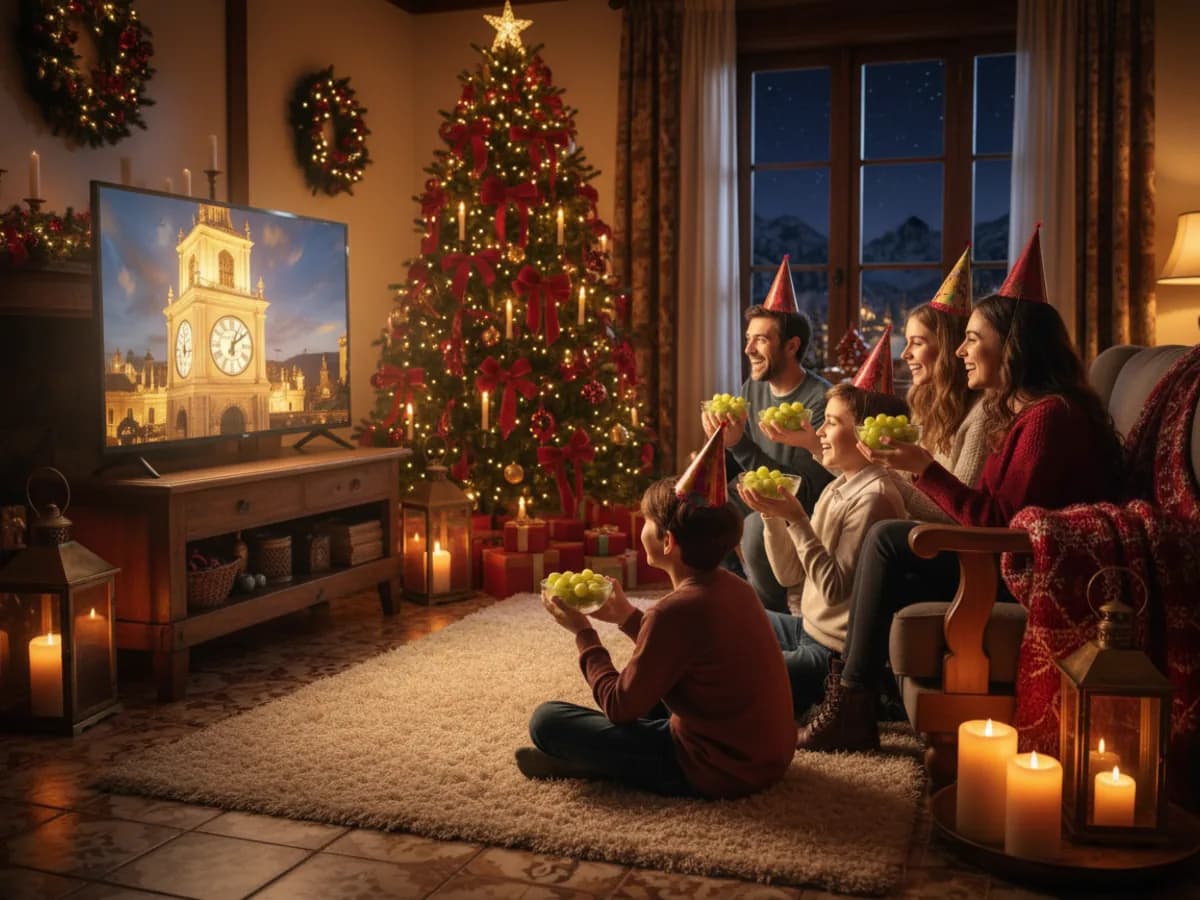
On December 31, Nochevieja, people in Spain swallow one grape on each stroke of midnight, twelve in all, to secure twelve months of luck. These are the uvas de la suerte, the lucky grapes.
The custom dates back at least to 1895: a Madrid newspaper, *La Correspondencia de España*, mentions it on January 1, 1896. It really spread in December 1909, when grape growers in the Alicante region, after an outstanding harvest, encouraged the public to eat their surplus at midnight.
The countdown is followed live on the clock of the Real Casa de Correos on Madrid's Puerta del Sol, where a ball drops before the twelve strokes. Public television has broadcast it since 1962, and families all over the country swallow their grapes in front of the screen, keeping time with that clock.
Why do Spanish children wait for January 6?
In Spain, the big presents come from the Reyes Magos, the Three Kings, who pass through on the night of January 5, the eve of Epiphany. Children write them a letter in the days before. In Alcoy the festivities even start the Sunday before, with the little parade of the *Pastoretes*, children dressed as shepherds who bring a gift to the Christ Child along with their flocks. On January 4, a royal herald arrives there with the *burretes*, little donkeys carrying the mailboxes where children drop their wish lists.
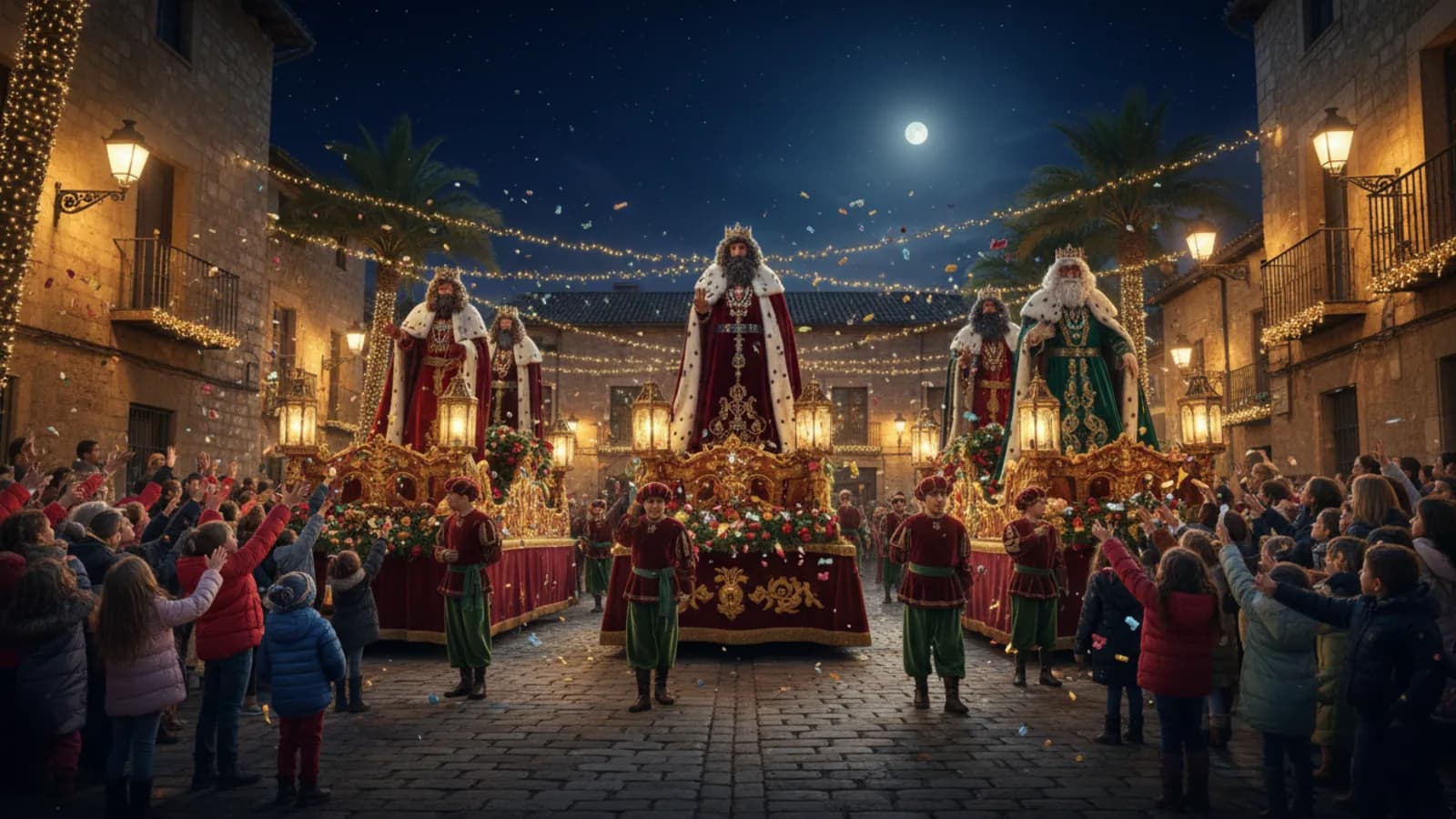
On the evening of January 5, cabalgatas parade through every town: floats, pages, the three Kings on their thrones and a shower of candy thrown to the crowd. The oldest on record is in Alcoy, held since 1885, where the pages climb to balconies on long ladders. In Granada in 1912, one was organized to collect toys for poor children; Seville has had its own since 1918, and public television has broadcast Madrid's since 1964. In the capital, the parade absorbed an older custom, the *fiesta de la escalera* of the early nineteenth century, when people went around asking for wine on the night of January 5. The next day families share a *roscón de Reyes*, the ring-shaped cake with a hidden figurine, described along with the Alcoy parade in our article on Christmas gift bringers.
Two regions also have a visitor of their own on December 24. In Catalonia, children beat the Tió de Nadal with sticks, a log they have fed since December 8, so that he “poops” candy and turrón under his blanket. In the Basque Country, Olentzero, the charcoal burner who came down from the mountains, brings the presents. Santa, called *Papá Noel* here, has made some room for himself, but the Kings are still the main gift givers. Children who want to write to Santa anyway can use our letter page.
- Dec. 8Catalan children start feeding the Tió.
- Dec. 22Lotería de Navidad draw at the Teatro Real.
- Dec. 24Nochebuena, the King's message and Misa del Gallo; Tió and Olentzero.
- Dec. 28Día de los Santos Inocentes, the day of pranks.
- Dec. 31Nochevieja and twelve grapes on the Puerta del Sol.
- Jan. 5Three Kings parades across the country.
- Jan. 6The Kings' presents and roscón de Reyes.
Sources
- Wikipedia, Spanish Christmas Lottery
- Público, ¿Por qué cantan los números de la Lotería de Navidad los niños de San Ildefonso?
- Consumer, Los niños de San Ildefonso
- Wikipedia (es), Nochebuena
- European Commission, Turrón de Alicante PGI
- Ajuntament de Barcelona, Christmas traditions
- Wikipedia, Caganer
- VilaWeb, Caganer, the star of Christmas in Catalonia
- Wikipedia (es), Día de los Santos Inocentes
- Wikipedia, Twelve Grapes
- Wikipedia (es), Cabalgata de Reyes Magos
- Spain.info, Cabalgata de los Reyes Magos de Alcoy