In much of the world, presents don't arrive on December 25, and they don't come down Santa's chimney. A child in Rome waits for the Befana on January 6. A child in Nuremberg waits for the Christkind on Christmas Eve. A child in Madrid leaves shoes out for the Three Kings, a child in Barcelona whacks a log, and a child in Reykjavik gets thirteen visits in thirteen nights.
These visitors aren't knockoffs of Santa Claus. Most of them are older than he is, and each has its own calendar, its own ritual and sometimes a frightening sidekick. Santa's own names, from Babbo Natale to Дед Мороз, are covered in our guide to his names around the world. Here we follow the ones who make the rounds instead of him, or right alongside him.
Who brings the presents, and on what date?
Gift season runs for more than a month, and every country holds a piece of it. The date almost always depends on the character: a saint comes on his feast day, the Christ Child on Christmas Eve, the Three Kings on Epiphany. Here is the calendar, from the first visitor to the last.
- Dec 5Sinterklaas in the Netherlands (pakjesavond); Krampus roams on the eve of Saint Nicholas Day in Austria and Bavaria.
- Dec 6Saint Nicholas in Lorraine, eastern France and Belgium, followed by Père Fouettard.
- Dec 8In Catalonia, children start feeding the Tió de Nadal.
- Dec 12In Iceland, the first of the thirteen Jólasveinar, Stekkjastaur, comes to town.
- Dec 24The Christkind in southern Germany and Austria, Olentzero in the Basque Country, the Tió in Catalonia.
- Dec 25Santa Claus, Father Christmas and Père Noël across the English-speaking world and France.
- Jan 1Ded Moroz in Russia for New Year's, Άγιος Βασίλης in Greece.
- Jan 6The Befana in Italy, the Three Kings in Spain, Mexico and much of Latin America.
These visitors have sometimes fought over the job. The most famous episode happened in France on December 23, 1951: on the square in front of Saint-Bénigne Cathedral in Dijon, local clergy burned an effigy of Father Christmas in front of 250 children, explaining that Christmas must remain "the anniversary of the Savior's birth." The anthropologist Claude Lévi-Strauss wrote an essay about it the following year, *Le Père Noël supplicié* ("Father Christmas Executed").
Saint Nicholas, Père Fouettard, Krampus: who rewards and who punishes?
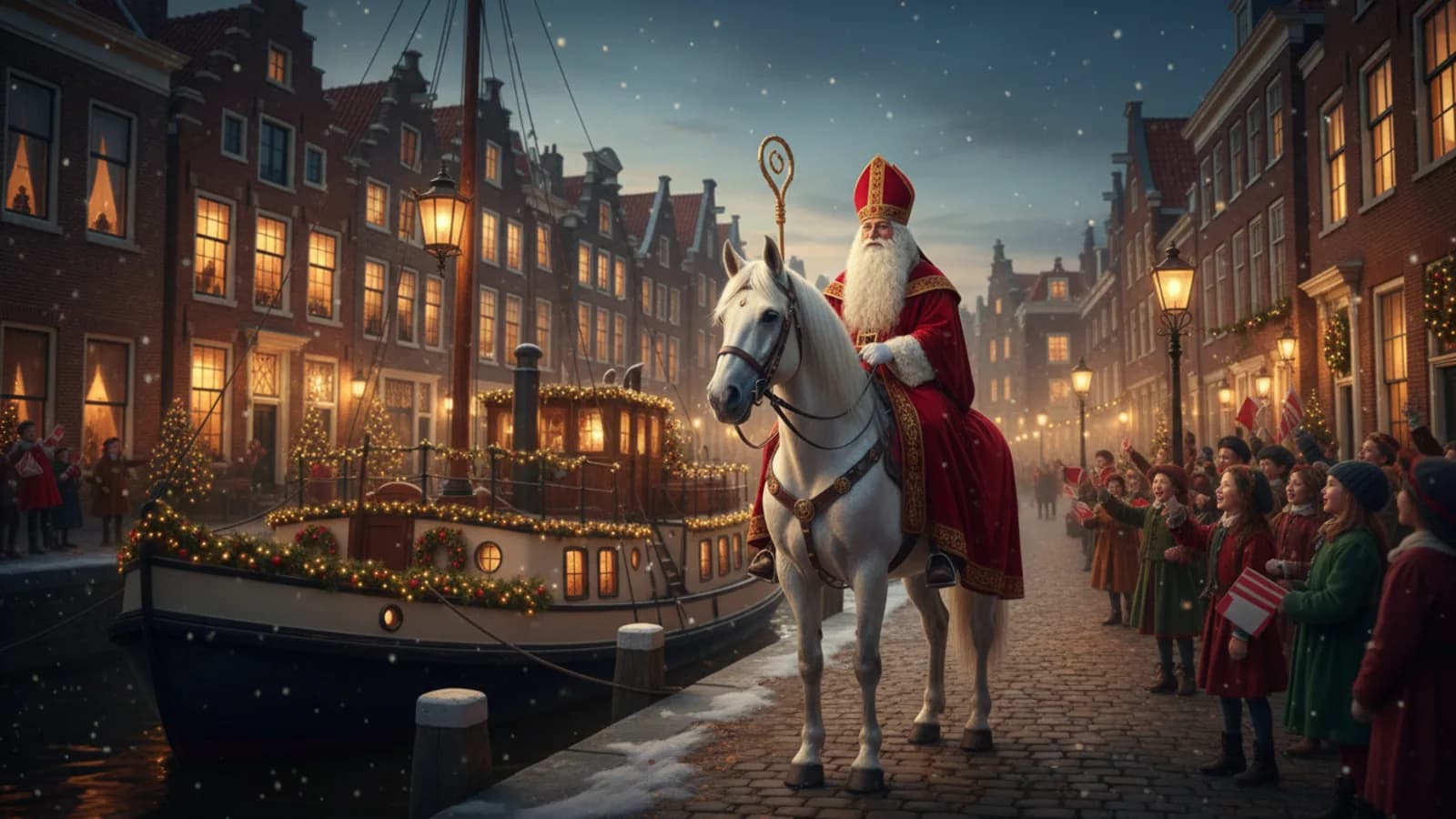
In Lorraine, in northeastern France, Saint Nicholas has been the region's patron saint since 1477. His best-known legend says he brought back to life three children killed by a butcher. On December 6 he traditionally brings an orange and gingerbread shaped like himself, and children leave sugar and a carrot for his donkey. In Nancy, the big Saint Nicholas parade runs from Place Carnot to Place Stanislas, and the basilica at nearby Saint-Nicolas-de-Port shows how old his cult is in the region.
Behind him walks Père Fouettard, "Father Whipper." He has no legend as old as the saint's: in the words of the French travel guide Le Routard, he is "a pure invention meant to intimidate disobedient children." In the Netherlands, Sinterklaas travels with Zwarte Piet; in German-speaking Switzerland, the Samichlaus comes with a donkey and a companion called Schmutzli; in Germany you may meet Knecht Ruprecht.
The most spectacular of these sidekicks is Austrian and Bavarian. Krampus has horns, dark hair and fangs, half goat and half demon, and he swats naughty children with birch sticks. His name is thought to come from the German *Krampen*, claw. He comes out on the eve of Saint Nicholas Day, *Krampusnacht*. The Catholic Church forbade rowdy celebrations in his name, and during World War II Europe's fascists condemned him as a creation of the Social Democrats.
None of it stuck. Today, in Austria, Germany, Hungary, Slovenia and the Czech Republic, groups of men dressed as devils take over the streets and chase passersby. Peter Jelavich, a historian at Johns Hopkins University, calls him a pagan character added onto Christmas. The custom has even crossed the Atlantic: Ypsilanti, Michigan, holds an annual Krampus ball.
Who is the Christkind, the Christ Child who brings presents?
The Christkind, the "Christ Child," brings presents on Christmas Eve across much of southern Germany, Austria and German-speaking Switzerland. Despite the name, it is rarely shown as a baby. Popular custom made it an angelic figure with blond curls, a white robe and a golden halo, often played by a girl.
Its origin is disputed. It appeared in Protestant regions as an alternative to Saint Nicholas, since the Reformation rejected the veneration of saints. Some credit Martin Luther with inventing it, a claim the University of Hamburg calls unproven. What is known is that from 1531 on, gift-giving in Luther's own family was already linked to the "Holy Christ." In a twist, Catholic regions such as Bavaria and the Rhineland adopted the Christkind in the early 19th century. In America, its diminutive *Christkindl* turned into Kris Kringle.
The most famous Christkind is Nuremberg's. Since 1969 the city has elected one every two years, and candidates must be between 16 and 19 on election day. On the Friday before the first Sunday of Advent, the Christkind, crowned, curly-haired and dressed in gold, opens the Christkindlesmarkt from the gallery of the Frauenkirche by reciting a prologue written in 1948 by Friedrich Bröger. In December she keeps well over a hundred appointments. For 2025 and 2026, her name is Nora Falk.
Who is La Befana, Italy's January 6 witch?
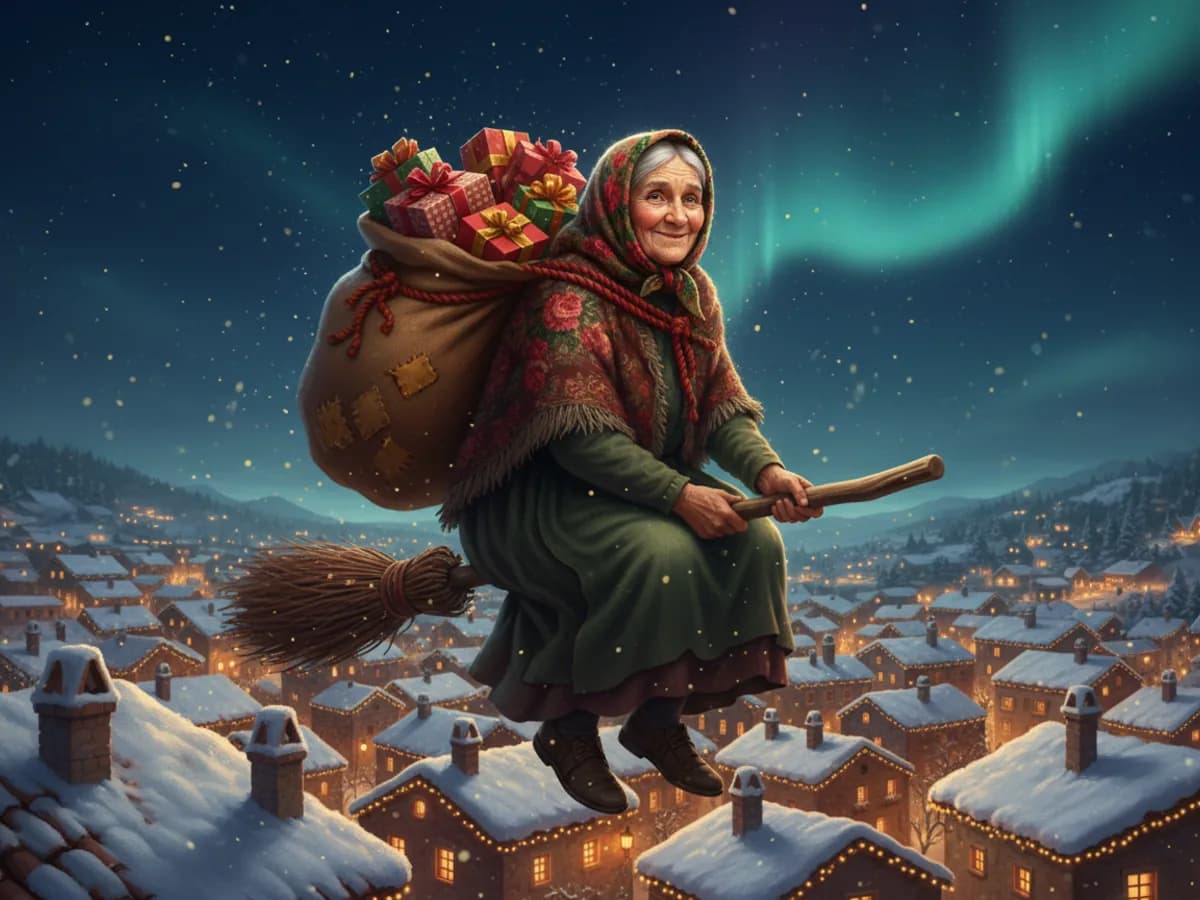
In Italy, the night of January 5 belongs to the Befana. Her name is a folk corruption of *Epifania*, Epiphany. The Treccani dictionary describes her as an old woman, very ugly but kindly, who comes down the chimney at night and fills good children's stockings with presents and sweets. Naughty children get lumps of coal. These days that coal is usually rock candy dyed black, sold in candy shops.
The best-known Christian legend puts her on the Three Kings' path. The Magi ask her the way to the Christ Child and invite her along; she says no, too busy with her housework. Later she changes her mind, sets out to find them and never does. Ever since, she has flown on her broom, and many say she sweeps the floor before she leaves.
The figure is older than that story. The 1930 Enciclopedia Italiana links the Befana to pre-Christian magical traditions and describes bonfires lit on the night of Epiphany. In Tuscan Romagna, her effigy was paraded on a cart to the village square and then burned. The small town of Urbania, in the Marche region, is considered her official home and hosts a festival every year between January 2 and 6 that draws 30,000 to 50,000 people.
Why do kids in Spain and Mexico get presents on January 6?
In the Spanish-speaking world, the big gift givers are the Reyes Magos, the Three Kings. Epiphany, January 6, marks their visit to the Christ Child, and that morning is when children find their presents. In Mexico, many children first write a letter to the Kings, some tie it to a helium balloon, and on the night before, a shoe often goes by the door.
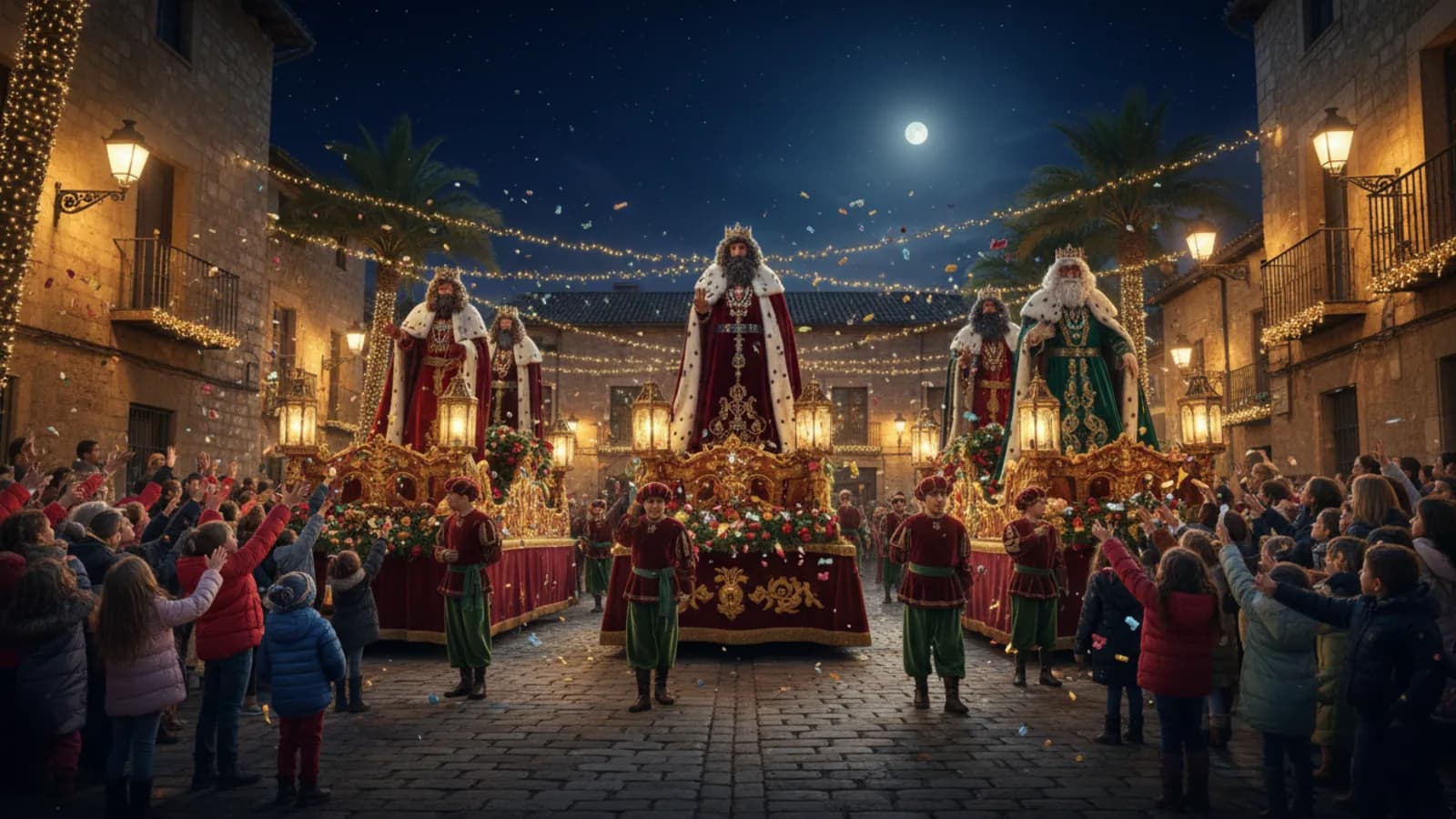
On the evening of January 5, the Kings parade through the streets. The cavalcade in Alcoy, in the province of Alicante, has run since 1885 and is one of the oldest in Spain. It is listed as a Festival of National Tourist Interest. Its royal pages climb long wooden ladders to deliver gifts straight to balconies and windows, and donkeys called *burretes* carry the mailboxes where children drop their wish lists.
January 6 ends with a ring-shaped cake. In Spain, the *roscón* hides a figurine that often represents one of the Kings. In Mexico, the *rosca de Reyes* hides a tiny Christ Child: whoever finds it must take it to church or host the family on February 2, Candlemas. Three Kings' Day stretches Christmas out by a full month.
Ded Moroz and Snegurochka: the New Year's gift bringers
In Russia and several other former Soviet countries, presents are given at New Year's. They come from Дед Мороз (Ded Moroz), "Grandfather Frost." The Soviet state fought him at first: in 1928 he was declared "an ally of the priest and the kulak." In 1935, when New Year celebrations were allowed again, he came back, and in 1998 his official residence was set in Veliky Ustyug, in Vologda Oblast.
He never travels alone. Снегурочка (Snegurochka), the Snow Maiden, in long silver-blue robes and a fur cap or a snowflake-like kokoshnik, helps him hand out the presents. She comes from a fairy tale that playwright Alexander Ostrovsky brought to the stage in 1873, with incidental music by Tchaikovsky, and that Rimsky-Korsakov later turned into an opera. Since the Soviet revival of New Year in the mid-1930s, she has been presented as his granddaughter.
Greece has a New Year's visitor too: Άγιος Βασίλης, Saint Basil, a fourth-century bishop of Caesarea whose feast falls on January 1. That night families share the *vasilopita*, a cake with a coin slipped into the dough before baking: whoever finds it has luck all year.
Tió de Nadal and Olentzero: presents in Catalonia and the Basque Country
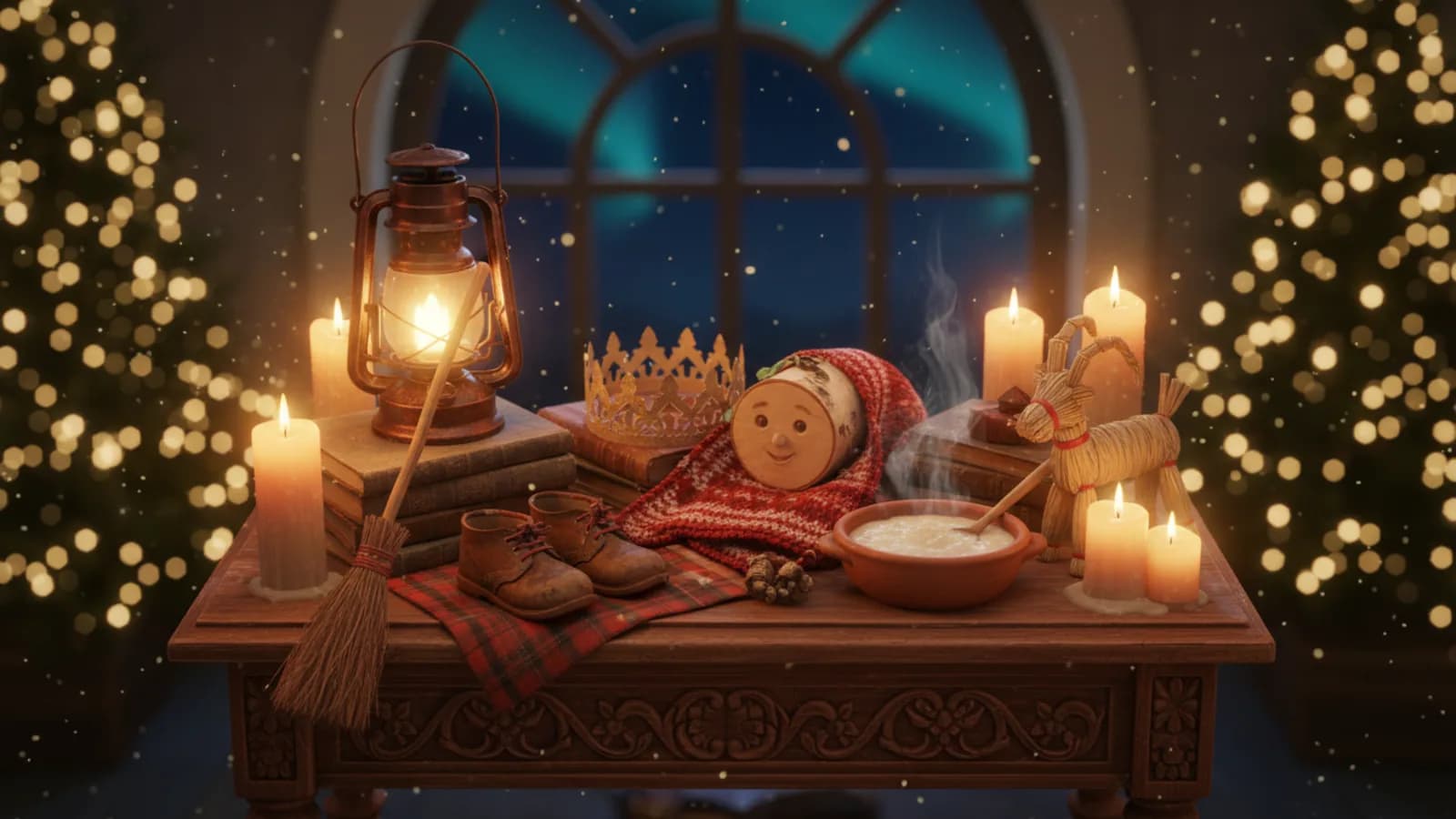
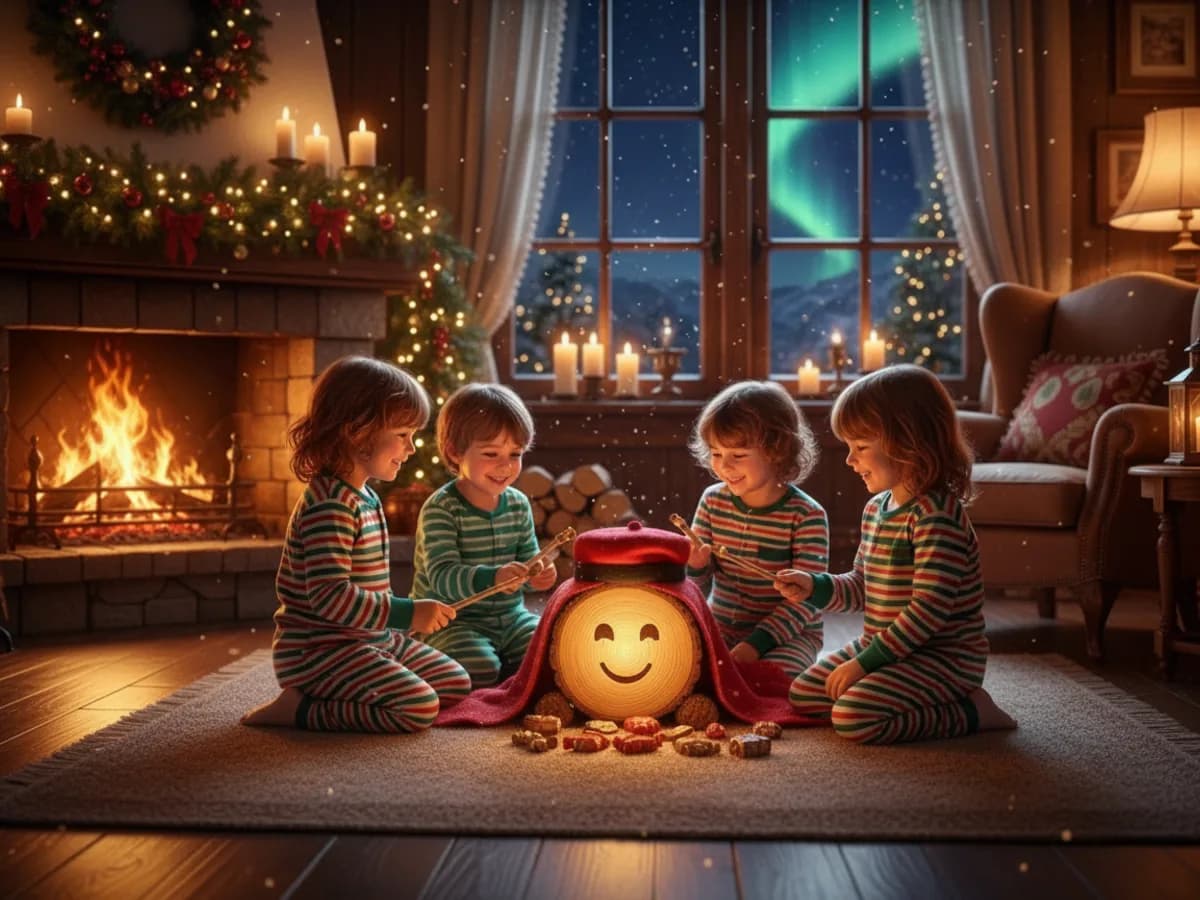
In Catalonia, presents come out of a log. The Tió de Nadal is a big, often knotty trunk brought into the house in the days before Christmas. Starting December 8, the Feast of the Immaculate Conception, children feed it every day (in the old days with bread, corn, carob or sawdust) and tuck a little blanket over it to keep it warm. On Christmas Eve they beat it with sticks while singing a traditional rhyme, then lift the blanket: the Tió has "pooped" sweets and presents. If they've misbehaved, it may leave nothing but coal.
Originally, the Tió was the log burned in the hearth on Christmas night, in Catalonia and on Mallorca. The custom has faded a little in cities, but it is still very much alive and coming back in many towns, and the city of Barcelona still lists it among its Christmas traditions.
In the Basque Country, the visitor of December 24 is Olentzero. He is a charcoal burner: according to legend, he was working in the mountains when he learned of Christ's birth and came down to share the news. He too began as a Christmas log, whose ashes were spread at the door the next day to protect the house. In the 20th century he started bringing presents to children. On the evening of the 24th, choirs walk the streets singing his story, and he is joined by Mari Domingi, a figure tied to nature and the winter solstice.
Joulupukki and the Yule Lads: visitors from the far north
In Finland, Joulupukki, the "Christmas goat," descends from a custom in which a man dressed as a goat went from house to house and was given the leftovers of the holiday meal. The figure lost his horns and grew a white beard but kept the name, and since a Finnish radio broadcast in 1927 he has been said to live on Korvatunturi, in Lapland. Farther south, in Norway, Denmark and Sweden, the farm spirit, the *nisse* or *tomte*, became a gift bringer. Traditionally he gets a bowl of porridge with a pat of butter on top, or rice pudding in Norway.
Iceland went for numbers. The Jólasveinar, the thirteen Yule Lads, arrive one by one, one night each, from December 12 to 24. Their names give away their habits: Stekkjastaur, "Sheep-Cote Clod," leads the way, followed by Þvörusleikir the Spoon Licker, Hurðaskellir the Door Slammer, Skyrgámur the Skyr Gobbler, Gluggagægir the Window Peeper, and finally Kertasníkir, "Candle Beggar," on the 24th. From December 11 to 24, children leave a shoe on the windowsill: it fills up with a small gift, or a potato after bad behavior. The season ends on January 6 with Þrettándinn.
The Yule Lads come from a rough family. The thirteen brothers are said to live in the mountains with their mother, Grýla, a fearsome troll, and her husband, Leppalúði, a lumbering oaf. The Yule Cat, huge and glowing-eyed, prowls the mountains on Christmas night and hunts anyone who hasn't gotten new clothes. The lads themselves are respectable enough to drop in at the National Museum of Iceland in Reykjavik: in December 2025 they visited one at a time, every day from the 12th to the 24th, in the children's and family room.
Sources
- Treccani, Vocabolario, "befana"
- Treccani, Enciclopedia Italiana, "Befana" by Raffaele Corso, 1930
- Wikipedia, Befana
- Universität Hamburg, Who is the Christkind?, 2025
- Christkindlesmarkt Nürnberg, Das Nürnberger Christkind
- City of Nuremberg, Das Nürnberger Christkind
- Wikipedia (German), Weihnachtsmann (Christkindl, Schmutzli)
- National Geographic, Krampus the Christmas Devil Is Coming to More Towns. So Where's He From?
- Le Routard, Saint-Nicolas et Noël en Lorraine
- Wikipedia, List of Christmas and winter gift-bringers by country
- Wikipedia, Sinterklaas
- macommune.info, Il y a 70 ans, le clergé brûlait le Père Noël à Dijon
- Spain.info, Cabalgata de los Reyes Magos de Alcoy
- Government of Mexico, Senasica, Día de Reyes
- Wikipedia, Christmas in Mexico
- Wikipedia, Rosca de reyes
- Wikipedia, Ded Moroz
- Wikipedia, Snegurochka
- Greek Herald, The Greek Father Christmas: Santa Claus or Saint Basil the Great?
- City of Barcelona, Christmas traditions
- Gran Enciclopèdia Catalana, "tió"
- Basque Country Tourism, Olentzero and Mari Domingi
- Wikipedia, Joulupukki
- Wikipedia, Nisse (folklore)
- Visit Iceland, Meet the Icelandic yule troll family
- National Museum of Iceland, The Yule lads visit the museum!
- Fondation Napoléon, Napoleon.org, Pain d’épice et chocolat pour la Saint-Nicolas (in French: the donkey and its carrot)