In France, Christmas doesn't start on December 24. In Nancy, children got their gingerbread from Saint Nicholas back on the 6th. In Marseille, Saint Barbara's wheat has been sprouting in three little dishes since the 4th. In Strasbourg, the Christmas market has been running since late November, as it has in one form or another since 1570.
The whole country shares a few fixed points: réveillon, the bûche, the tree, the nativity scene, and Père Noël coming in the night. But each region adds its own layer, and those local details often explain the national habits best. Our Christmas traditions page tours the world in a few cards; here we stay in France and take our time.
When does Christmas start in France?
The French Christmas calendar stretches over more than a month. It opens in the east with Saint Nicholas Day, December 6, a holiday far more alive in Lorraine, Alsace and the north than anywhere else in the country. It closes in early January with Epiphany and the galette des rois, a puff pastry filled with almond frangipane that hides a small charm called a fève: whoever finds it is crowned king or queen.
- Dec. 4Saint Barbara's Day: in Provence, wheat is sown in three dishes and should sprout by Christmas.
- Dec. 6Saint Nicholas Day in Lorraine, Alsace and the north, with parades in Nancy and Saint-Nicolas-de-Port.
- Late Nov. to late Dec.Christmas markets, including Strasbourg's Christkindelsmärik, founded in 1570.
- Dec. 24Réveillon, midnight Mass, and in Provence the gros souper followed by thirteen desserts.
- Dec. 25Père Noël's presents under the tree, then Christmas lunch.
- Early Jan.Epiphany and the galette des rois, on January 6 or the first Sunday in January.
That calendar explains why two French children don't necessarily have the same Christmas. A child in Lorraine may get treats twice in three weeks, once from Saint Nicholas and once from Père Noël. A child in Provence will see the Christmas Eve table stay set for three days. The story of Saint Nicholas in Lorraine has its own article: who was Saint Nicholas.
Who brings presents in France: Père Noël or Saint Nicholas?
In most of the country, Père Noël, Father Christmas, comes on the night of December 24. Children used to set their shoes in front of the fireplace for him to fill, and the magazine FrenchEntrée notes that small toys, candy and fruit were also hung on the tree. Today the presents usually wait under the tree on the morning of the 25th.
This white-bearded Père Noël in a red coat mostly took hold in France after World War II. Not everyone welcomed him. On December 23, 1951, part of the clergy in Dijon burned his effigy in front of Saint-Bénigne Cathedral. The next day Canon Kir, the city's mayor, had him reappear on the rooftop of city hall. The whole affair is told in the true story of Santa Claus.
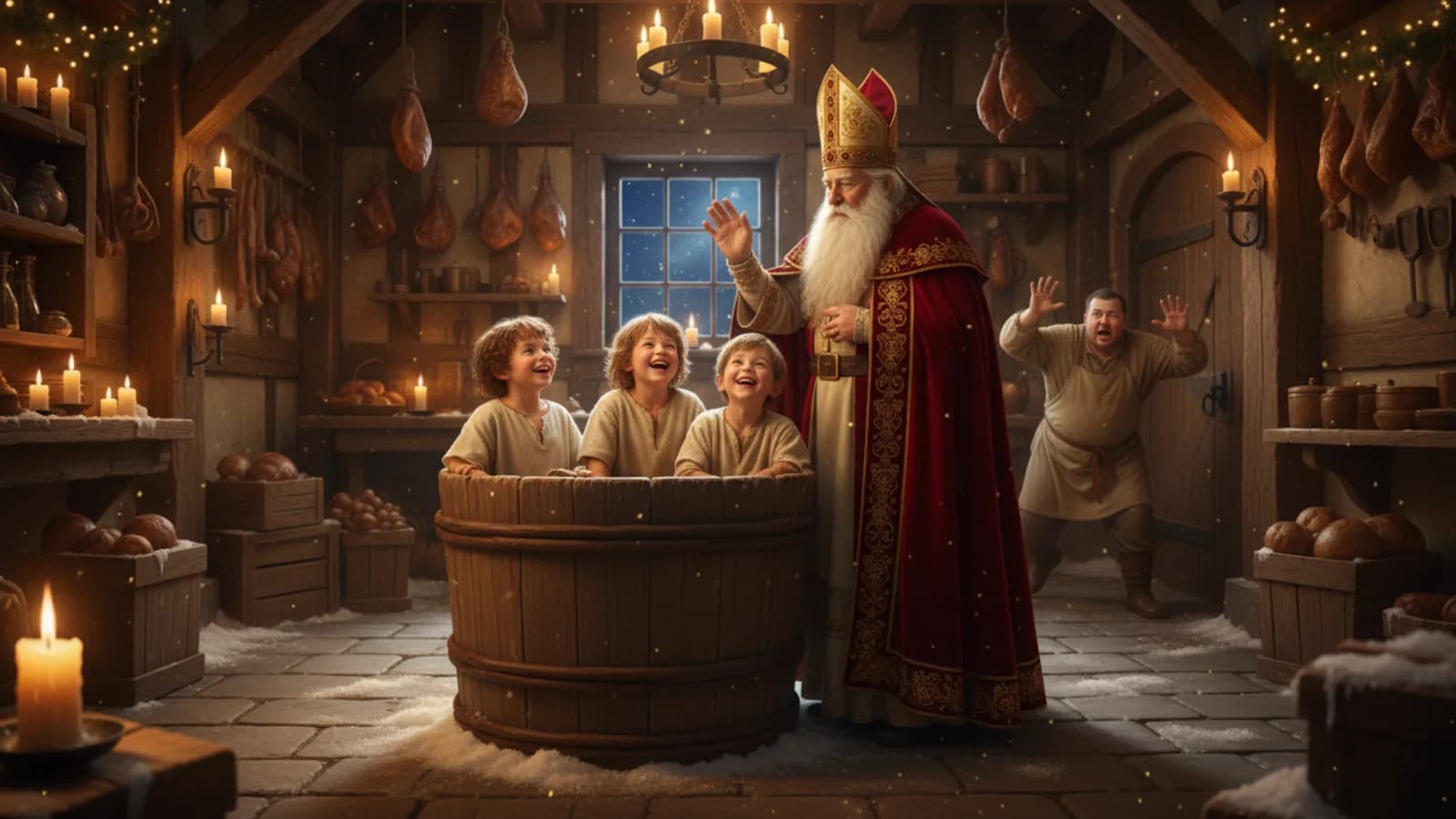
In the east, Saint Nicholas never stepped aside. He comes on the night of December 5, dressed as a bishop with miter and crozier, followed by Père Fouettard, "Father Whipper," who threatens disobedient children. He traditionally brings an orange and gingerbread shaped like himself, and children leave him a small glass of mirabelle plum brandy, with sugar and a carrot for his donkey. His companions change from region to region; we have sorted them out in Christmas gift bringers around the world.
One address connects all these children. Since 1962, La Poste, the French postal service, has answered letters to Père Noël. The Secrétariat du Père Noël works out of Libourne, near Bordeaux, and a child only has to write "Père Noël" on the envelope. To send yours to the village, use our letter page.
What is the French réveillon?
The word comes from the verb *réveiller*, to wake up. The French national language resource CNRTL defines it as a festive meal eaten during the night of Christmas and, since the late 19th century, during New Year's Eve too. Its meaning as a late-night meal is recorded as early as 1531, in the writer Charles de Bourdigné, as "a small meal taken at night in company."
Originally, families stayed up for midnight Mass, then ate on their return, deep in the night. Many have since reversed the order and dine on the evening of the 24th before church, or skip the service altogether. The idea hasn't changed: a long meal, more elaborate than any other of the year, shared before the presents arrive.
The menu depends on the region. FrenchEntrée lists turkey, capon, goose, chicken and boudin blanc, a delicate white sausage, as main dishes, with oysters to start and a bûche for dessert.
Why do the French eat a Yule log cake at Christmas?
Before it was a cake, the bûche was a real log. According to the City of Paris, the custom is said to come from a rite marking the end of the winter solstice in northern Europe: a large piece of wood was burned. In Provence, the Marseille tourist office describes the rite of the cacho fio: the eldest in the family, often the grandfather, lit a log of olive or fruit wood, blessed the fire and sprinkled it with cooked wine while reciting a blessing in Provençal.
E se sian pas maï, que siegen pas mens!
The cake itself is Parisian. The City of Paris notes that the pastry chef Pierre Lacam, once ice-cream maker to Prince Charles III of Monaco, published the recipe in an 1890 book. He said he drew on Antoine Charabot, a pastry chef at the Quillet shop on rue de Buci, in the 6th arrondissement. The exact date of the first bûche is unknown.
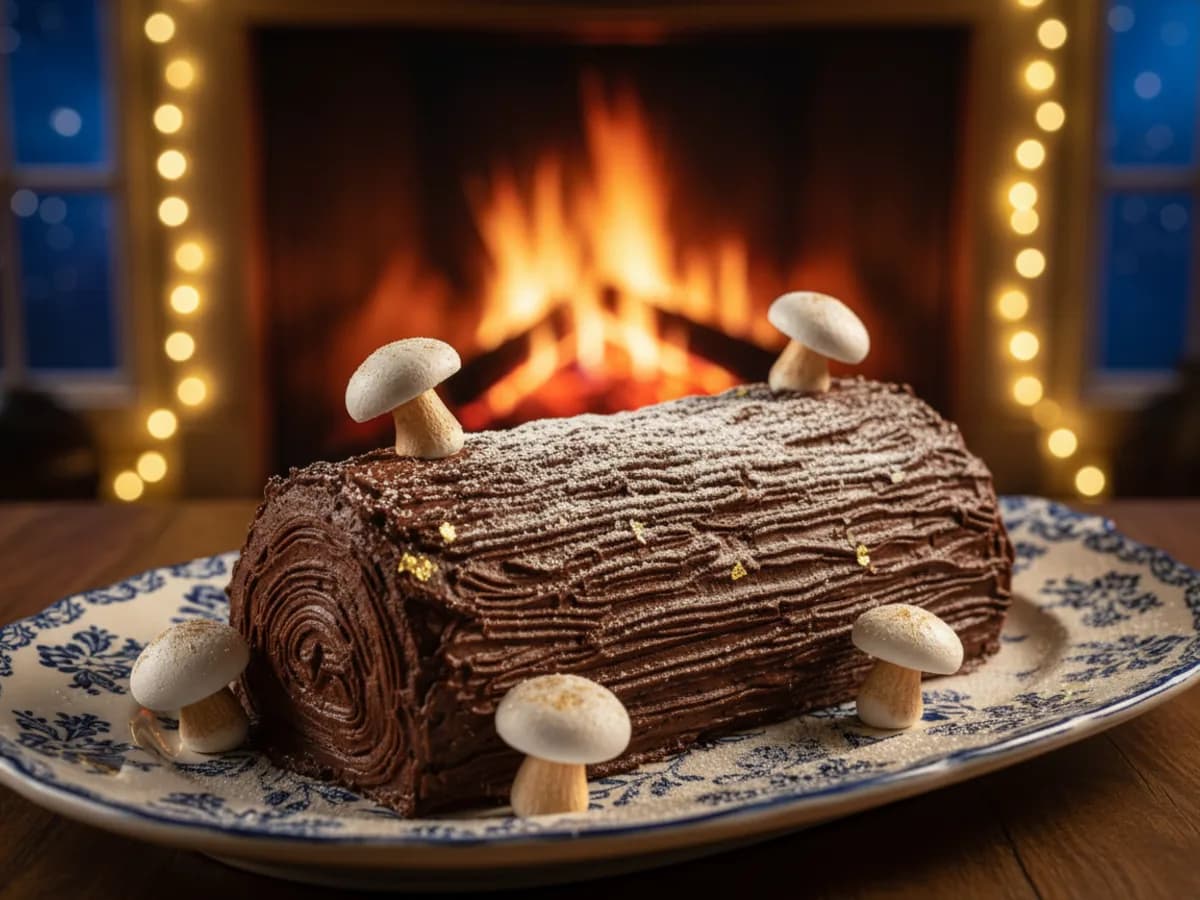
According to the same source, Paris pastry shops spread the bûche across the country after 1945. It has kept the look of wood: a rolled sponge, frosting ridged like bark, sometimes a few meringue mushrooms. For holiday baking with the family, Mrs. Claus shares her own favorites in our recipes.
What are the 13 desserts of Christmas in Provence?
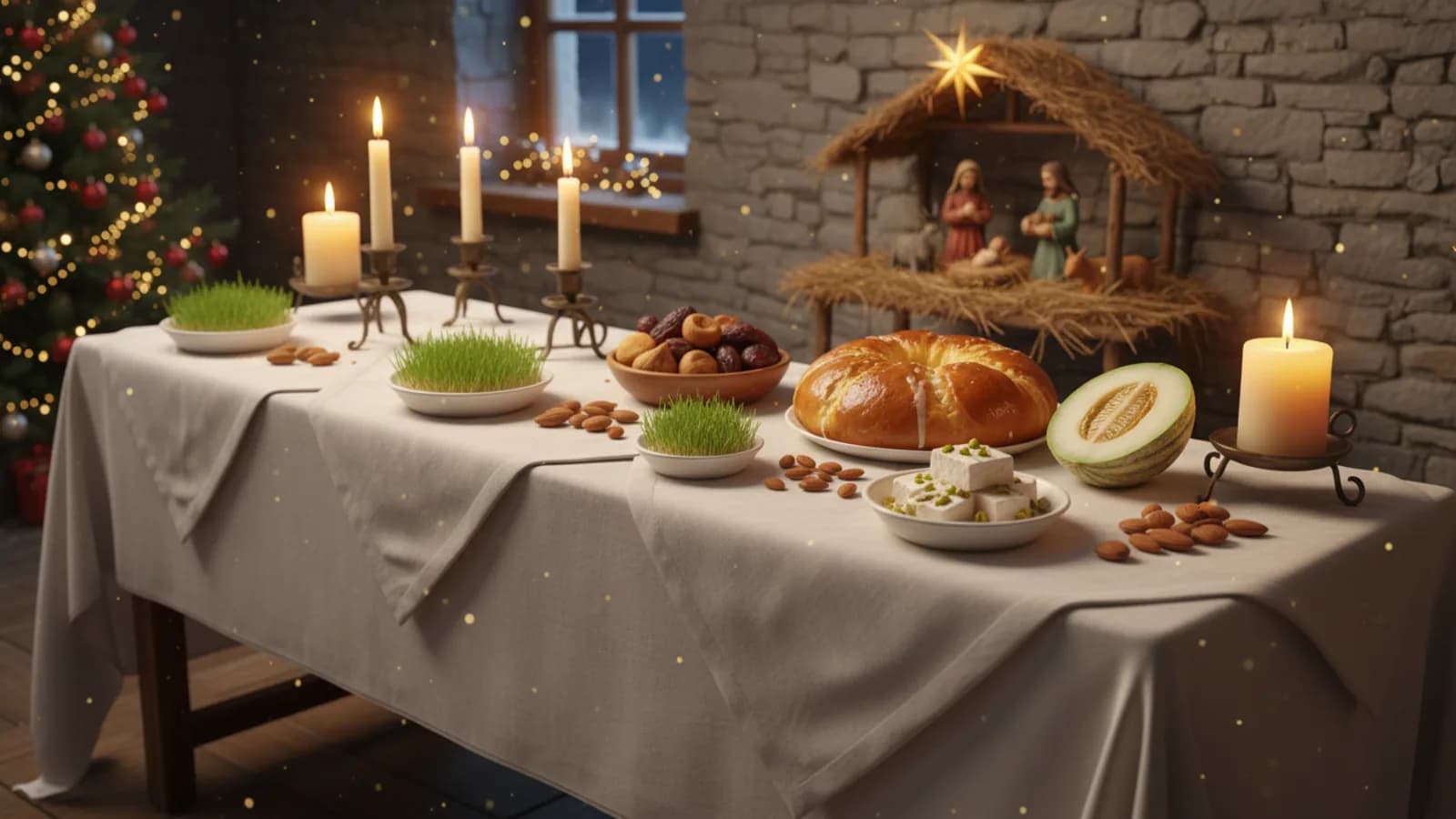
In Provence, Christmas Eve dinner is called the gros souper, the "big supper." According to France.fr, the country's official tourism site, it is a meatless but generous meal: seven dishes, in memory of the wounds of Christ, including salt cod à la raïto, a Provençal tomato sauce. It ends with the thirteen desserts, which the Marseille tourist office links to the Last Supper: twelve desserts for the twelve apostles, one for Christ.
The setting matters as much as the menu. The table is laid with three tablecloths, surrounded by three candles, and set with the three dishes of wheat sown on Saint Barbara's Day, December 4, a symbol of the Trinity. The desserts stay on the table for three days, and every guest is supposed to taste each one. Everything is served with vin cuit, a sweet cooked wine.
- Pompe à l'huile, a flat olive-oil brioche
- White nougat and black nougat, often said to stand for good and evil
- The four mendiants: dried figs, raisins, almonds and hazelnuts or walnuts, for the four mendicant orders
- Dates, whose pit is said to bear the mark of Christ
- A green melon stored on straw and white grapes kept in the cellar
- Depending on the town: calissons from Aix, candied fruit, oreillettes (thin fried pastries), tangerines, quince paste, watermelon jam
The exact list changes from town to town and family to family, and that's the point. Its history is more recent than people think: the Marseille tourist office dates the number thirteen to 1925.
What are santons, the clay figures of Provence?
The nativity scene, the crèche, is still at the heart of a French Christmas, especially in the south. Its little clay figures are called santons. According to the Marseille tourist office, the Provençal santon in unfired clay was born in Marseille at the end of the 18th century and created by Jean-Louis Lagnel (1764-1822).
Its great showcase is Marseille's Foire aux santons, the oldest santon fair in Provence, which dates, the tourist office says, from "the day after the Revolution." It sets up every year from the third weekend of November until early January on the Old Port, and opens with a Mass said in Provençal.
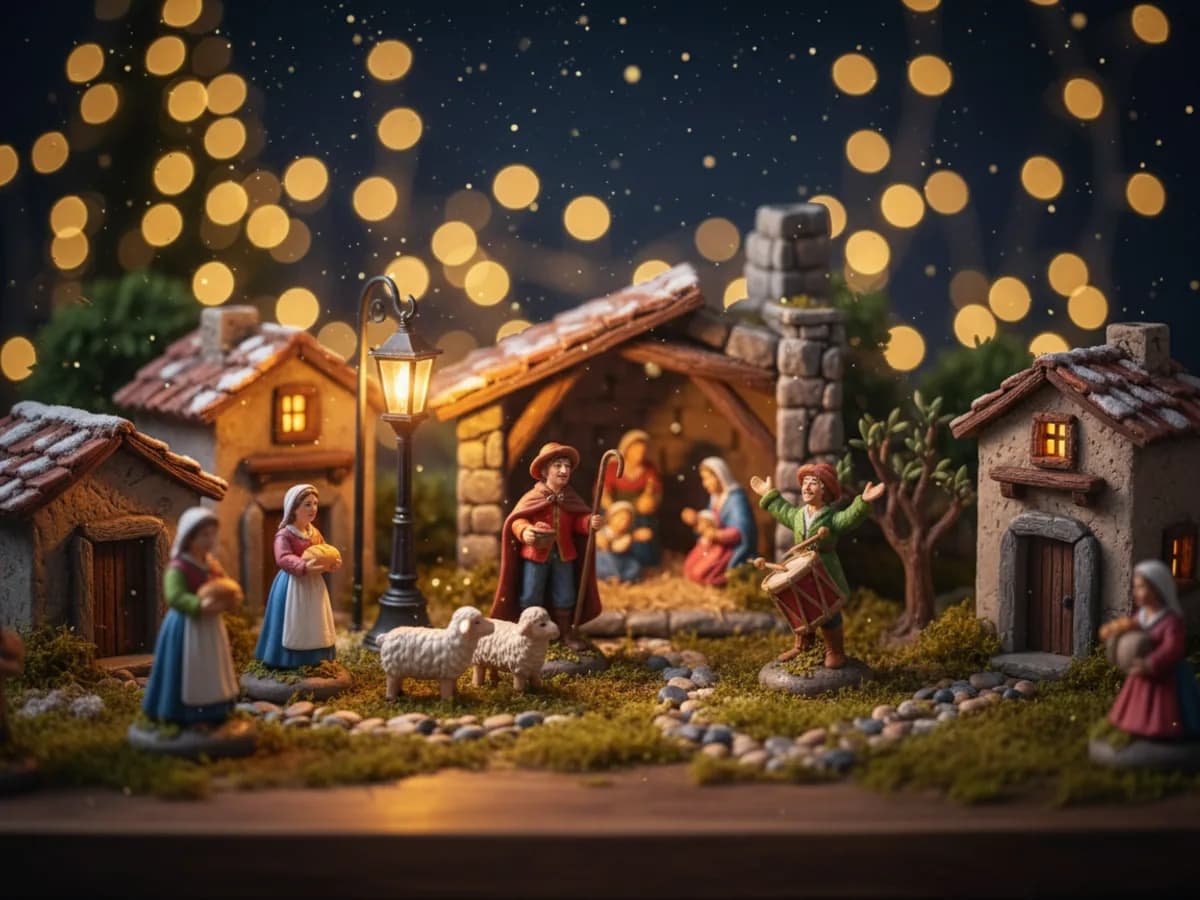
A Provençal crèche doesn't stop at the Holy Family, the ox, the donkey and the Three Kings. It rebuilds an entire village: the mayor, the baker, the priest, the tambourine player, the Bohemian couple, the blind man and his son. The most famous figure is lou Ravi, arms raised to the sky, delighted by the birth even though he has nothing to give. He gave French the expression "le ravi de la crèche," someone a little too easily amazed.
The craft is very much alive: about 120 santon workshops operate between Marseille, Aubagne and Aix-en-Provence. In Allauch, Gilbert Orsini shows an animated nativity of 100 square meters (about 1,075 square feet) with 650 santons every year. Some workshops even make modern characters, a soccer player or a pizza maker, next to the traditional shepherd.
Where do France's Christmas trees and markets come from?
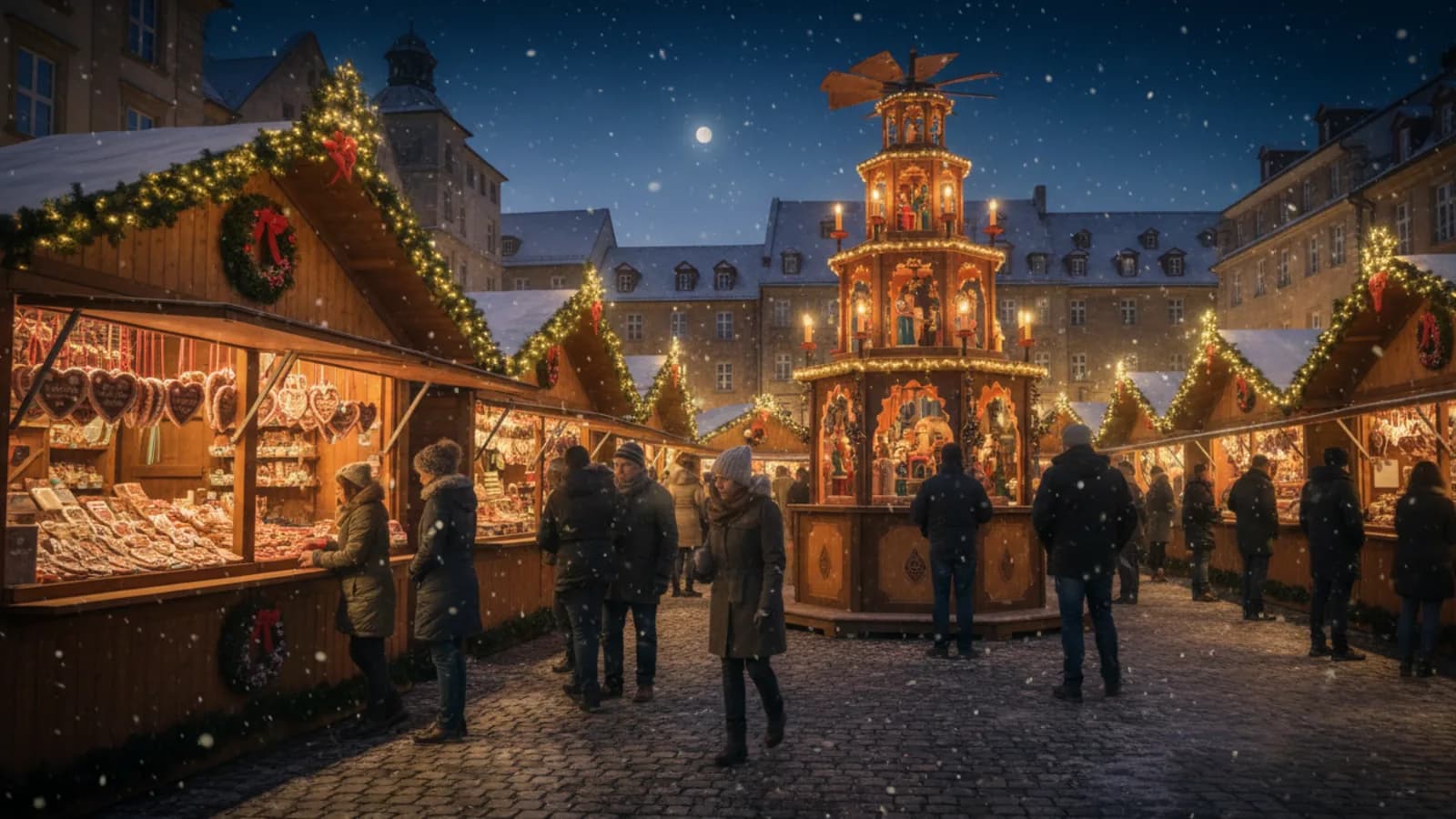
Alsace gave France its two most exported Christmas images. The first is the Christmas market. Strasbourg's, the Christkindelsmärik, "Christ Child market" in Alsatian, began in 1570, making it one of the oldest in Europe. For a long time it was the only one in France. After moving from the cathedral square to Place du Château and Place Kléber, it settled on Place Broglie in 1871.
The second is the tree. In the archives of Sélestat, an account book dated December 21, 1521, records 4 schillings paid to forest guards to watch over the *meyen*, the trees, on Saint Thomas's Day. The town sees it as the oldest written mention of a Christmas tree, and its Humanist Library displays the ledger every winter alongside two books from 1555 and 1600. Strasbourg supplies another often-quoted date, 1605, which FrenchEntrée gives for the city's first Christmas tree.
Today the tree and the crèche share many French living rooms, sometimes the same sideboard. The full story of the tree, from ancient Rome to the Victorians, is in how did Christmas start.
Sources
- Marseille tourist office, Les santons en Provence
- Marseille tourist office, The thirteen desserts of Christmas
- City of Paris, Ces 5 pâtisseries ont été inventées à Paris (bûche de Noël)
- CNRTL, Trésor de la langue française informatisé, "réveillon"
- City of Strasbourg, Le marché Christkindelsmärik
- Sélestat Haut-Koenigsbourg tourist office, Exhibition: 1521, the origins of the Christmas tree
- FrenchEntrée, Christmas Traditions in France
- Le Routard, Saint-Nicolas et Noël en Lorraine
- macommune.info, Il y a 70 ans, le clergé brûlait le Père Noël à Dijon
- France.fr (Atout France), Noël et traditions culinaires en Provence
- Fondation Napoléon, Napoleon.org, Pain d’épice et chocolat pour la Saint-Nicolas (in French: the donkey and its carrot)