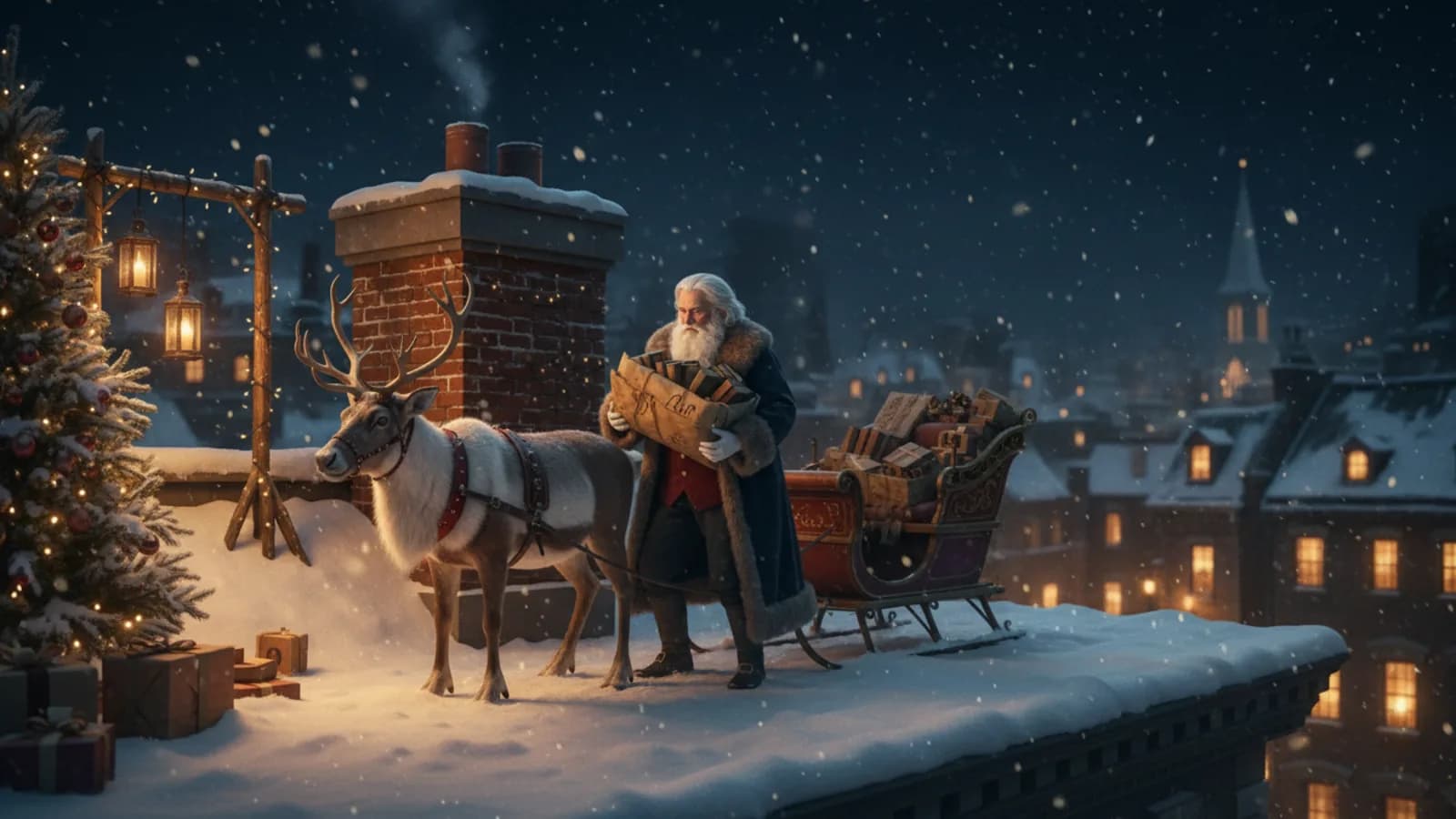
In the village stable, every stall carries a small wooden nameplate. Seven of them carry a name taken from a poem printed on December 23, 1823, in a newspaper in upstate New York. Rudolph's was added in 1939, and it is the only one with a red bulb over the door. The last, at the end of the row, belongs to Blizzard, the cold-weather expert.
These names have changed spelling, language and sometimes meaning over two centuries. In French there are even two competing sets, depending on which translation of the poem you open. Here are the names of Santa's reindeer, what they mean and how to remember them before December 24.
What are the names of Santa's reindeer?
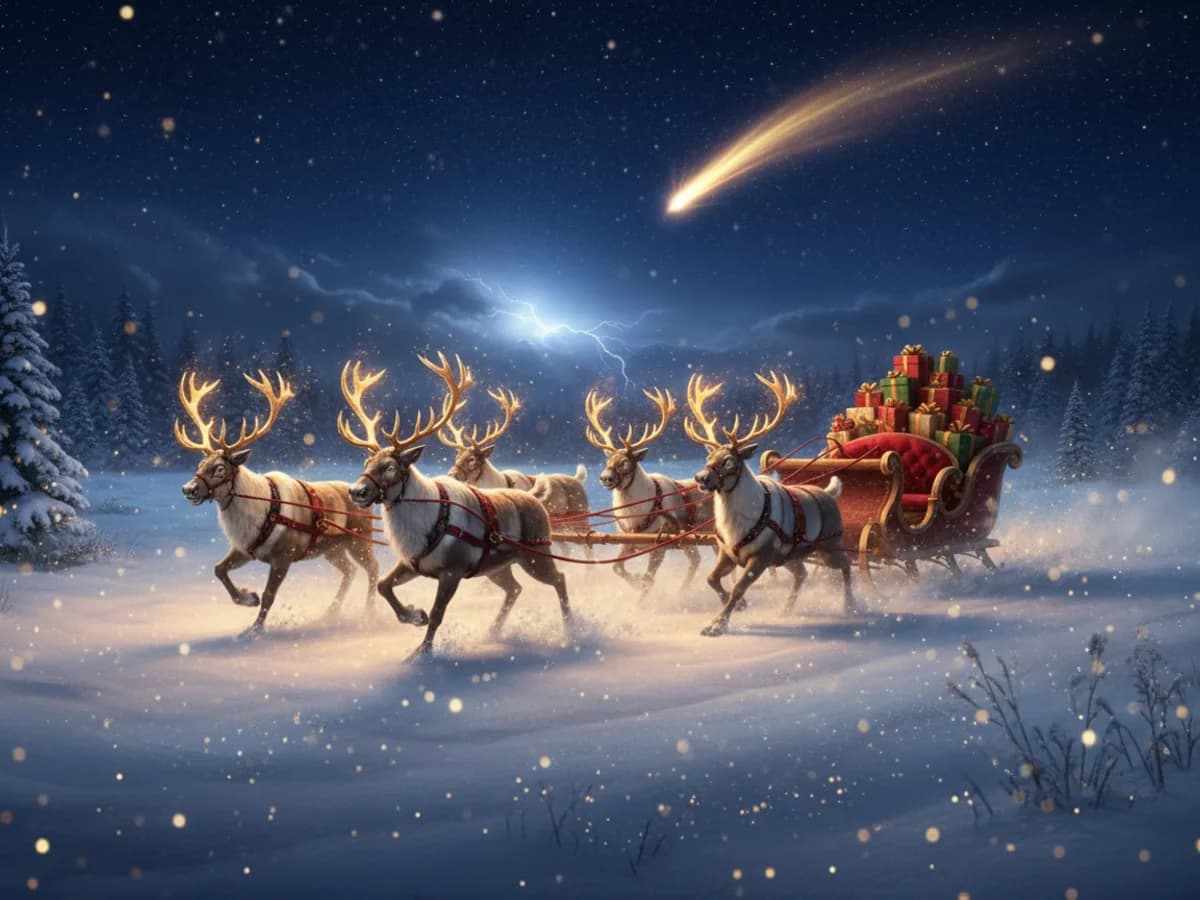
The official team has eight reindeer, plus one. The eight come from the poem “A Visit from St. Nicholas,” printed without a byline in the Troy Sentinel in 1823 and later claimed by Clement Clarke Moore. The narrator hears the visitor whistle, shout and call his team by name, two by two, before they fly up to the roof.
Now, Dasher! now, Dancer! now, Prancer and Vixen! / On, Comet! on, Cupid! on, Donder and Blitzen!
- Dasher, called Tornade in the French village (Fougueux in one translation).
- Dancer, called Danseur.
- Prancer, called Fringant.
- Vixen, called Furie or Rusé in French translations; in the village, her stall now belongs to Blizzard.
- Comet, called Comète.
- Cupid, called Cupidon.
- Donder, later Donner, called Tonnerre (Élégant in one translation).
- Blitzen, called Éclair.
- Rudolph, added in 1939, who keeps his English name in the French village (Rudolphe in some books).
The ninth is not in the poem. Rudolph the Red-Nosed Reindeer was born in 1939 in a booklet written by Robert L. May for the Montgomery Ward department stores in Chicago. His whole story, from May's office to the song and the 1964 TV special, is told in Where did Santa's reindeer come from?.
What do Santa's reindeer names mean?
The 1823 names were not picked at random. They describe a gait, a temperament or something in the sky, and they tend to come in pairs. The poem calls them the way a coachman calls his horses: in couples, in starting order.
- Dasher: one who dashes, a fast runner.
- Dancer: the dancer, no mystery there.
- Prancer: one who prances. To prance is what a horse does when it springs forward on its hind legs.
- Vixen: a female fox. Since the late sixteenth century the word has also meant a quarrelsome, hot-tempered woman, hence the French “Furie.”
- Comet: a heavenly body streaking across the sky.
- Cupid: the Roman god of love.
- Donder: thunder, in Dutch.
- Blitzen: lightning, after the German Blitz.
The last two make an oath. “Donder en Blixem” in Dutch means “thunder and lightning,” an echo of New York's Dutch past as New Amsterdam. So the team brings together three racing gaits, a fox, a comet, a winged god and a thunderstorm.
Reindeer or caribou?
The word for the animal itself changes from place to place. According to the Alaska Department of Fish and Game, reindeer and caribou are one and the same species. In Europe they are all called reindeer. In Alaska and Canada, the word is kept for the semi-domesticated animals, the ones people herd and harness, and the wild herds are called caribou. It is also the only member of the deer family in which both males and females grow antlers. Santa's reindeer, who have let themselves be harnessed since 1821, have certainly earned their name.
Is it Donner, Donder or Dunder?
All three existed. In the version printed in Troy in 1823, the last two reindeer are called Dunder and Blixem, from Dutch. When Moore included the poem in his collection Poems in 1844, he wrote Donder and Blitzen, a form closer to German for the second name. Edmund Clarence Stedman's An American Anthology, which covers American poetry from 1787 to 1900, later kept the same forms, Donder and Blitzen.
Donner, the most common spelling today, is German too. According to Wikipedia's article on Santa's reindeer, “Donner and Blitzen” turns up in texts dated from 1843 to 1900, but that spelling only became standard in the early twentieth century, long after Moore's death. You even find “Donner and Blixen” in 1850, 1857 and as late as 1899.
In the village, all three are accepted. Four handwritten copies of the poem by Moore are known, three of them in museums, including the library of the New-York Historical Society; the fourth, signed in 1860 as a gift to a friend, sold in December 2006 for $280,000. The details of how the spellings settled, anthology by anthology, are gathered in The history of 'Twas the Night Before Christmas.
What are Santa's reindeer called in French and other languages?
In the village, the profiles on the reindeer page read Rudolph, Dasher, Comet, Cupid, Dancer, Prancer, Blitzen, Donner and Blizzard; the French site calls them Rudolph, Tornade, Comète, Cupidon, Danseur, Fringant, Éclair, Tonnerre and Blizzard. For the poem itself there is no official French translation, and two sets of names circulate. The most widespread, found for instance in the multilingual table on French Wikipedia, gives: Tornade, Danseur, Fringant, Furie, Comète, Cupidon, Tonnerre and Éclair. Rudolph becomes Rudolphe.
The second comes from a French translation of the poem published on the language site Lexilogos, with no translator named. There the reindeer line becomes: Fougueux, Danseur, Fringant, Rusé, Comète, Cupidon, Élégant and Éclair. The “miniature sleigh” turns into “un tout petit traîneau,” a very small sleigh, pulled by “huit rennes minuscules.”
The two sets agree on five names: Danseur, Fringant, Comète, Cupidon and Éclair. They split on three: Dasher is Tornade (tornado) or Fougueux (fiery), Vixen is Furie or Rusé, Donder is Tonnerre (thunder) or Élégant. The first stays close to the meaning of the English and Dutch words, the second strays well away from it for Donder. Bilingual families can pick whichever their children like best: the reindeer answer to both.
And in other languages?
- In German, the team usually keeps its English names, which makes Donner and Blitzen sound almost like home.
- In Italian: Fulmine, Ballerina, Saltarellino, Freccia, Cometa, Cupido, Tuono and Lampo.
- In Finnish: Juoksija, Tanssija, Siro, Leikkisä, Komeetta, Amor, Ukkonen and Salama.
- In Finland, Rudolph is called Petteri Punakuono.

Why is Rudolph called Rudolph, and are there other reindeer?
Rudolph nearly had another name. According to Mental Floss, Robert L. May turned down Rollo, which sounded too sunny and happy, and Reginald, which sounded too British. Romeo and Rodney were on the list as well. He kept Rudolph, and chose a red nose over huge glowing eyes, reasoning that kids would be quicker to tease a red nose. Montgomery Ward handed out 2.4 million copies of the 1939 booklet in its first year, and Rudolph made his first screen appearance in 1948, in a Fleischer Studios cartoon.
Other writers gave other names. In 1897, John C. Fleming published “A Costly Christmas,” with Slasher and Crasher alongside Donner and Blitzen. In 1902, L. Frank Baum hitched ten reindeer in The Life and Adventures of Santa Claus, led by Flossie and Glossie; their full list appears in What powers does Santa have?. On screen, the animated special Prep & Landing (2009) keeps Dasher and Dancer but adds Thrasher, who leads the advance team, and leaves Rudolph out of its world entirely.
Children invent reindeer too. Among the emails to Santa studied by psychologists Andrew Shtulman and Rachel Yoo, published in 2015, one question appears as an example of a factual question: “Did you get a new reindeer named Olive?” In the village, the official answer stays cautious. All we know is that the stable welcomes a few calves every spring, and their names are settled only after long discussions.
How do you remember all of Santa's reindeer names?
The easiest way is to follow the poem: the names come in pairs, and each pair has its own logic. The first two run and dance, the next two prance and scheme, the two after that come from the sky and from love, and the last two make the storm. Rudolph leads the way.
The poem even hands you a memory trick. Right after calling his eight reindeer, the visitor shouts, “Now dash away! dash away! dash away all!”, a direct echo of Dasher, the first name on the list. Say it out loud on Christmas Eve and the whole team falls into line in your head. In the village, where Blizzard holds Vixen's stall, the pairs go like this:
- Dasher and Dancer: the speedy ones.
- Prancer and Blizzard: the bounce and the big chill.
- Comet and Cupid: the heavenly ones.
- Donner and Blitzen: the storm.
- Rudolph: the lantern.
One question often comes up along with the names: are Santa's reindeer girls? According to the Alaska Department of Fish and Game, the biggest males shed their antlers by late October, while pregnant females keep theirs until spring. Reindeer still wearing antlers on December 24 are therefore likely to be females. The subject is covered in detail in Where did Santa's reindeer come from?.
To meet them up close, every reindeer has its own profile on the reindeer page, and the stable is marked on the village map. On the evening of the 24th they are all in harness: you can follow them on the Santa tracker.
Sources
- Project Gutenberg, 'Twas the Night before Christmas: A Visit from St. Nicholas
- Wikipedia, Santa Claus's reindeer
- Wikipedia, A Visit from St. Nicholas
- Wikipedia (French), Rennes du père Noël (reindeer names in several languages)
- Lexilogos, Clement Moore, La Visite de saint Nicolas, English text and French translation
- Wiktionary, vixen, prance and dasher
- Mental Floss, 12 Shiny Facts About Rudolph the Red-Nosed Reindeer
- Wikipedia, Rudolph the Red-Nosed Reindeer
- Alaska Department of Fish and Game, Caribou species profile
- Shtulman and Yoo, “Children's understanding of physical possibility constrains their belief in Santa Claus,” Cognitive Development, 2015