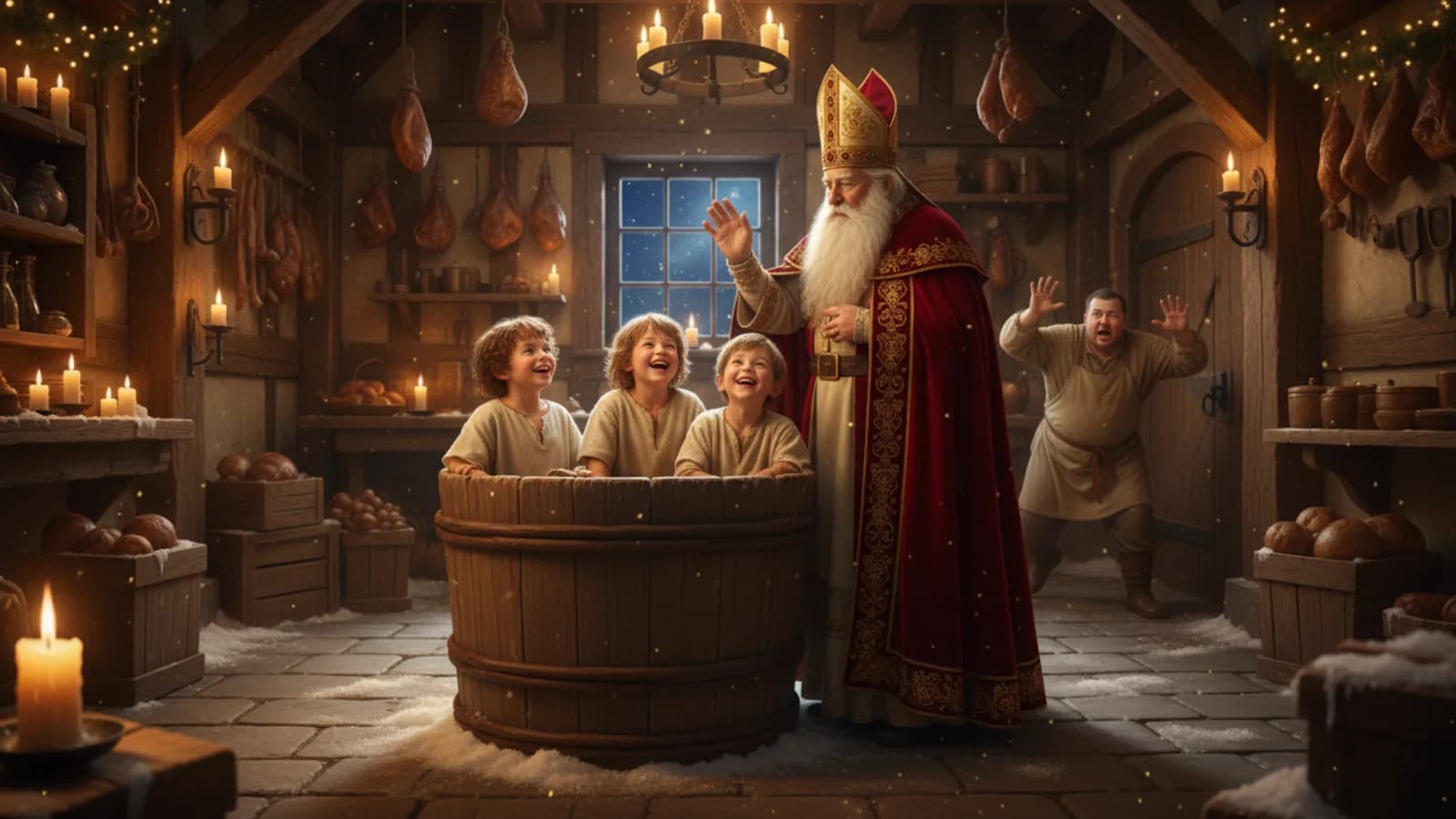
“How old are you?” It is one of the questions children ask most often in their letters, right after “Did you get my list?” It deserves a real answer with real dates, because Santa has an ancestor whose hometown, bishop's seat and even approximate height are known.
That ancestor is Nicholas. He was born around 270 AD in Patara, on the coast of Lycia in what is now Turkey, and by tradition he died in 343. His bones crossed the Mediterranean in 1087, a finger bone reached Lorraine in France eleven years later, and researchers at Oxford radiocarbon-dated a fragment attributed to the saint in 2017. The North Pole Archives have run the numbers.
How old is Santa Claus today?
The firmest answer starts with Saint Nicholas, the bishop from whom Santa inherited his name and his habit of giving in secret. The ecumenical martyrology of the Monastery of Bose, in Italy, gives his dates as “ca. 270-343.” Counting from 270, Santa turns about 1,756 in 2026.
The word “about” matters. The martyrology says “ca. 270”: the year is an estimate, not a date copied from a birth record. That is why the honest answer is that Santa is more than 1,750 years old. Counting from his death in 343 instead, Saint Nicholas Day 2026 falls 1,683 years later.
There are other ways to count. Start from the modern character, the one in “A Visit from St. Nicholas,” printed on December 23, 1823, in the Sentinel of Troy, New York, and he is just over 200. Start from Haddon Sundblom's Coca-Cola Santa of 1931 and he is not even 100. All three answers are correct, but only the first tells the whole story, which we follow in the true story of Santa Claus.
What year was Santa born?
According to tradition, Nicholas was born around 270 AD in Patara, in Lycia, a region in the southwest of Asia Minor. He later became bishop of Myra, another Lycian town. In 325 he took part in the Council of Nicaea, according to the Bose martyrology. One story, reported by The Irish Times, has him getting into a fight there with Arius, whose teaching divided the bishops, but the episode belongs to storytelling more than to the record.
- ca. 270Nicholas is born in Patara, Lycia.
- 325Nicholas attends the Council of Nicaea.
- 343Nicholas dies, on a December 6.
- 1087His bones are carried to Bari, Italy.
- 1098By tradition, Aubert de Varangéville brings a finger bone to Lorraine, France.
- 1823“A Visit from St. Nicholas” is printed in Troy, New York.
- 1912The U.S. Post Office lets postal workers and citizens answer letters to Santa.
No reliable ancient source gives the exact day and month of his birth. That is why his feast falls not on the day he was born but on the day he died.

When is Santa's birthday?
December 25 is not Santa's birthday: Christmas celebrates the birth of Jesus. The date that belongs to Nicholas is December 6. The Bose martyrology puts it plainly: December 6 is the day Nicholas died, in 343. A second feast, on May 9, marks the arrival of his body in Bari.
Some regions keep that date with real ceremony. In Lorraine, in eastern France, Saint Nicholas is the patron saint of the region, and the big parade in Nancy takes place around December 6, according to France's official tourism site. Elsewhere in France he often walks with a darker companion, Père Fouettard. We cover these customs in more detail in our Christmas traditions.
So many families end up with two dates: December 6 for the saint, and the night of December 24 for Santa. Children who want to wish him a happy birthday can pick whichever date they like and put it in their letter.
How old was Saint Nicholas when he died?
From 270 to 343, the math gives about 73 years. The bones agree. In 1957, during restoration work at the basilica in Bari, Italian anatomy professor Luigi Martino examined the remains with X-rays and skull measurements. Because the remains can no longer be examined directly, his records were used in 2016 by the Face Lab at Liverpool John Moores University, led by Caroline Wilkinson, to rebuild the saint's face.
The result, reported by The Irish Times on December 23, 2016, describes a man who died in his early 70s. He stood about 5 feet 4 inches, average for the time, with a slender to average build. He had chronic arthritis in the spine and pelvis, common at that age.
One detail stands out: the nose. It had been broken and “healed asymmetrically, giving him a characteristic nose and rugged facial appearance,” in Caroline Wilkinson's words. The Santa on Christmas cards has a round, cherry-red nose. His ancestor's nose was crooked.
- Age at death: early 70s, about 73 if you take 270 to 343.
- Height: about 5 feet 4 inches.
- Health: chronic arthritis of the spine and pelvis.
- Face: a broken nose that healed off-center.
Where are Saint Nicholas's remains?
Nicholas was first buried outside the city of Myra. In 1087 his bones were taken to Bari, in southern Italy, where they rest in the Basilica di San Nicola. The church of San Nicolò al Lido in Venice holds up to 500 fragments, which an anatomical study found to complement the Bari collection, according to Popular Archaeology.
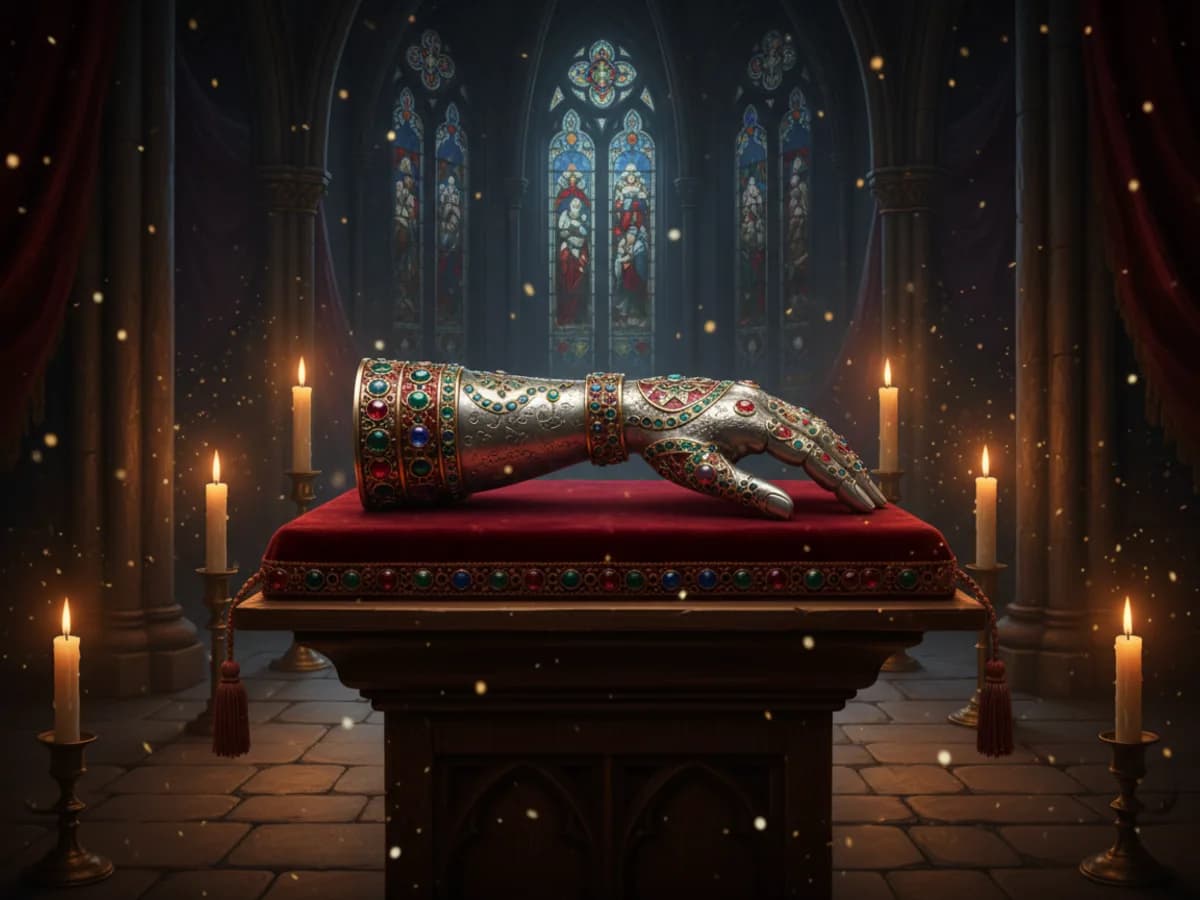
France has a share too. By tradition, Aubert de Varangéville brought a finger bone of the saint home in 1098, and it is kept today in Saint-Nicolas-de-Port, near Nancy. The French Ministry of Culture's heritage database describes the arm-shaped reliquary that holds it: an 1892 piece of silverwork signed by Henri Bossert, a Nancy goldsmith, set with diamonds and an emerald, on a wooden base covered in red velvet.
In December 2017, Tom Higham and Georges Kazan of the University of Oxford radiocarbon-dated a small pelvis fragment attributed to the saint. It came from Lyon, France, and belongs to Father Dennis O'Neill of St. Martha of Bethany Church in Morton Grove, Illinois. The verdict: the bone dates from the fourth century, the period when Nicholas died. Georges Kazan called it exciting to think that relics this ancient “could in fact be genuine,” while his colleague kept the scientist's caution.
Science is not able to definitely prove that it is, it can only prove that it is not.
Is Santa Claus still alive?
The question has two answers, depending on whether we mean the bishop or the character. By tradition, Bishop Nicholas died in 343. Santa, on the other hand, has never stopped getting mail, and some very serious institutions have organized themselves to answer it.
In the United States, Postmaster General Frank Hitchcock first let postmasters pass Santa letters on to people willing to answer them in November 1911, then renewed the permission in 1912, the year USPS counts as the start of what became Operation Santa. By the 1940s the mail was so heavy that the Postal Service asked charities and businesses to help. A century later, New York City's Operation Santa alone received more than half a million letters a season, the Postal Bulletin reported in 2012.
France followed in 1962, when postal minister Jacques Marette set up a national service for Santa's mail. His sister, pediatrician Françoise Dolto, who had written to Santa herself at age five to ask for a little mail carrier's box, drafted the first reply sent to children, according to a study by Antoine Georget and Valérie-Inés de La Ville for La Poste's history committee. In 1962, 2,000 cards went out. In 1963 the service received 18,300 letters. In 1967 the work moved from Paris to Libourne, near Bordeaux, and the name “Secrétariat du Père Noël” first appeared in January 1970.
And since 1955, the military has followed his flight. A Sears ad in Colorado Springs printed the wrong number, a command center hotline, and Colonel Harry Shoup picked up. His daughter Pam Farrell remembers “a small voice that just asked, ‘Is this Santa Claus?’” The tracking still runs every year, and you can follow it on our Santa tracker.
Why does Santa look like an old man?
Because he has always been pictured that way. Icon painters showed Nicholas as a balding old man with a rounded beard. The 1823 poem calls him “a right jolly old elf,” with a beard “as white as the snow.” The story of his wardrobe is told in why Santa wears red.
In 1931, when Haddon Sundblom began painting Santa for Coca-Cola, he first used his friend Lou Prentiss, a retired salesman, as his model. Mental Floss notes that this Santa had ruddy cheeks and wrinkles that made him look more human than earlier versions. The face generations of children know is therefore that of a retiree, which matches the age of the bishop of Myra at his death, a little over 70.
Thomas Nast had already settled the character's age before him. From 1863 to 1886, in Harper's Weekly, he drew a fat, usually short Santa with a bushy white beard. The tiny elf of the 1823 poem, small enough for a miniature sleigh, slowly dropped out of the pictures, leaving a jolly grandfather, neither young nor frail, recognizable at a glance.
The character does not age from one picture to the next: the Santa of 1931 and the Santa of today look the same age. The simplest way to learn more is still to ask him directly by talking to Santa.
Sources
- Monastery of Bose, Ecumenical Martyrology, “Nicholas of Myra (ca. 270-343),” December 6
- The Irish Times, Patsy McGarry, “The real thing: Scientists recreate Santa Claus's face,” December 23, 2016
- Popular Archaeology, “Could ancient bones suggest Santa was real?” (University of Oxford), December 6, 2017
- French Ministry of Culture, Palissy database, “Bras-reliquaire de saint Nicolas,” Saint-Nicolas-de-Port
- Comité pour l'histoire de La Poste, Antoine Georget and Valérie-Inés de La Ville, “L'Opération Père Noël a 50 ans,” 2012
- United States Postal Service, Postal Bulletin, “Celebrate 100 Years of the Letters to Santa Program,” 2012
- MPR News / NPR StoryCorps, “NORAD's Santa tracker began with a typo and a good sport,” 2014
- The Coca-Cola Company, “Haddon Sundblom and the Coca-Cola Santas”
- Academy of American Poets, Poets.org, “A Visit from St. Nicholas” (1823)
- Mental Floss, Maureen Monahan, “The Holly Jolly History of the Santa Suit,” 2016
- France.fr (Atout France), “Où fêter la Saint-Nicolas en France ?”