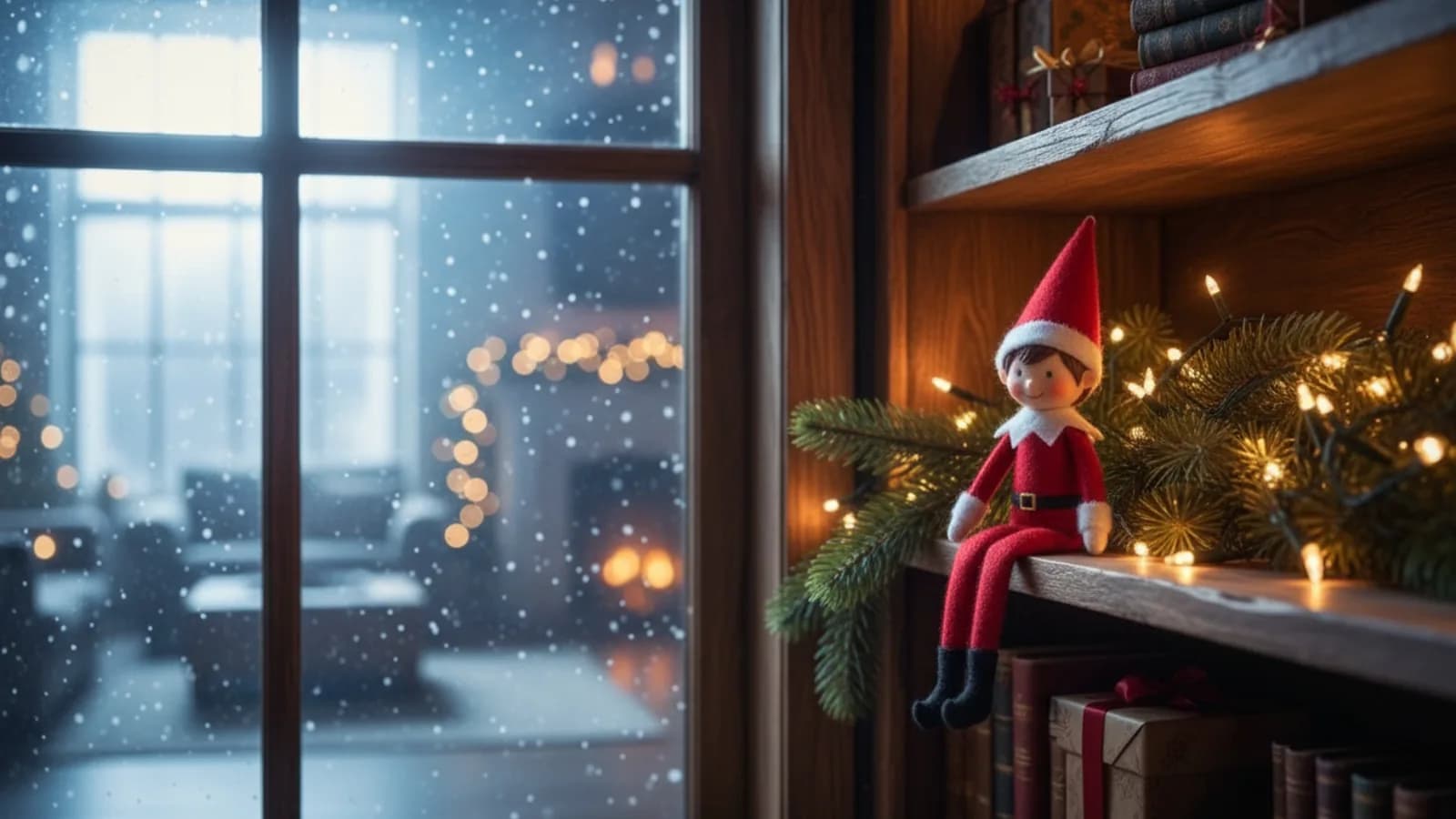
It is 11 p.m., the house is asleep, and you realize the elf has not moved since last night. Thousands of parents know that moment, ever since a little red felt figure with a porcelain-like face took up residence on American bookshelves, and then on shelves in Quebec and France, where families often call it the “lutin farceur,” the prankster elf.
This guide gathers what is known about where it came from, the rules set by the book, easy ideas for tired evenings, what to do when a child touches it, and what some academics hold against it. If your child is starting to doubt Santa, the elf question is covered in our guide on how to tell your child the truth.
Where did the Elf on the Shelf come from?
It started as a family game. In the United States, Carol Aebersold kept a Santa’s elf alive for her twin daughters, Chanda Bell and Christa Pitts, when they were little. As adults, the daughters suggested turning it into a book. Written in 2004 with Chanda Bell and illustrated by Coë Steinwart, “The Elf on the Shelf: A Christmas Tradition” came out in 2005, sold in a box with an elf figure.
The book was self-published. Christa Pitts handled sales, and the three women spent the following years going from book signing to trade show. The big push came in 2007: a photo of actress Jennifer Garner holding the box made the rounds, and the “Today” show ran a segment on the elf. Sales took off.
- 2005Carol Aebersold and Chanda Bell self-publish the book, sold with an elf figure.
- 2007A photo of Jennifer Garner with the box leads to a segment on the “Today” show.
- 2011CBS airs a 30-minute animated special, “An Elf’s Story,” on November 26.
- 2012The elf becomes a giant balloon in the Macy’s Thanksgiving Day Parade in New York, alongside Hello Kitty and Papa Smurf.
- 2013The book reaches No. 1 on the USA Today bestseller list.
The company behind the brand, the Lumistella Company, is based in Atlanta and run by the two sisters. It does not publish its accounts. Christa Pitts has said it has “adopted” out more than 22.9 million elves, pets and mates to date. In France and elsewhere, the character has mostly spread in a looser form, with no book or official box, using an elf bought anywhere.
What are the rules for the Elf on the Shelf?
The book sets only a handful of rules, which the brand calls the rules for the “Scout Elf.” They fit on an index card and form the heart of the game. Everything else is up to you.
- Santa sends the elf to the family to watch the children during the holiday season.
- The elf gets its Christmas magic when the family gives it a name. The last page of the book is there to record that name and the “adoption” date.
- Each night it flies to the North Pole to report to Santa, then comes back before the children wake up, often in a new spot.
- Children must not touch it, or it may lose its magic. They can, however, talk to it and share their wishes.
- On Christmas Eve its mission ends: it goes home to the North Pole until the next season.
For the arrival, the official site talks about a “Scout Elf Return Week,” which falls at the end of November and runs into early December. It adds that some elves arrive in late November and others wait until the second week of December. So nothing forces you to bring it out on day one: many families have it arrive on December 1, the same day as the Advent calendar.
What are some easy Elf on the Shelf ideas for every night?
The elf has twenty-four nights ahead of it, and it is usually parental fatigue, not a lack of ideas, that keeps it stuck in place. Since 2024 the brand itself has sold 24-day idea kits, a sign the pressure is well known. The ideas below take under two minutes and nothing you do not already have at home.
Two-minute appearances
- Sitting in the breakfast cereal bowl with a spoon in hand.
- Hanging upside down from a branch of the tree, as if it fell asleep mid-climb.
- Hiding in the fridge, bundled up “because it got too hot by the radiator.”
- Reading one of the kids’ books, with a flashlight beside it.
- In the middle of the stuffed animals, like a bandleader or a schoolteacher.
Nights when you have a little more time
- A tiny letter, written very small, with news from the North Pole and a pointer to our village elves.
- A trail of footprints in flour on the counter, leading to the cookie jar.
- The elf bringing paper and an envelope so your child can write their letter to Santa.
- A kindness mission: a drawing for the neighbor, a box of toys to donate.
Keep the elaborate nights for weekends, and do not measure yourself against the scenes on social media. Over the years those spectacular setups have become part of the tradition for some families, but your child will never see other people’s photos. They will only see that the elf moved.

What if your child touches the elf or it forgets to move?
Both accidents happen in nearly every home, and the first one often brings tears. A 4 or 5 year old who hugged the elf may sincerely believe they “broke” it. The official site offers three remedies, to pick according to age and mood.
- Write a little apology note to the elf or to Santa: according to the brand, the most effective fix.
- Sprinkle a little cinnamon next to the elf, not on it. The brand compares it to vitamins that help the elf get back to the North Pole for a checkup with the “elf doctors.”
- Sing a Christmas carol as a family, since elves love music and the cheer brings their magic back.
The next morning the elf turns up somewhere else, good as new. You can add a note in its handwriting: “Thanks for the cinnamon, I feel brand new.” The message to get across is simple: an accident can be fixed, and nobody is in trouble.
And when the elf forgot to move?
The official site supplies its own excuses for late elves: a snowstorm that held them up, a sightseeing stop on the way, extra flight training, or letters to Santa to file before leaving. You can borrow them on the morning the elf stayed put: “There was a blizzard on the road from the North Pole, he got back too late to change spots.”

Is the Elf on the Shelf a good idea for kids?
The most quoted criticism comes from Canada. In December 2014, Laura Pinto, a professor in the faculty of education at the University of Ontario Institute of Technology (now Ontario Tech), and Selena Nemorin, of Monash University in Australia, published a paper with the Canadian Centre for Policy Alternatives titled “Who’s the Boss?” Their thesis: the elf gets children used to the idea of being watched all the time.
Their argument rests on the no-touching rule. With an ordinary doll, the child runs the game. With the elf, the child has to accept that a doll watches and reports on them, with no power over it. The authors saw this as training to accept, or even seek out, outside observation of one’s actions without question. The Atlantic reported at the time that some children rang their own doorbell to let the elf know they were home.
Others answer that it is only a game. Judith Tellerman, a psychologist at the University of Illinois College of Medicine, sums up the other side: “The elf is a visual cue to act nice.” No published study has so far measured any effect of the elf on children’s behavior, in either direction. The debate remains a debate of ideas.
The criticism also targets parents. Writer Kate Tuttle, in The Atlantic, called the elf “a marketing juggernaut dressed up as a tradition,” and Washington Post critic Hank Stuever called it “just another nannycam.” In practice, how you use it matters more than the object itself.
- An elf that plays pranks and leaves funny notes looks like a shared game of imagination.
- An elf held up as a threat (“I’m telling the elf”) looks more like the control tool Pinto and Nemorin describe.
- An elf that encourages acts of kindness shifts the focus from surveillance to other people.
What are the alternatives to the Elf on the Shelf?
Plenty of families have kept the idea of a character who changes places every morning while giving it a different job. Some versions are commercial, others completely homemade.
The prankster elf, a French and Quebec version
In France, the most common practice is not the branded Elf on the Shelf but the “lutin farceur.” According to the French science magazine Futura, which traced its history in December 2024, it blends three stories: the 2005 American book, a Quebec grandfather, Mr. Tremblay, who drew footprints in the snow for his grandchildren and invented traps with them to catch the elf, and the Icelandic Yule Lads. The prankster elf sleeps by day, gets up to mischief at night, and watches no one.
Kindness Elves
Blogger Anna Ranson, who writes The Imagination Tree, described her “Kindness Elves” in November 2013, an idea she had come up with two or three years earlier. They arrive in early December in a little house with a letter introducing themselves. Each morning they suggest a good deed, placed next to the object it needs: a mixing bowl for baking cookies to give the neighbors, a box for donating toys to a children’s hospital. They encourage rather than watch, and sometimes leave a note praising a kindness.
Mensch on a Bench, for Hanukkah
When his son Jacob asked for an Elf on the Shelf, Neal Hoffman told him he could have a “mensch on a bench” instead. In Yiddish, a mensch is a person of integrity. He funded the project on Kickstarter, and the first 1,000 plush Mensches, sold for Hanukkah 2013, were gone in ten days. One of his rules: on one night of the holiday, you give a present to someone in need instead of receiving one.
You can also skip the character altogether. An Advent calendar with one door a day, an activity drawn from a jar, or a North Pole letter every Saturday gives the same morning surprise. To meet the December visitors of other countries, including Iceland’s thirteen Yule Lads, read our article on Christmas gift bringers around the world.
Sources
- Wikipedia, The Elf on the Shelf
- The Hustle, The Elf on the Shelf empire, 2024
- NBC New York, Hello Kitty, Papa Smurf and Elf on the Shelf join the 2012 Macy’s parade
- The Elf on the Shelf (official site), FAQ: touching your Scout Elf
- The Elf on the Shelf (official site), FAQ: elf return
- The Atlantic (via Nextgov), Santa Claus and the Surveillance State, 2014
- Ontario Tech University, Toy Story 2: What is the Elf on the Shelf teaching kids and parents?, 2015
- Futura, L’incroyable histoire des lutins farceurs, 2024
- The Imagination Tree, The Kindness Elves, 2013
- ABC13, Mensch on a Bench is Hanukkah’s answer to Elf on a Shelf, 2015