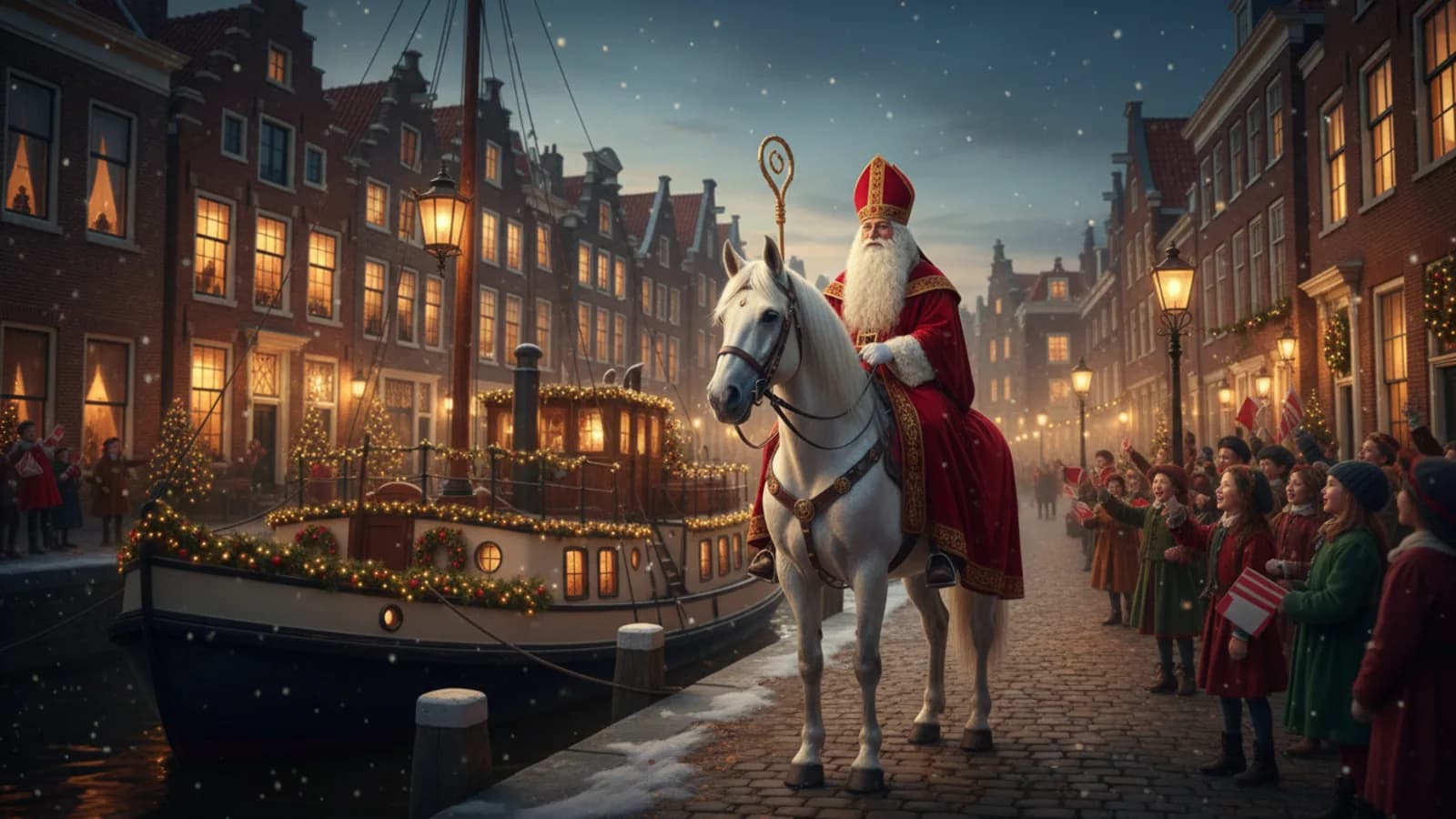
In mid-November, a steamboat sails into a Dutch harbor, broadcast live on national television. On deck, an old white-bearded bishop in a red miter, holding a golden crosier, waves to the crowd: Sinterklaas has arrived from Spain. For three weeks children set out their shoes by the fireplace, and on the evening of December 5 there is a knock at the door: a sack of presents is waiting on the step. Christmas, on the 25th, comes afterward, almost as a second holiday.
Sinterklaas is Saint Nicholas, and it was his Dutch name, reshaped in New York, that gave English Santa Claus: that story is in the true story of Santa Claus, and his other names are in our article on Santa's names around the world. Our Traditions page covers other countries. Here we follow the Dutch season from mid-November to December 26, including the controversy over his companion, Zwarte Piet, which we present through the sources and the views of each side.
When does Sinterklaas arrive in the Netherlands, and why from Spain?
The season opens on the first Saturday after November 11, Saint Martin's Day. That is the day of the intocht, Sinterklaas's arrival: he steps off a steamboat, mounts his white horse and rides through town. The national arrival moves to a different port every year and is broadcast live on television, and then every town holds its own. The horse was called Amerigo until 2019, when he retired and was replaced by Ozosnel.
Why Spain? Nobody knows for sure. One theory points to his relics, half of which were moved in 1087 from Myra to Bari, in southern Italy. The oldest source tying Sinterklaas to Spain is, oddly, American: a pamphlet published in New York in 1810 by John Pintard. Today, in the story told to children, the saint spends the rest of the year in Madrid.
The modern picture of the saint and his journey owes a lot to one book. In 1850 the schoolteacher Jan Schenkman published *Sint-Nicolaas en zijn knecht* (“Saint Nicholas and His Servant”) in Amsterdam, the first picture book in which the saint plays the lead. Schenkman brought together the horse, the ride over the rooftops and the arrival from Spain, and his opening poem brings the saint in by steamboat from Spain. His song *Zie ginds komt de stoomboot* (“Look, there comes the steamboat”) is still sung. Reprinted well into the twentieth century, with editions known from 1880, 1905 and 1907, the book helped turn Saint Nicholas's Day into a children's holiday. Since 2001 the season has also had its own daily TV newscast, the *Sinterklaasjournaal*, which follows the saint's adventures every evening until December 5.
What happens on pakjesavond, December 5?
Once the saint has arrived, children “set out their shoe,” *schoen zetten*. In the evening they leave it by the fireplace, or at a chosen spot in homes without one, sing a Sinterklaas song before bed and tuck a carrot or an apple inside for the horse, often with a drawing. In the morning the shoe holds a treat or a small present.
The big night is December 5, the eve of the saint's feast: pakjesavond, “present night.” In the middle of the evening there is a loud knock or ring at the front door, a handful of pepernoten rattles against the window, and when someone opens up there is nobody there, only a sack of presents on the step. In Belgium and much of the southern Netherlands, presents come on the morning of December 6 instead, Saint Nicholas Day, as they do in Lorraine, in eastern France.
Among adults and older children, the evening often turns into a game: dice or other rules decide who grabs, passes or opens a present, or who has to take on a challenge. With little ones, the question of who knocked at the door can last for years. When and how to tell them the truth, which applies just as well to Sinterklaas, is covered in our guide for parents.
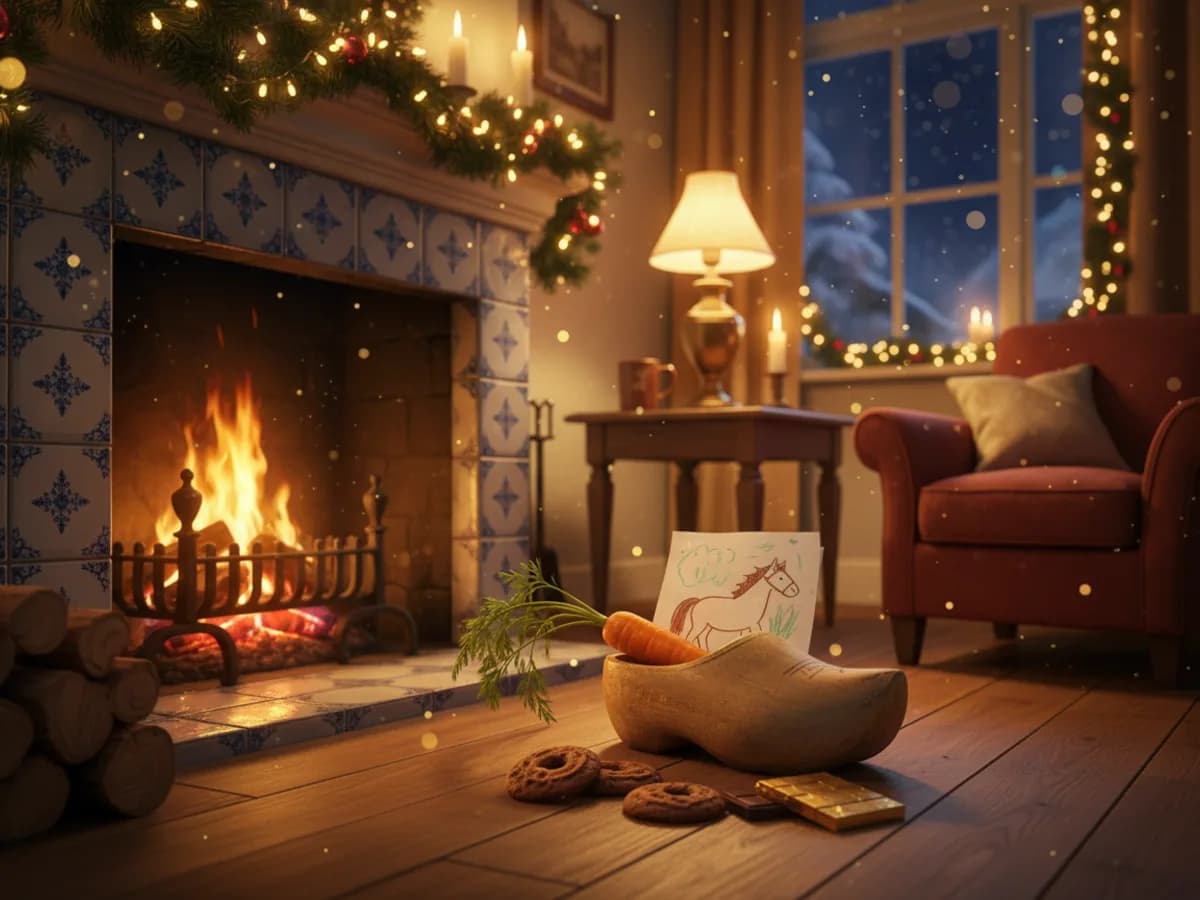
Poems, surprises and chocolate letters: the rituals of Sinterklaas
A Sinterklaas present is never handed over bare. It comes with a poem, the *Sinterklaasgedicht*, which the recipient reads aloud in front of everyone. Written in the voice of Sinterklaas or Piet, who are supposed to know everyone's little secrets, it tells funny, gently teasing stories about the person in simple rhymes. The present itself is often hidden inside a surprise, a handmade contraption that has to be torn apart to find what is inside.
The sweets have their own alphabet. The chocolate letter, *chocoladeletter*, comes shaped as an S for Sinterklaas, a P for Piet or the child's first initial. Two small cookies that foreigners mix up are told apart: pepernoten, slightly tough little chunks of gingerbread, and kruidnoten, small, round, crunchy cookies that taste like speculoos. They used to be tossed by the handful to children; after a few overly enthusiastic throws, they are now usually handed out instead.
On the evening of the 5th, these treats pass from hand to hand between the presents while the poems are read one by one. To bake spiced cookies with your kids, see our recipes, and for another visitor who fills children's stockings, Italy's Befana, read our article on Christmas gift bringers.
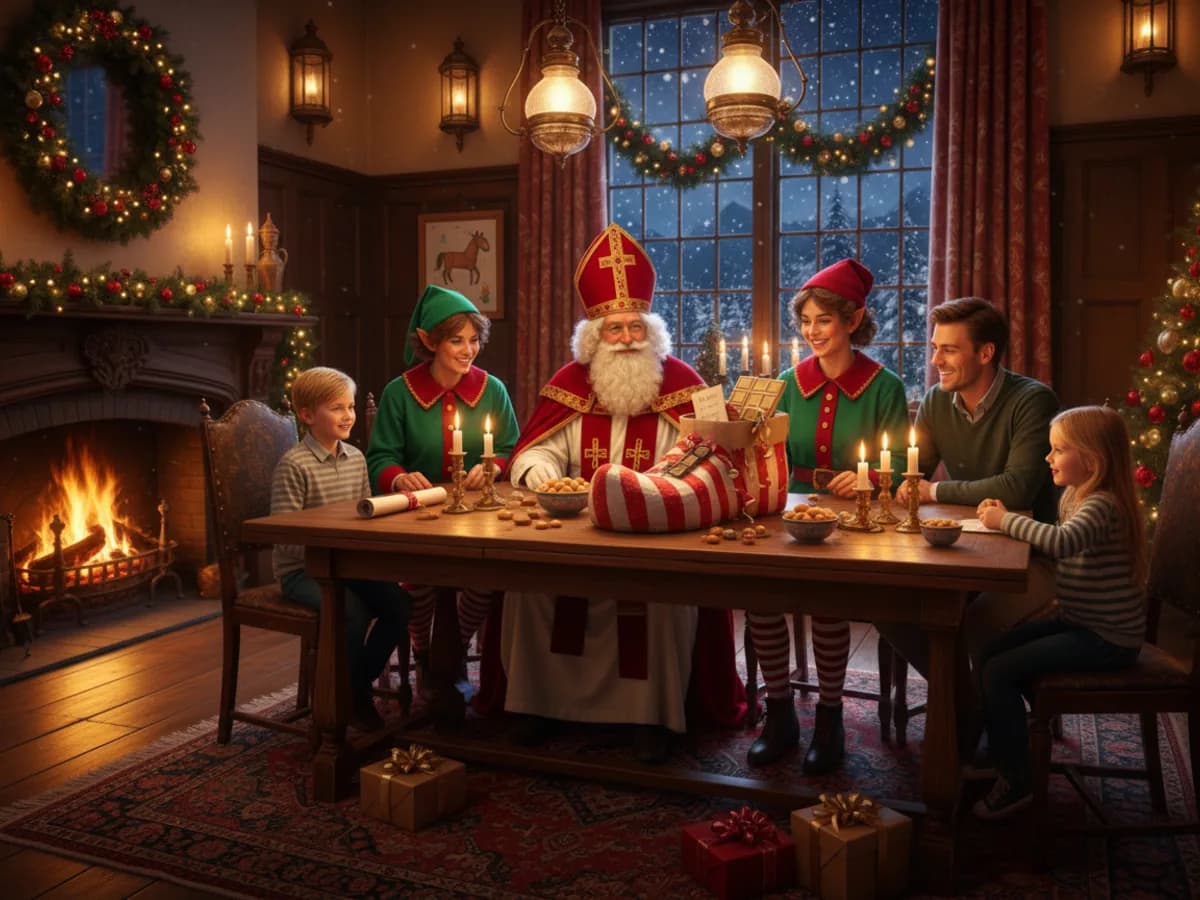
Who is Zwarte Piet, Sinterklaas's companion?
Sinterklaas travels with helpers called Piet or Pieten. In the traditional version, usually played by white performers, they wear black face paint, a curly wig, red lipstick and earrings: this is Zwarte Piet, “Black Pete.” They help the saint, toss pepernoten and make children laugh. In Lorraine, Saint Nicholas's companion is Père Fouettard instead, who appears in our article on Christmas gift bringers.
The character entered print with Jan Schenkman's book, which shows the saint's servant as a young dark-skinned page in Moorish dress. NPR notes that he rose to prominence in the 1850s, around the time minstrel shows, with white performers in blackface, became popular in the United States, and that the Netherlands did not abolish slavery in its colonies until 1863. According to the same source, the original costume copied the way wealthy Amsterdam families dressed the enslaved Black children they had brought back from the colonies.
His defenders see something else entirely. To them, Piet is black because he climbs through chimneys and gets covered in soot, and it has nothing to do with skin color. Other explanations have circulated since the twentieth century, such as the story of a former slave freed by the saint, which appeared in newspapers between 1947 and 1954. In 2013, 92 percent of Dutch people asked in a survey did not see the character as racist, and for many he is still the prankster of their childhood memories.
Why is Zwarte Piet controversial in the Netherlands?
The criticism is not new: as early as 1987, a segment of *Sesamstraat*, the Dutch *Sesame Street*, asked whether the character could be seen as racist. The debate went national in the 2010s. In 2011 the artist Quinsy Gario drew national attention with a protest at the saint's arrival in Dordrecht. The Kick Out Zwarte Piet movement, led among others by the activist Jerry Afriyie, campaigns every season. Many Black Dutch people say they have been called “Zwarte Piet” as an insult.
In August 2015 the United Nations Committee on the Elimination of Racial Discrimination published its observations on the Netherlands. It acknowledged that the tradition is enjoyed by many, but noted that the character is sometimes portrayed in a way that reflects negative stereotypes and is experienced by many people of African descent as a vestige of slavery. It recommended that the country find “a reasonable balance, such as a different portrayal.” The same text raised concern about violence against peaceful protesters.
At times the debate spilled into the street, with protests and counter-protests around Sinterklaas's arrivals, near Dokkum in 2017 and in The Hague in 2019. For many organizers, that was one more reason to look for a version of the holiday in which every family could recognize itself.
The roetveegpiet, a compromise
One solution gradually took hold: the roetveegpiet, the “soot-smudged Piet,” whose face just carries a few black streaks, as if he had come out of a chimney. The broadcaster RTL adopted him in 2016. The public broadcaster NTR, which makes the *Sinterklaasjournaal*, has been changing gradually since 2014; in 2019 the national arrival and the show featured only roetveegpieten. On June 4, 2020, Prime Minister Mark Rutte told parliament that his views had undergone “major changes” and that he had met many people who feel discriminated against because Piet is black, while saying it was not the government's job to force the change. He called it a folk culture that changes over time under pressure from public debate.
Opinion has shifted, without consensus. According to the polling firm Ipsos I&O, 65 percent of Dutch people wanted to keep a fully black Zwarte Piet in 2016, 33 percent in 2022 and 38 percent in November 2024, while about 35 percent wanted him replaced by other Pieten. In 2019, according to NPR, committees in several cities dropped Zwarte Piet from their parades, while about a dozen smaller towns affirmed the opposite. Outside the Netherlands, Suriname replaced the December 5 celebration with a children's day as early as 2013, and Aruba banned the character in 2020.
How do the Dutch celebrate Christmas after Sinterklaas?
Christmas, *Kerstmis*, arrives three weeks after present night, and it lasts two days. December 25 is Eerste Kerstdag, “first Christmas Day,” and the 26th is Tweede Kerstdag, “second Christmas Day.” Both are public holidays, although many shops reopen on the 26th. The American-style Santa exists too: he is the Kerstman, “the Christmas Man,” and the language keeps him clearly apart from Sinterklaas. Exchanging presents at Christmas is catching on, even though most families already did so on December 5.
The most typical meal is gourmetten: everyone cooks bite-size pieces of meat, vegetables and mini pancakes at the table, on a hot griddle and in little pans. People also slice kerststol, a fruit bread with a small island of almond paste in the middle of every slice. *Kerstkransjes*, little wreath-shaped cookies, hang from the tree on ribbons. At 1 p.m. on the 25th, King Willem-Alexander gives his Christmas speech, aired on public and commercial channels alike.
- 1087Half of Saint Nicholas's relics are taken to Bari.
- 1655Utrecht bans Saint Nicholas pastries from December 1 to 8.
- 1850Jan Schenkman publishes Sint-Nicolaas en zijn knecht.
- 2001The first Sinterklaasjournaal airs on television.
- 2015The UN Committee on the Elimination of Racial Discrimination addresses Zwarte Piet.
- 2019Only roetveegpieten at the national arrival; Amerigo makes way for Ozosnel.
- 2020Mark Rutte says his view of Zwarte Piet has changed.
Sources
- Wikipedia, Sinterklaas
- Wikipedia, Zwarte Piet
- IamExpat, How to celebrate Sinterklaas present night
- NPR, George Floyd's Death And Years Of Dialogue Are Helping The Dutch Disown Black Pete, 2020
- UN Committee on the Elimination of Racial Discrimination, Concluding observations on the Netherlands, CERD/C/NLD/CO/19-21, 2015 (NOS copy)
- NOS, Alternatieve Sintjournaals zonder roetveegpiet, 2019
- DutchNews, Dutch prime minister tells MPs he has changed his views on Zwarte Piet, 2020
- Binnenlands Bestuur, Opnieuw meer Nederlanders voor verandering uiterlijk Piet, 2022
- Welingelichte Kringen (ANP), Draagvlak voor Zwarte Piet neemt iets toe, 2024
- DutchReview, Sinterklaas for expats
- DutchNews, How to go Dutch at Christmas, 2018
- DBNL (from the Koninklijke Bibliotheek copy), Jan Schenkman, St. Nikolaas en zijn knecht, 1850, full text
- Wikipedia, Saint Nicholas and his servant