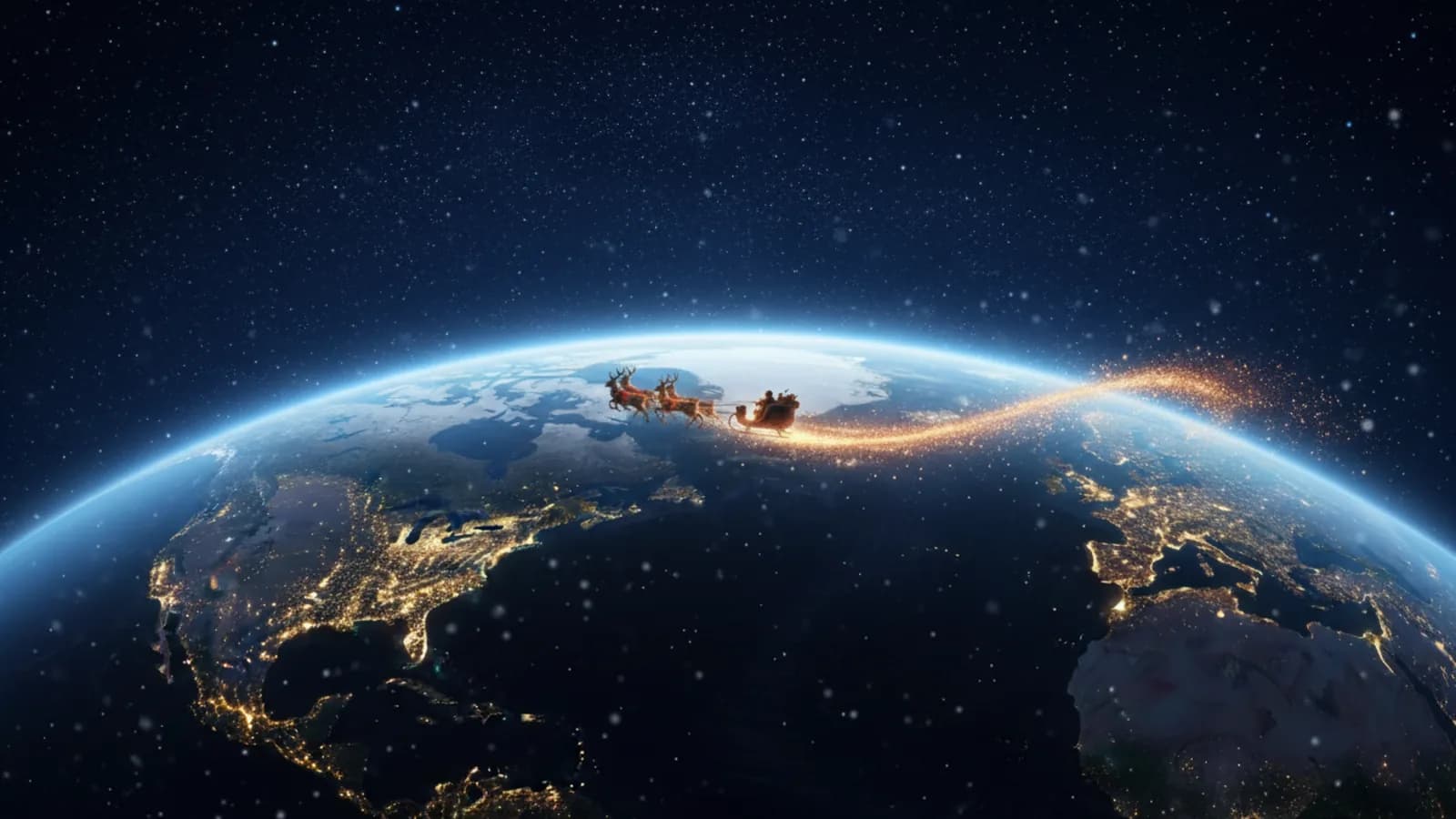
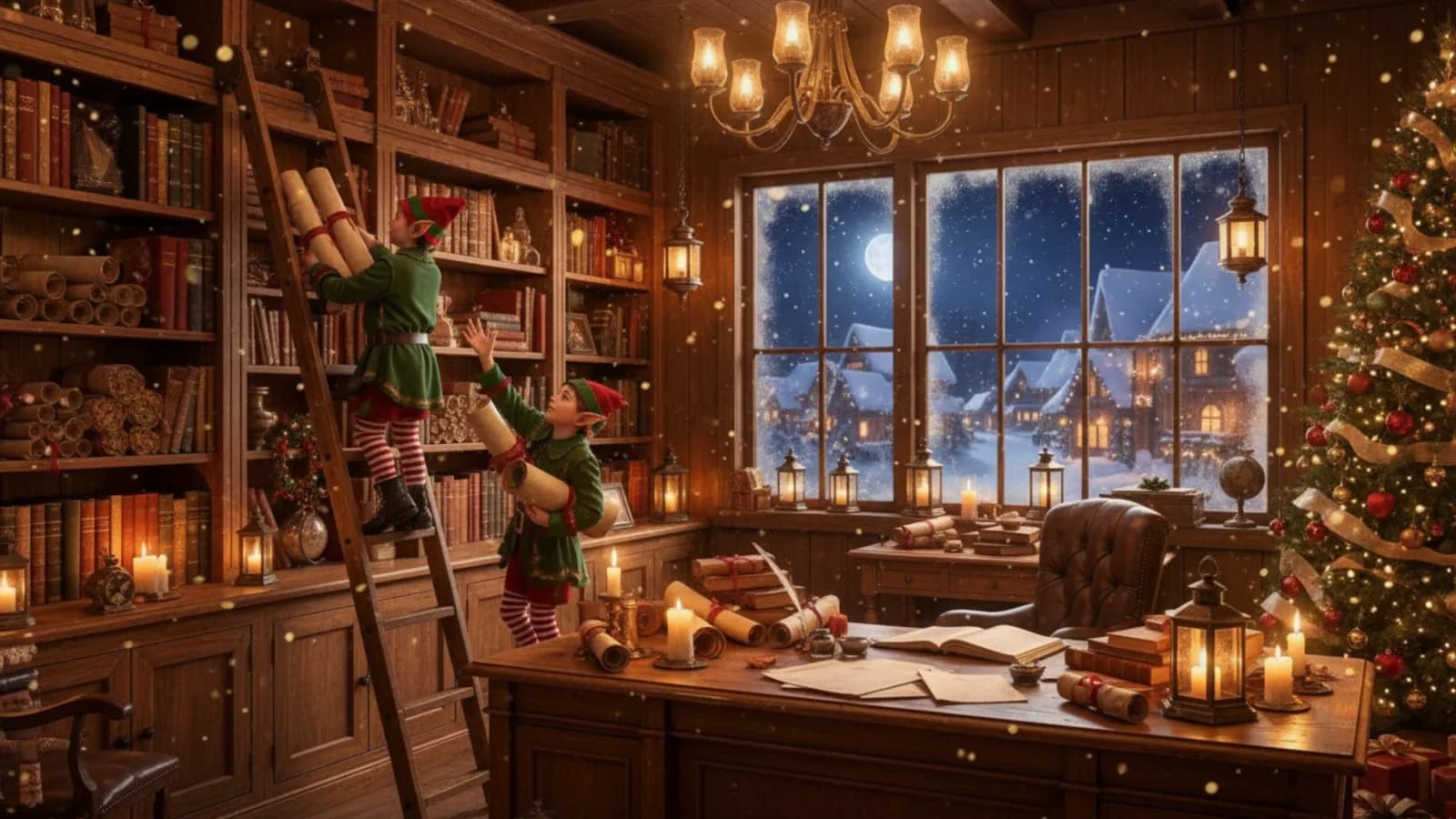
Kids ask it straight out: “How does he do it?” How he fits down a chimney that narrow, how he knows who has been good, how he gets around the whole world in one night without a single new wrinkle. The North Pole Archives have no instruction manual signed in his hand, but they have something better: two centuries of poems, engravings and stories that describe his talents one by one.
The first American text that shows him at work dates from 1821. The most famous poem follows in 1823. The cartoonist Thomas Nast gives him a workshop and a ledger in 1866, and L. Frank Baum, the author of The Wonderful Wizard of Oz, makes him immortal in 1902. Here is what those documents say, power by power, along with whatever the village elves were willing to add.
What powers does Santa have?
Put the stories side by side and you get a fairly precise list. Each power has a text it comes from, usually a date, sometimes an author. None of those texts tries to explain everything: they show Santa doing things without saying how he does them. That is exactly what makes them so good to reread.
- Flying through the night with a sleigh and reindeer: one reindeer in 1821, eight in 1823.
- Going in and out by the chimney with a simple nod, described in 1823.
- Passing through walls in houses with no chimney, in Baum's 1902 story.
- Knowing who has been good, thanks to a behavior ledger Thomas Nast drew in 1866.
- Hearing children's wishes from Korvatunturi, the ear-shaped mountain in Finnish Lapland.
- Never dying, thanks to the mantle of immortality in the 1902 story.
Add one older talent to the list, inherited from Saint Nicholas, the bishop of Myra who gave Santa his name: showing up wherever he is needed. We come back to it at the end, because it may be the most important of them all.
How does Santa go back up the chimney?
The answer takes two lines. In “A Visit from St. Nicholas,” printed without an author's name on December 23, 1823, in the Sentinel of Troy, New York, the visitor first comes down the chimney “with a bound.” When his work is done, he lays a finger beside his nose, gives a nod and rises back up the flue. No ladder, no rope: one gesture is enough.
And laying his finger aside of his nose, And giving a nod, up the chimney he rose.
The same poem describes a visitor who speaks not a word and goes straight to his work. He fills the stockings, turns with a jerk, and gives a wink and a twist of his head that put the narrator at ease. The Santa of 1823 is small and quick, almost an elf, which surely helps in narrow flues. Clement Clarke Moore claimed the poem thirteen years later, an attribution some scholars dispute in favor of Henry Livingston.
And houses with no chimney? In 1902, L. Frank Baum took up the question in “The Life and Adventures of Santa Claus.” In his story, Claus uses chimneys at first, until stoves replace open hearths and the flues get too narrow. The fairy Wisk then suggests going through the walls, and with her and his other helpers Claus has no trouble at all getting into the new-fashioned houses. Baum adds that parents can act as “deputies” and fill the stockings for him. The full chimney story is in why does Santa come down the chimney.
How can Santa fly?
He doesn't fly alone: his reindeer carry the sleigh. The first text to show them dates from 1821. That year the New York printer William B. Gilley put out a small booklet, “The Children's Friend,” with eight colored engravings. Its poem, “Old Santeclaus with Much Delight,” sends a single reindeer over the rooftops and the snowfields on Christmas Eve.
His reindeer drives this frosty night, O'er chimney tops, and tracts of snow.
Two years later the Troy poem moves up to “a miniature sleigh, and eight tiny reindeer.” In 1902 Baum invents a rule that explains everything: the reindeer belong to the Forest of Burzee, and their guardians, the Knooks, lend them to Claus only one night a year, on Christmas Eve, as long as they are home by daybreak. He may pick ten at most. The first two are called Glossie and Flossie, and the full team also includes Racer, Pacer, Reckless, Speckless, Fearless, Peerless, Ready and Steady.
Santa isn't the only one crossing the rooftops. In the Netherlands, Sinterklaas rides his white horse over the houses during the weeks before December 5 and drops presents down the chimney. Where the reindeer came from, what they are called and why Rudolph's nose is red: it's all in where did Santa's reindeer come from and Santa's reindeer names.

How does he do it all in one night?
Here the old texts keep quiet. The 1823 poem only says that the visitor arrives, works without a word and leaves “like the down of a thistle” on the wind. The 1821 poem sets the date: “Each Christmas eve,” no longer December 6, Saint Nicholas Day. Nobody in the nineteenth century tried to work out how many houses he had to visit per second.
Baum's story offers two clues. First, Claus isn't alone: by the end of the book he has four deputies, Kilter, Peter, Nuter and Wisk, from four different magical peoples. Kilter, “the silent and swift,” even collects children's letters. Second, parents help him. In the 1902 story, Santa is already a team.
There is also a more down-to-earth explanation, which has to do with the Earth's rotation: Christmas night doesn't fall at the same moment everywhere, so a traveler following the time zones has far more than twenty-four hours. We walk through the math in how does Santa deliver presents in one night.
How does Santa know who has been good?
The power children fear most has a date too. On December 29, 1866, Thomas Nast published a double-page spread in Harper's Weekly titled “Santa Claus and His Works.” In its panels, Santa watches for good children, works in his workshop and checks a big account book. When Nast collected his drawings in a volume in 1890, the captions were printed with them: “On the look out for good children” and “Account book, record of behaviour.”
For listening, Santa also has a well-chosen address. In 1927 the Finnish radio host Markus Rautio announced that he lives on Korvatunturi, in Lapland. The name means “Ear Fell,” and people say its shape lets Santa hear the wishes of every child on Earth. Santa's other addresses are collected in where does Santa Claus live.
The list, the ledger, Sinterklaas's big red book and the songs about them have a whole history of their own, which we tell in how does Santa know if you are naughty or nice. For a first opinion, our nice detector gives a verdict in a few seconds.
Is Santa immortal?
In Baum's story, yes, and we even know how it happened. Claus grew up in the Forest of Burzee, taken in by the wood nymph Necile. He is mortal, and he grows old. As the Spirit of Death draws near, Ak, the Master Woodsman of the World, calls a council of all the immortals. Every one of them votes yes, and Claus receives the Mantle of Immortality. Ak then proclaims Claus “the Patron Saint of Children.”
Five years earlier, a New York newspaper had given its own answer. On September 21, 1897, The Sun ran an unsigned editorial replying to a letter from eight-year-old Virginia O'Hanlon, who wanted to know whether Santa Claus was real. Its author, Francis Pharcellus Church, was only named after his death in 1906. The piece became the most reprinted editorial in newspaper history.
No Santa Claus! Thank God! he lives, and he lives forever.
The same editorial promises that a thousand years from now he will still make glad the heart of childhood. Bishop Nicholas, for his part, died in Myra in 343, by tradition. The math on Santa's age, counted from that date, is in how old is Santa Claus.
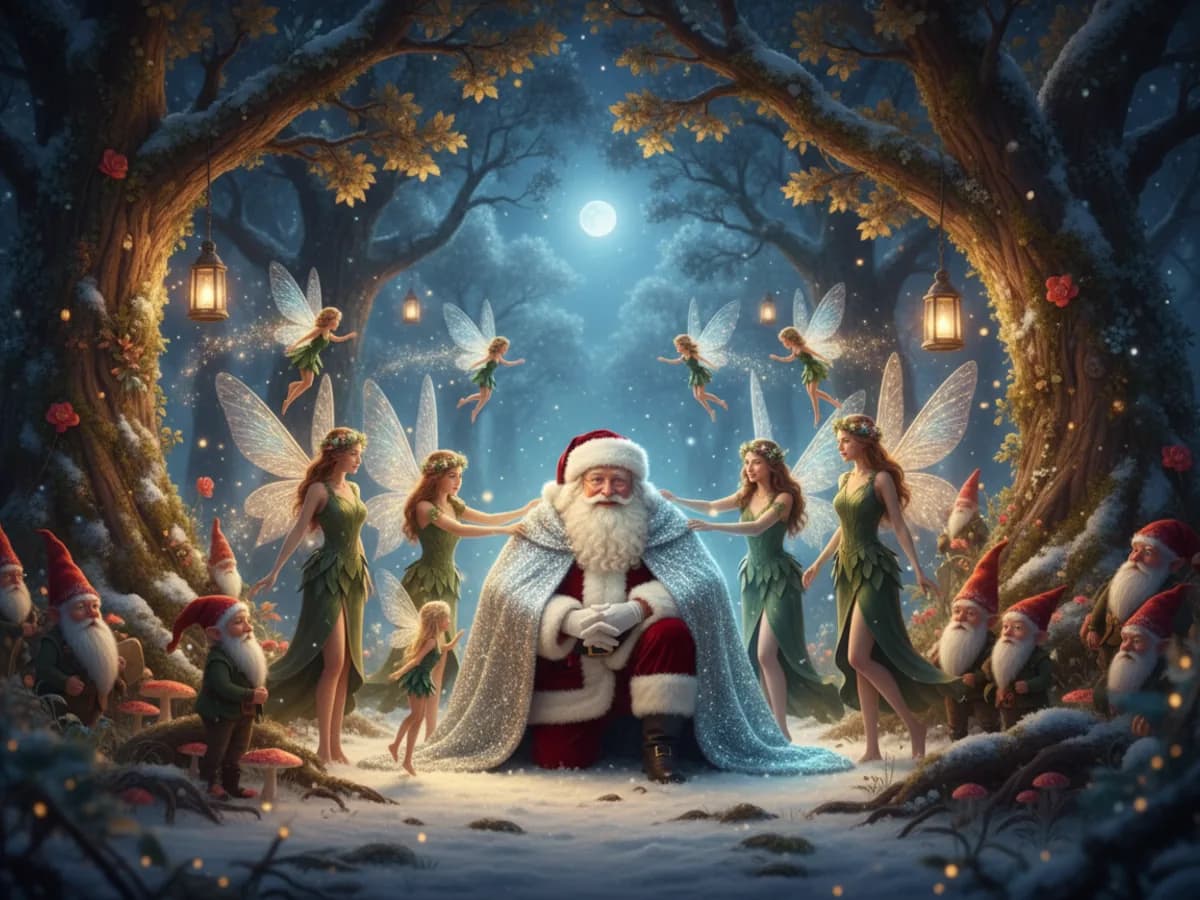
Where does Santa's magic come from?
Long before the reindeer, Saint Nicholas had a reputation for turning up at the right moment. The St. Nicholas Center, an American resource center devoted to the saint, tells the story of the sailors of Myra. Caught in a storm in the eastern Mediterranean, their ship runs aground in shallow water. The sailors pray to Bishop Nicholas, though he is far away. He appears on deck, helps them tighten the ropes on the mast, and the ship works free before the vision fades.
Safe in port, the sailors go to the cathedral in Myra to give thanks and recognize the bishop they saw on board. When they ask how he heard them, he answers that a life given to others lets a person see and hear those in danger. Seeing from afar, hearing the call, arriving in time: fifteen centuries early, those are the very talents children credit to Santa.
The bishop's other legends, the three young women and the dowry gold, the three children saved from the butcher, are told in who was Saint Nicholas. And to put the question to the man himself, there is always a letter to Santa or a chat with him.
Sources
- Academy of American Poets, Poets.org, “A Visit from St. Nicholas” (1823)
- Wikipedia, “Old Santeclaus with Much Delight” (The Children's Friend, 1821)
- Project Gutenberg, L. Frank Baum, “The Life and Adventures of Santa Claus” (full text)
- Wikipedia, “The Life and Adventures of Santa Claus” (Bowen-Merrill, 1902)
- Colgate University, Picker Art Gallery, Thomas Nast, “Santa Claus and His Works,” Harper's Weekly, December 29, 1866
- Project Gutenberg, Thomas Nast, “Thomas Nast's Christmas Drawings for the Human Race,” Harper & Brothers, 1890
- Wikipedia, “Korvatunturi”
- Yle News, “Christmas special: How Santa became Finnish,” 2019
- Wikipedia, “Yes, Virginia, there is a Santa Claus” (The Sun, 1897)
- St. Nicholas Center, “The Sailors' Friend”
- Wikipedia, “Sinterklaas”
- MPR News / NPR StoryCorps, “NORAD's Santa tracker began with a typo and a good sport,” 2014