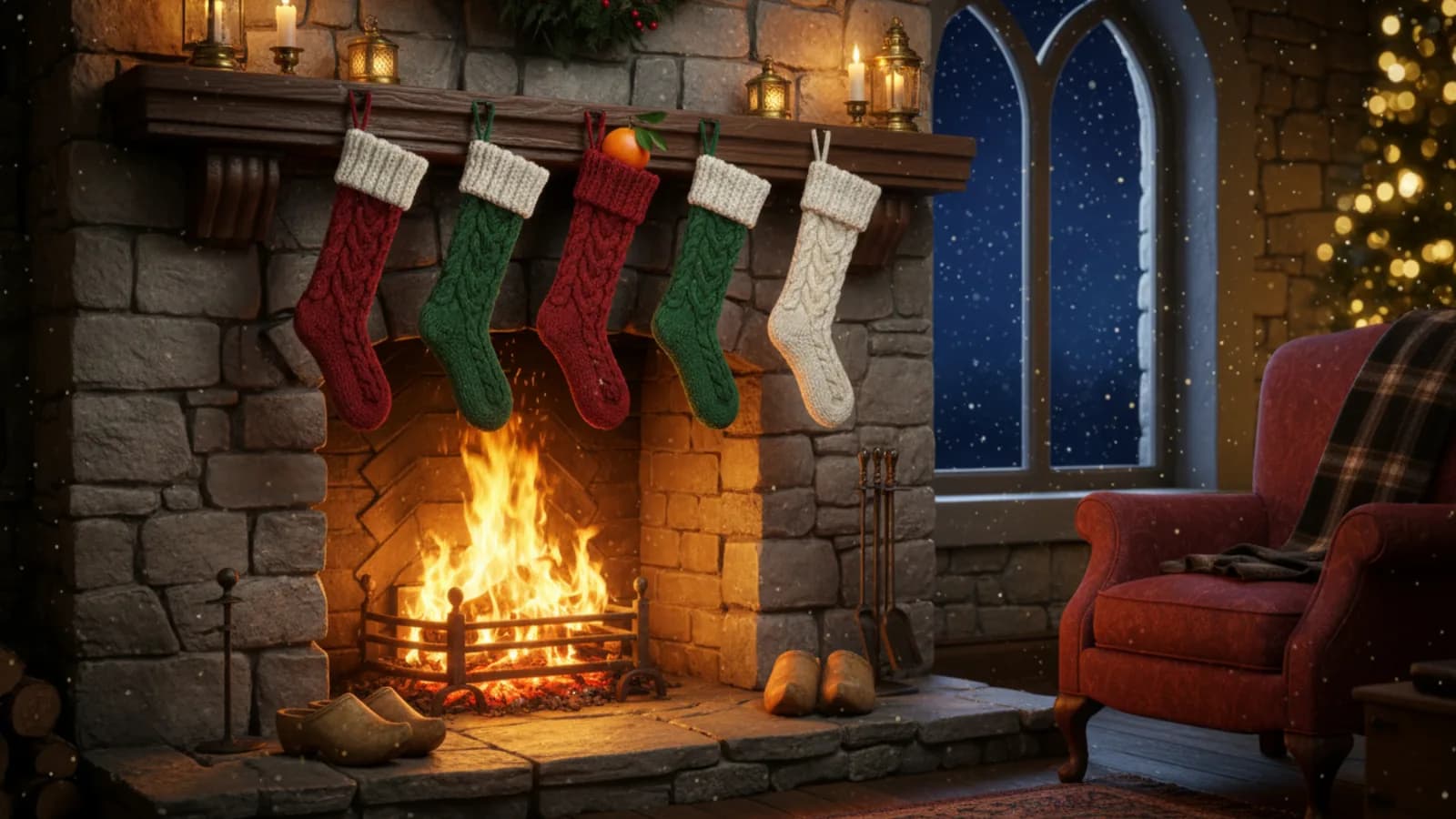
In 1903, a boy named Ralph Bates Silloway ended his letter to Santa Claus with an odd line: “I watch for you every night in the stove.” He had understood the rule perfectly. Santa comes in where the smoke goes out, even when all that is left is a pipe.
The rule is not obvious. A visitor who gets covered in soot to come inside, when there is a perfectly good front door, is a strange idea when you stop to think about it. It has a long history all the same, made of a hearth that warmed the whole family, sprites that used the flue, a bishop who tossed gold into a house in secret and a few New York writers. Our archivists have filed the evidence in order.
Why does Santa come down the chimney?
Because for centuries the fireplace was the center of the house. Meals were cooked there, people warmed themselves there, stories were told there. French still carries the trace: the Trésor de la langue française dates the word foier, meaning the hearth of a fireplace, to around 1135, and finds it meaning “the place where a family lives” in Ronsard in 1572. In French, foyer still means both the fire and the people gathered around it, much like “hearth and home” in English.
December made the hearth matter even more. The medievalist Karin Ueltschi, of the University of Reims, quotes Maupassant calling the month “a black hole at the bottom of the year,” when people shut themselves in “by the hearth.” That is where the Yule log burned, a custom first described in detail by a student from Basel in 1597, and one that, she points out, required a hearth in the house.
At night the door was bolted and the shutters closed. The flue was the only opening left to the outside, and above all to the sky. For someone who travels through the air, it is the most logical way in there is: land on the roof, and the path leads straight down to the spot where the family has left its shoes.
Who came down the chimney before Santa?
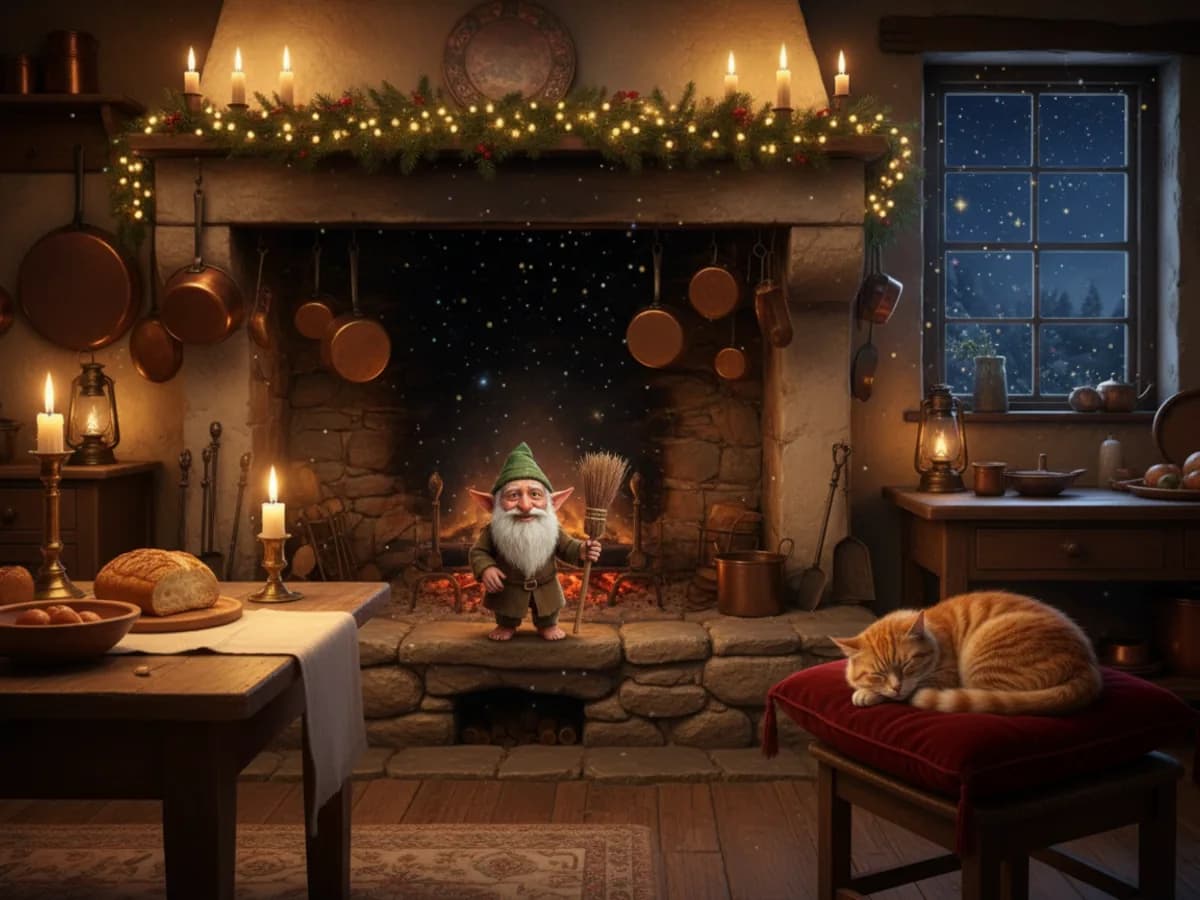
Santa did not invent the route. Mental Floss, which gathered the traditions on the subject, cites a 15th-century French scholar, Petrus Mamoris, who argued that witches, elves and their kind did not enter houses by passing through walls but by coming down the chimney. In Renaissance tales, fairies appear through the flue, and witches fly up it on their broomsticks to reach the Sabbath.
- In Scotland and England, the brownie, a household spirit, does the chores while the family sleeps, and comes and goes by the chimney.
- In Slovenia, the skrat, a shape-shifting spirit, flies down the flue in fiery form to bring riches to the families he favors.
- In Celtic lore, the bodach is a bogeyman who slips down the chimney to carry off naughty children.
- In Greece, the kallikantzaroi, mischievous goblins, come down chimneys during the twelve days between Christmas and Epiphany.
- Among German immigrants in Pennsylvania, the Belsnickel frightened naughty children; the Philadelphia Gazette wrote on December 19, 1827, that he “slips down the chimney, at the fairy hour of midnight.”
In Italy, the Befana does the same on the night of January 5, filling the stockings of good children. We tell her story in Christmas gift bringers around the world. By the time Santa arrives, the chimney has long been the doorway of night visitors, kind and unkind alike.
Did Saint Nicholas really throw gold down a chimney?
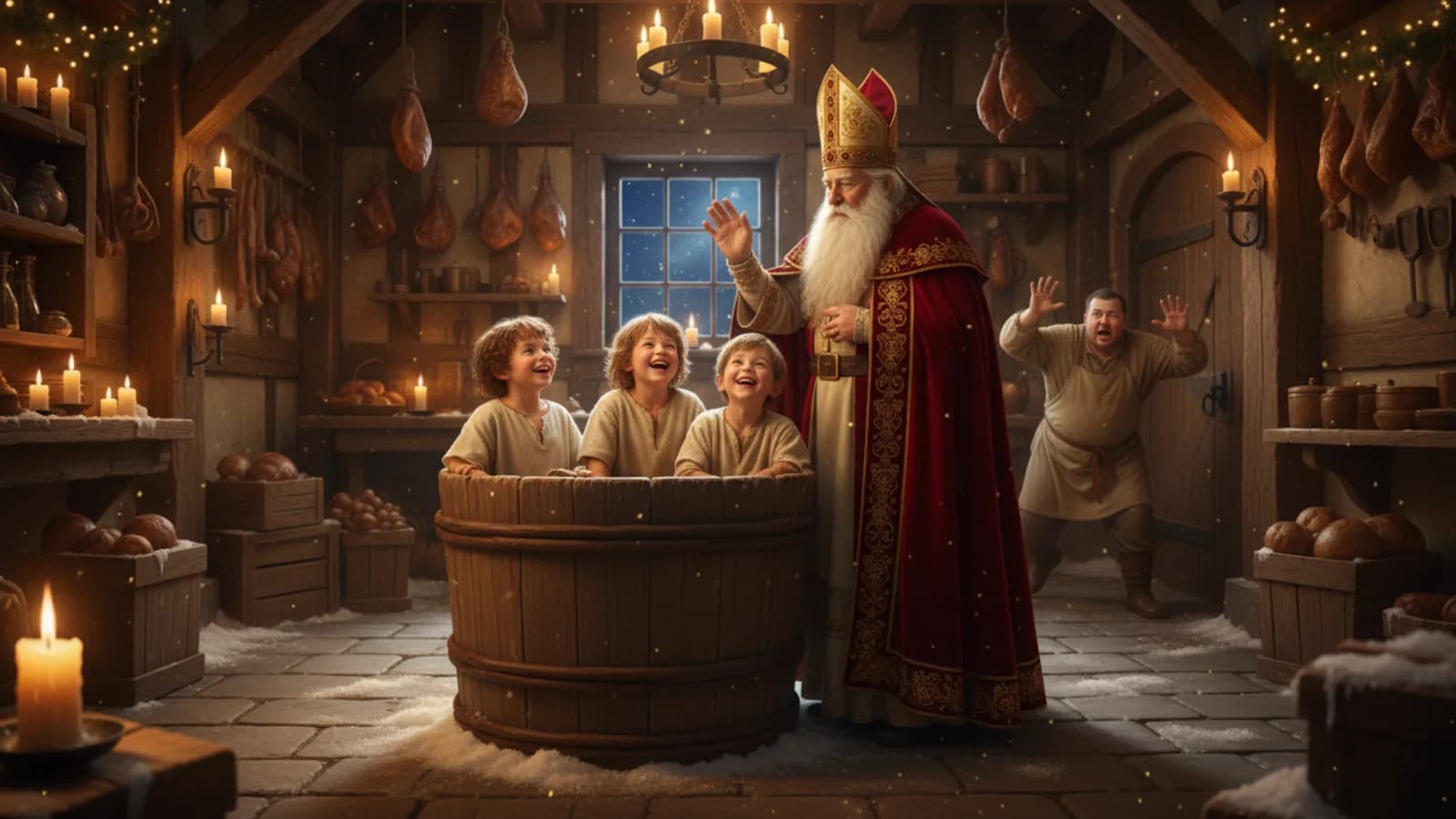
The best-known legend of Nicholas, bishop of Myra, born around 270 according to tradition, tells of a ruined father who cannot pay dowries for his three daughters. Without a dowry, they cannot marry. Three times, at night, the bishop gets a bag of gold into the house without being seen. We cover his life in Who was Saint Nicholas?.
The gold takes a different route depending on who tells it, and the St. Nicholas Center, which collects the stories about the saint, publishes both. In its long telling, the first bag sails through an open window and lands in a stocking set to dry by the fire. In its short version for children, the first bag is left on the doorstep, the second is tossed down the chimney, and the third goes through a window while the father keeps watch.
According to Mental Floss, early versions mostly have the window, and the chimney comes later. The St. Nicholas Center adds that some versions have a shoe rather than a stocking, which would explain the European custom of leaving shoes out for the saint.
It sailed in through an open window, landing in a stocking left before the fire to dry.
Why did children leave their shoes by the fireplace?
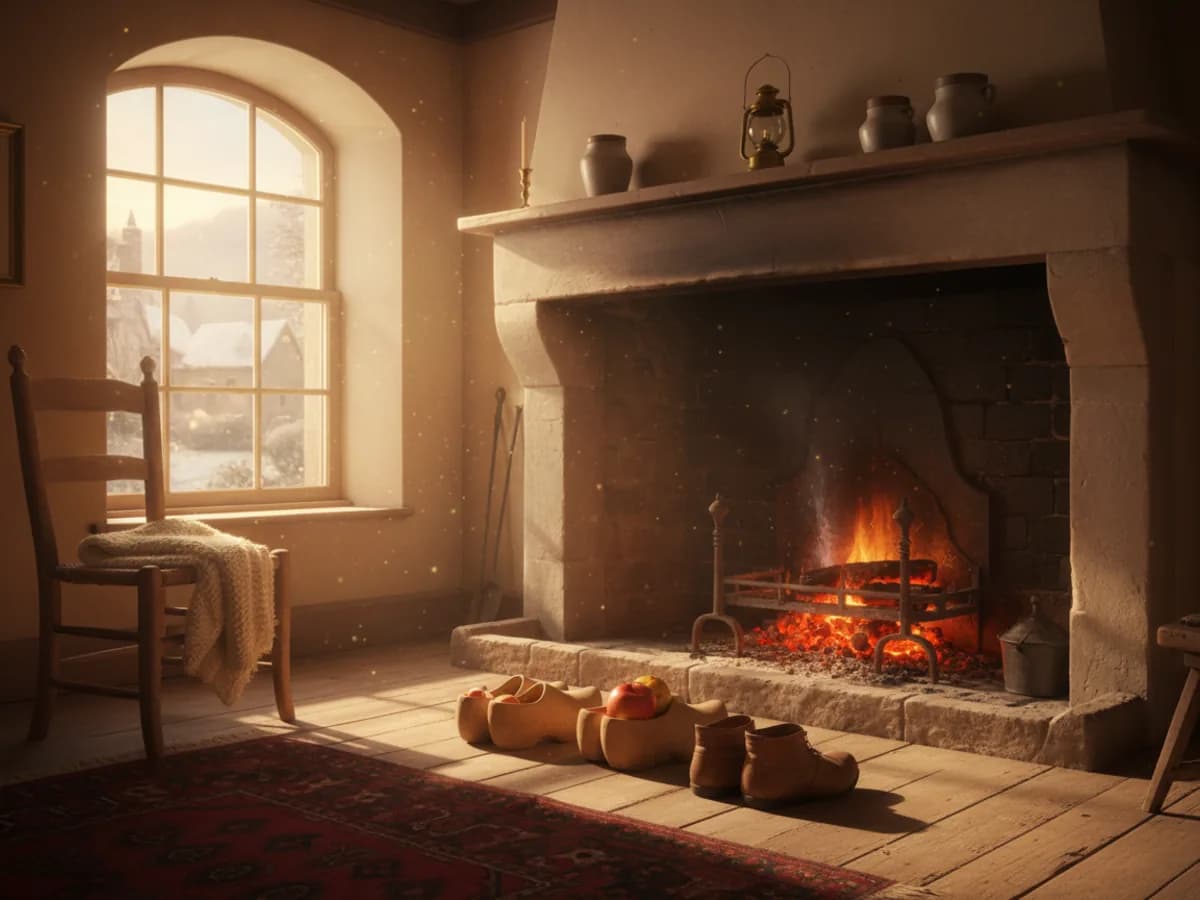
Before stockings, there were shoes. The St. Nicholas Center describes the old custom of putting nuts, apples and sweets into shoes left beside beds, on windowsills or before the hearth. By the seventeenth century the custom was well established in the Dutch Republic, as one famous painting shows.
The Rijksmuseum in Amsterdam holds a picture of that morning. In The Feast of St Nicholas, painted by Jan Steen between 1665 and 1668, a little girl clutches a bucket full of treats while a boy on the left wails: all he found in his shoe was a switch, a bundle of twigs. By the chimney, young people sing a Sinterklaas song.
In France, it was the wooden clog or the shoe. The Office québécois de la langue française notes in its entry on the Christmas stocking that French children placed a sabot or a shoe near the bed or the fireplace. George Sand, born in 1804, writes in her memoir Histoire de ma vie, published in 1855, that she waited for “the little Father Christmas” to come “down the chimney pipe,” and that her first glance the next morning was for her shoe “at the edge of the hearth.” She found a little cake there, an orange or a fine red apple.
That detail matters. In early 19th-century France, Father Christmas was already using the flue, years before the American poem of 1823. The hanging stocking, meanwhile, is an English-speaking habit, which we follow step by step in the history of Christmas stockings.
When did Santa start coming down the chimney?
In America, the idea took shape in New York over about fifteen years. In 1809, Washington Irving published his History of New York, in which Dutch families hang a stocking “in the chimney” on Saint Nicholas Eve and find it filled in the morning. In the revised editions that followed, the saint no longer just drops presents down the chimneys of his favorites: one night a year, Irving writes, he “rattles down the chimneys” of the descendants of the patriarchs.
- 1809Washington Irving describes the stocking hung in the chimney on Saint Nicholas Eve.
- 1810For the New-York Historical Society's Saint Nicholas dinner, John Pintard has Alexander Anderson make a picture of the saint, with treats in stockings hanging at a fireplace.
- 1821The booklet The Children's Friend, published by William B. Gilley, sends the sleigh “o'er chimney tops”; one engraving shows it resting on a roof.
- 1823The Troy Sentinel prints the unsigned “A Visit from St. Nicholas,” in which the visitor comes down the chimney and leaves the same way.
The 1823 poem turned the idea into a scene. The stockings are “hung by the chimney with care,” the visitor comes down “with a bound,” and his furs are “all tarnished with ashes and soot.” He fills the stockings without a word, lays his finger aside of his nose, gives a nod, and rises up the chimney. The poem, credited to Clement Clarke Moore in 1837 and included in his 1844 collection, gets its own story in the history of “’Twas the Night Before Christmas”.
Down the chimney St. Nicholas came with a bound.
One detail makes the scene work: in the poem, the visitor is “a right jolly old elf” with a “miniature sleigh” and “eight tiny rein-deer.” A small figure fits easily down a flue. Once illustrators, Thomas Nast first among them from 1863, drew him at full human size, the chimney suddenly got a lot narrower. Columnist Justin Fox sees this as the source of the unlikely picture of a full-grown man squeezing down a chimney.
How does Santa get in if you don't have a chimney?
The question is almost as old as the poem. According to New England Today, cast-iron stoves spread through American homes in the 1830s and 1840s: more efficient than an open hearth, they needed only a narrow pipe, and children began to wonder whether Santa could crawl down a stovepipe.
In 1893, an opinion piece in Harper's Weekly fretted that when the airtight stove came in, “a mode of ingress other than the chimney should have been provided.” Ten years later, Ralph Bates Silloway was still watching his stove. Today the question is wider still. Bloomberg columnist Justin Fox noted in 2020 that only 39 percent of new single-family homes built in the United States in 2019 had a fireplace, the lowest share since the Census Bureau began tracking it in 1973.
How families answer it
- The magic key: Santa opens the front door with a special key. Romper described it in 2019 as a Christmas tradition, to be revealed to children in a letter or an Advent calendar.
- The window: Justin Fox's family left one slightly ajar every Christmas Eve.
- The stove itself: in 2023, a six-year-old in Vermont told New England Today that Santa, being magic, fits through the little holes in the bottom of the stove.
- The door and the spare key: a Maine boy whose fireplace is walled up told the same magazine that Santa uses the spare key.
- Plain magic: the answer most parents settle on, as long as the children are asleep.
On the night of December 24, the Santa tracker follows his route from rooftop to rooftop, chimney or not. And for another logistics question that comes up every year, see how Santa delivers presents in one night.
Sources
- Mental Floss, Why Does Santa Claus Come Down the Chimney?, 2018
- New England Today (Yankee), Hearth of the Matter: A Timeline of Santa's Fireplace Challenges, 2023
- St. Nicholas Center, Three Impoverished Maidens
- St. Nicholas Center, The Legend of Saint Nicholas
- St. Nicholas Center, Origin of Santa Claus
- Rijksmuseum, Jan Steen, The Feast of St Nicholas, 1665-1668
- Karin Ueltschi, “Quand tu descendras du ciel”: mythologies des enfances et de Noël, Revue Silène, 2024
- Lexilogos, Père Noël (excerpt from George Sand, Histoire de ma vie)
- Office québécois de la langue française, Vitrine linguistique, bas de Noël
- CNRTL, Trésor de la langue française, etymology of foyer
- Project Gutenberg, Washington Irving, Knickerbocker's History of New York
- Wikipedia, Old Santeclaus with Much Delight
- Project Gutenberg, ’Twas the Night before Christmas: A Visit from St. Nicholas
- The Herald (Bloomberg Opinion, Justin Fox), With fewer chimneys in houses, what's Santa to do?, 2020
- Romper, What Does Santa Do Without A Chimney? He's Magic, 2019
- evangelisch.de (epd), Warum Schornsteinfeger als Glücksbringer gelten, 2025