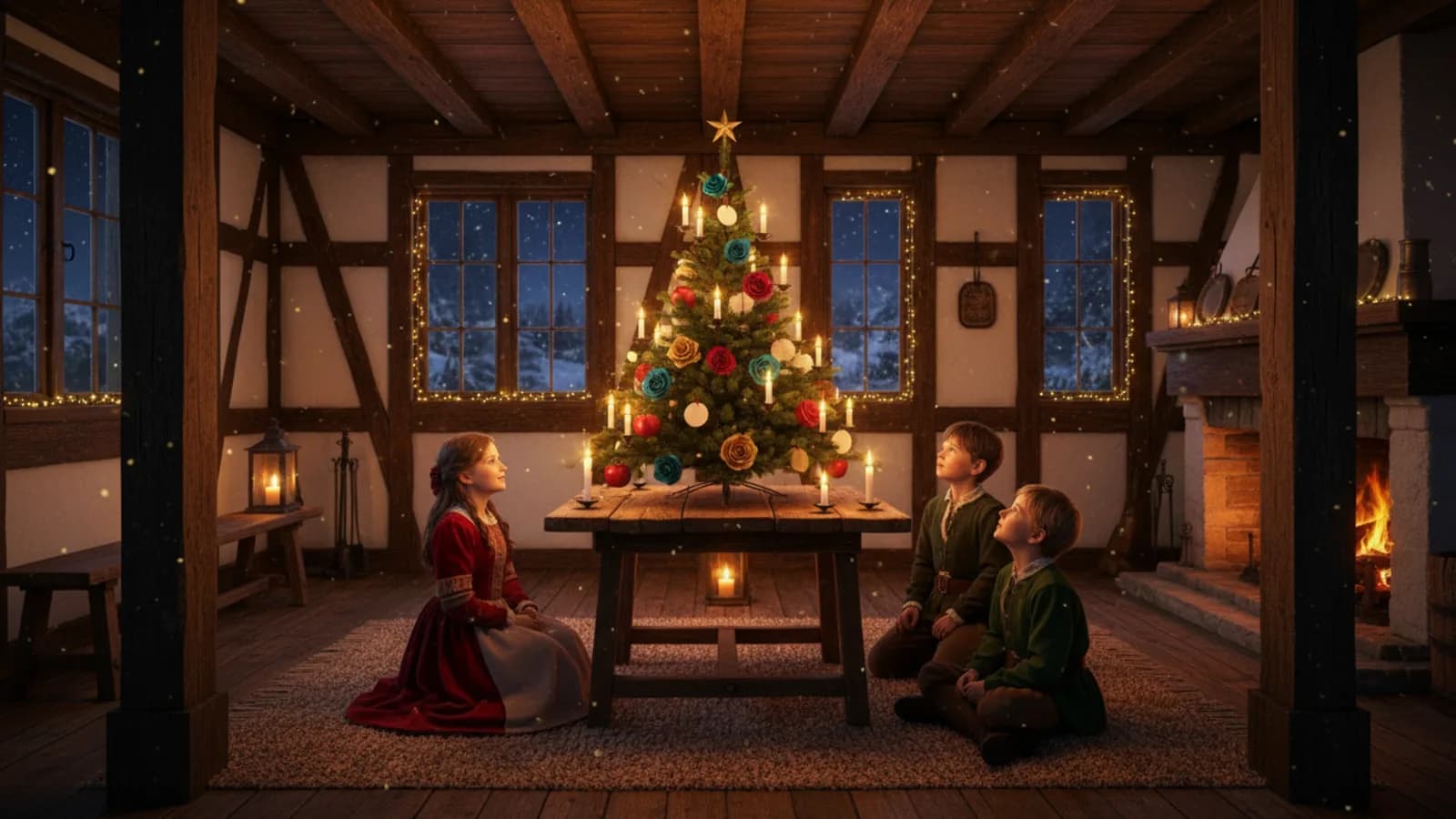
On the evening of December 5, in a house in Amsterdam, a child sets a shoe by the stove with a carrot tucked inside. A few weeks later, in Boston, another family hangs four red wool stockings from the mantel. Both habits share an ancestor: a story about gold thrown into a dark house by a bishop from Asia Minor, told since the Middle Ages.
In between come wooden clogs in eastern France, a New York writer who half invented a custom, a poem from 1823 that made it famous, and an orange pushed all the way down to the toe. Our archivists have put those pieces back in order.
Why do we hang stockings at Christmas?
No document says, “On this day, someone hung the first stocking.” What we have is a legend about Saint Nicholas, bishop of Myra in the fourth century. A ruined father cannot pay dowries for his three daughters and is about to abandon them to a terrible fate. Nicholas wants to help without shaming him, so he comes by at night and tosses a bag of gold through the open window.
The versions disagree on one detail that matters a great deal to us. In one, the gold simply rolls across the floor. In another, reported by zoologist Desmond Morris in his book Christmas Watching (1992), it lands in a stocking hung by the fire to dry. That variant is the one that stuck: a secret gift, left at night, in a piece of clothing set near the hearth.
Some storytellers swap the bags for three balls of gold. Those three balls became one of Saint Nicholas's emblems, and also the sign of pawnbrokers, whose patron he is. The St. Nicholas Center, which documents the customs linked to the saint, notes that they are often shown as oranges or even apples. We will come back to that at the toe of the stocking.
For the full story of the bishop, his Council of Nicaea in 325 and the relics carried off to Bari in 1087, read Who was Saint Nicholas?. Here we follow only the object: the shoe first, then the stocking.
Before the stocking came the shoe: French clogs and Dutch shoes
For centuries in Europe, children hung nothing at all: they set out their shoes. They did it on the eve of December 6, Saint Nicholas Day, not at Christmas. The Fondation Napoléon, in an article on Saint Nicholas gingerbread and chocolate, describes the scene as French children lived it in the nineteenth century: in the evening they put their wooden clogs, called sabots, at the foot of the fireplace, and the saint came back with a donkey loaded down with treats.
What went inside depended on the household. The same article mentions toys in the shoes of well-off families, and walnuts, hazelnuts or honey cakes in the galoshes of everyone else. It also quotes a young Belgian conscript stationed in Paris who received a basket of sweets from his family on Saint Nicholas night in 1809. In Lorraine, the region of eastern France whose patron is Saint Nicholas, the December 6 celebration never went away.
In the Netherlands the idea is the same, with a horse instead of a donkey. According to the St. Nicholas Center, children place a shoe by a window, a door or the heater, along with a drawing, a wish list and a carrot or some hay for Sinterklaas's horse. Sometimes a saucer of water too. In the morning they find chocolate coins, a chocolate letter for their initial, pepernoten and small presents.
Until the 1940s, Dutch children found their gifts in their shoes on the morning of December 6. Today the main celebration takes place on the evening of the 5th, around the family table. The shoe still goes by the door for several evenings in a row in late November and early December.
France kept the shoe all the way into its pop songs. In “Petit Papa Noël,” written by Raymond Vincy to music by Henri Martinet and sung by Tino Rossi in 1946, a child asks Father Christmas not to forget his little shoe. The record holds the title of best-selling single in French history. The little shoe is still in the chorus.

How did the stocking reach New York?
The move from shoe to hanging stocking can be read in New York texts of the early 1800s. In 1809, Washington Irving published his History of New York, a satirical chronicle of the old Dutch colony. In the first edition he writes that under Governor Peter Stuyvesant, Saint Nicholas's Day never went by without presents and “hanging the stocking in the chimney.” In the revised editions that followed, the custom becomes a “pious ceremony” of the first settlers, and the stocking is always found “miraculously filled” in the morning.
Nor was the day of St. Nicholas suffered to pass by, without making presents, hanging the stocking in the chimney, and complying with all its other ceremonies.
Irving was writing as a humorist, and nothing proves seventeenth-century colonists really did this. But the passage fixed the picture. A year later, on December 6, 1810, John Pintard commissioned engraver Alexander Anderson to make a print for the New-York Historical Society's first Saint Nicholas dinner. The St. Nicholas Center calls it the first American image of the saint, and it shows children's treats in stockings hanging at a fireplace.
- 1809Washington Irving mentions the stocking hung in the chimney for Saint Nicholas's Day.
- 1810Alexander Anderson's print shows stockings filled with treats hanging at the hearth.
- 1821The booklet The Children's Friend has Santeclaus pass “each Christmas eve” by children's beds and stockings.
- 1823“A Visit from St. Nicholas” opens with stockings hung by the chimney “with care.”
The 1821 booklet, published in New York by William B. Gilley, matters twice over. First, the visit no longer happens on December 6 but on Christmas Eve. Second, the visitor has seen “beds and stockings” in the houses, which shows the reader already expected the object. For disobedient children, the same booklet leaves a long black birch rod in place of toys.
Two years later, on December 23, 1823, the Troy Sentinel printed without a byline the poem that would be credited to Clement Clarke Moore in 1837 and that he would claim in his own Poems in 1844. Its third line settled the stocking for good: “The stockings were hung by the chimney with care.” Further on, the visitor goes straight to work without a word and fills all the stockings before rising back up the flue. On that last move, see Why does Santa come down the chimney?.

When did stockings catch on in Britain and elsewhere?
In Britain the traditional figure is Father Christmas. For a long time he stood for feasting and merriment more than for bringing presents. The Library of Congress, in a 2018 post on its Folklife Today blog by Stephen Winick, dates the arrival of the American mythology, sleigh and flying reindeer included, to the 1860s.
The two characters began to merge in the 1870s. The same post cites the Oxford Dictionary of English Folklore: by 1883, a French visitor to England wrote, as a matter of common knowledge, that Father Christmas comes down chimneys and puts toys and sweets in stockings.
Italy has its own stocking, and it has nothing to do with Christmas Eve. La Befana, an old woman on a broomstick, comes on the night of January 5, the eve of Epiphany, and fills good children's stockings with sweets. The others get coal. We introduce her alongside the other gift-bringers in Who brings Christmas presents around the world?.
What goes in a Christmas stocking?
English has a word for it: stocking stuffers in the United States, stocking fillers in Britain. It means the small gifts that fit inside a stocking, as opposed to the packages under the tree. In some families the stocking is opened first, at dawn, before the grown-ups are up. In others it is the heart of the children's Christmas.
Why is there an orange in the toe of the stocking?
The orange goes straight back to the legend. The St. Nicholas Center explains that the gold Nicholas gave is often shown as golden balls, which are in turn symbolized by oranges or apples. An orange in the toe of the stocking is therefore a reminder of the saint's gift.
And the lump of coal?
The threat of coal belongs to the same family as the birch rod in the 1821 booklet. In Western tradition, a child who has behaved badly all year gets nothing but a lump of coal. In the Netherlands, children once risked a potato or a little bag of salt. Italy's Befana, for her part, leaves coal for children who were not good.
- An orange or a clementine, in memory of Saint Nicholas's gold.
- Walnuts and hazelnuts, as in the galoshes of the 1800s.
- Chocolate coins, inherited from Dutch shoes.
- A chocolate letter for the child's initial.
- A small toy, a pencil, a paperback book.
- A note in Santa's own handwriting.
That last one is a specialty of our house. Children who have written to Santa know that a reply can hide at the bottom of a stocking just as well as in a mailbox.
Where do you hang a stocking if you don't have a chimney?
At first, children simply used one of their everyday socks. Then came stockings made just for the holiday, bigger and decorated. Today many families sew or knit their own and stitch each person's name on the cuff, so Santa never mixes up who gets what.
A chimney is no longer required. Stockings hang from bedposts, doorknobs, a low branch of the tree or a stair banister. Tradition asks only that they be empty, in plain sight and ready before the children fall asleep. The 1821 booklet already mentioned beds as often as stockings.
Families who prefer a shoe have history on their side: it is older than the stocking by several centuries. Nothing stops you from doing both, a shoe for Saint Nicholas Day on December 6 and a stocking for the 24th. To count the days in between, our Advent calendar opens one door a day.
Sources
- St. Nicholas Center, Origin of Santa Claus
- St. Nicholas Center, St. Nicholas and American Christmas Customs
- St. Nicholas Center, Sinterklaas in the Netherlands
- Fondation Napoléon, Napoleon.org, “Pain d'épice et chocolat pour la Saint-Nicolas”
- Project Gutenberg, Washington Irving, Knickerbocker's History of New York
- Wikipedia, Old Santeclaus with Much Delight (1821)
- Project Gutenberg, 'Twas the Night before Christmas: A Visit from St. Nicholas
- Library of Congress, Folklife Today, Stephen Winick, “Christmas Cousins: Father Christmas and Santa Claus,” 2018
- Wikipedia, Christmas stocking
- Wikipedia (French), Petit Papa Noël (song)
- Internet Archive, Washington Irving, A History of New York, first edition, vol. II, Inskeep & Bradford, 1809