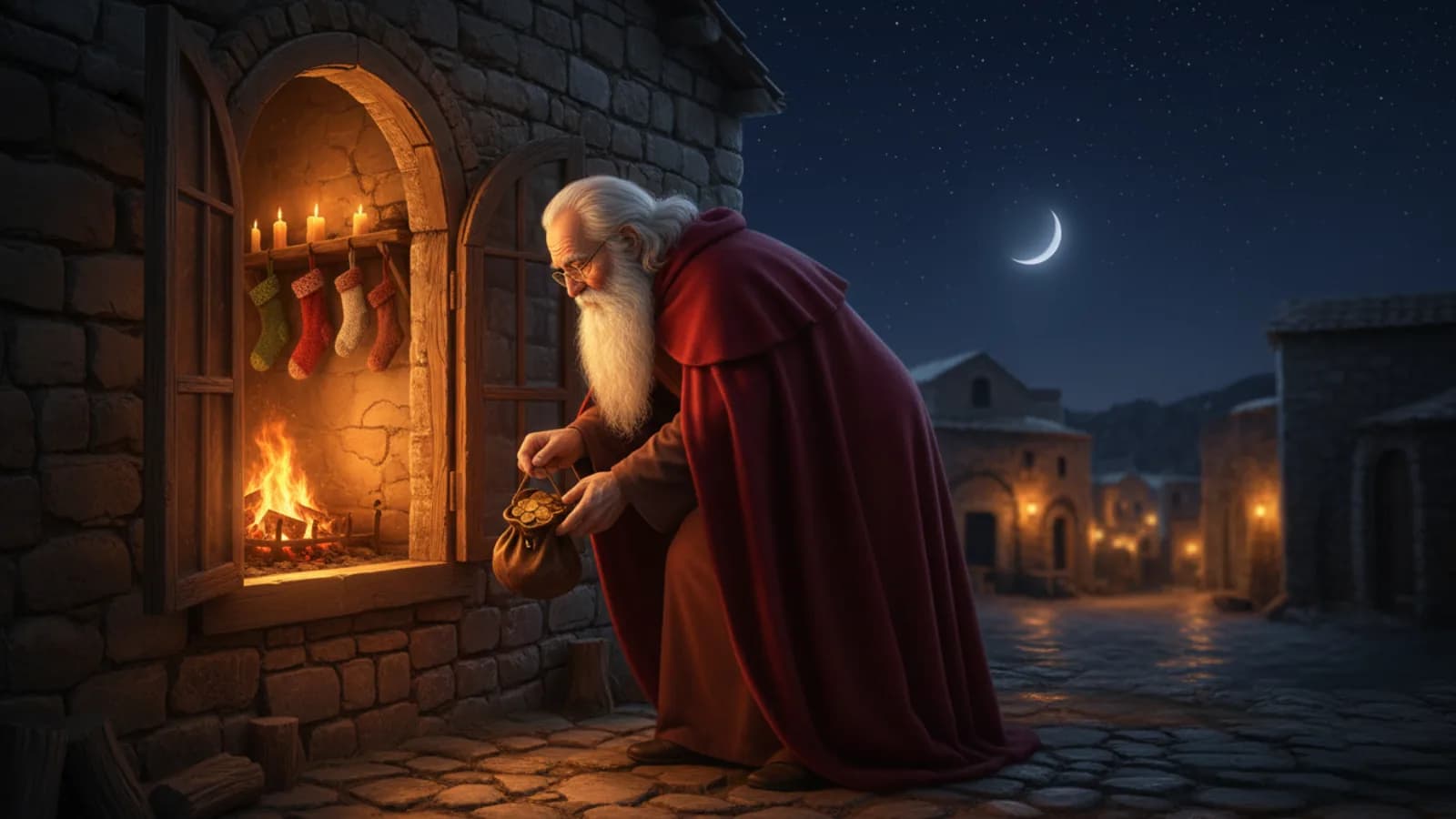
On Tuesday, December 23, 1823, readers of the Sentinel, a newspaper in Troy, New York, found a fifty-six-line poem with no author's name. It opened with “'Twas the night before Christmas,” described the midnight visit of a small, round man and ended with a good-night wish. Two centuries later it ranks among the best-known poems ever written by an American.
Its history reads like a detective story. The text passed from hand to hand before it reached the printer, waited fourteen years for an author's name, and that name is still argued over by professors armed with statistical software. We reopened the file, document by document. For the full story of Santa from Myra to New York, see the true story of Santa Claus.
How did the poem end up in a Troy newspaper?
According to the account handed down by the Moore family and retold by Columbia Magazine, it began on Christmas Eve 1822 in a large Manhattan house called Chelsea House. Clement Clarke Moore, a professor of Greek and Hebrew, read aloud a poem he had written for his six children. He had no plans to publish it.
Among the family's friends was Harriet Butler, visiting from Troy, a small city on the Hudson north of New York. She asked if she could copy the poem. About a year later it was in the hands of Orville L. Holley, editor of the Sentinel. By exactly what route? The sources disagree. An 1844 letter from the publisher Norman Tuttle to Moore says Holley got it from Mrs. Sackett, the wife of Daniel Sackett. Troy local historian Carl Johnson leaves both trails open, Harriet Butler or Sarah Sackett.
The paper ran it on December 23, 1823, as “Account of a Visit from St. Nicholas,” unsigned. In Troy, a plaque at 225 River Street now marks where the newspaper had its offices. Holley kept the secret himself. Only on January 20, 1829, did he hint at the author, calling him a gentleman “of more merit as a scholar and a writer than many of more noisy pretensions.”
The poem did not wait for its author. Other papers reprinted it year after year, often just before Christmas. It traveled without a name, like a folk song, and every reader who clipped it from a newspaper helped set one specific evening in American homes: the night of December 24.

Who was Clement Clarke Moore?
Clement Clarke Moore was born in 1779 and died in 1863. His father, Benjamin Moore, was president of Columbia College and Episcopal bishop of New York. The son graduated first in his class at Columbia, produced the first Hebrew lexicon in the United States and sat on the university's board of trustees for forty-four years. In 1822 he had just been appointed professor of Greek and Hebrew literature at the General Theological Seminary.
Columbia Magazine describes the family estate: about thirty acres on Manhattan's west side, named Chelsea by his English-born grandfather. The three-story house stood where West 23rd Street meets Ninth Avenue today. Part of that land is now Clement Clarke Moore Park, at West 22nd Street and Tenth Avenue.
Moore said he modeled his visitor on “a portly, rubicund Dutchman” from the neighborhood, possibly his gardener. He also knew Washington Irving, whose History of New York, published in 1809 and reprinted in 1821, describes a pipe-smoking Dutch Saint Nicholas. The little man in the poem, pipe clenched in his teeth and belly shaking, owes a good deal to that portrait.
Why did he wait until 1844 to put his name on it?
Moore's name first appears in 1837. That year Charles Fenno Hoffman published The New-York Book of Poetry with George Dearborn, and the poem appears on pages 217 to 219, credited to “Clement C. Moore.” Moore did not include it in a book of his own until his Poems of 1844, from Bartlett and Welford. In a letter that year he explained that he had written it “not for publication, but to amuse my children,” and claimed it as his “literary property, however small the intrinsic value of that property may be.” A seminary professor who published scholarly works was plainly in no hurry to be known first for a nursery rhyme.
Who really wrote 'Twas the Night Before Christmas?
Another family has said for more than 150 years that the poem belongs to its ancestor. Henry Livingston Jr. was born on October 13, 1748, in Poughkeepsie on the Hudson, and died there on February 29, 1828. A major in the American expedition against Canada in 1775, he later farmed and wrote light verse, published unsigned or over the single initial “R.” in New York Magazine and the Poughkeepsie Journal. He never claimed the poem, and no known printing carries his name.
The Livingston case rests on memories. His sons Charles and Edwin, and a neighbor named Eliza, later recalled their father reading them the poem as his own as early as 1807. The family says it once owned a manuscript in his hand, full of crossings-out. It is said to have burned in a house fire in Wisconsin.
- 1807According to his children's recollections, Henry Livingston Jr. reads the poem to the family.
- 1823The Troy Sentinel prints the poem without an author's name on December 23.
- 1828Livingston dies. His sons say they find a newspaper clipping and a marked-up draft in his desk.
- 1837Charles Fenno Hoffman credits the poem to Clement C. Moore in The New-York Book of Poetry.
- 1844Moore publishes the poem in his collection Poems.
- 1859The Livingston family learns of Moore's claim. Edwin says the manuscript was lost in a fire.
- 1899A grandson of Sidney Livingston makes the first public claim in his Long Island newspaper.
- 1920The Christian Science Monitor runs an article on the Livingston case on August 4.
In 1999, Mary Van Deusen, a Livingston descendant, brought in Donald Foster, a Vassar College English professor known for identifying anonymous authors. His book Author Unknown, published by Henry Holt in 2000, came down on Livingston's side. His arguments: the galloping anapestic meter Livingston often used, an unusual use of the word “all,” Dutch reindeer names that suited a man of Dutch descent, and a Moore said to hate tobacco, who would never have put a pipe in his hero's mouth.
The pushback came quickly. The historian Stephen Nissenbaum, author of The Battle for Christmas, concluded in 2001 that Moore wrote it: “I believe he did.” He placed the poem in the circle of John Pintard and the New York gentlemen then building themselves a Dutch past. The manuscript dealer Seth Kaller and the researcher Scott Norsworthy also published detailed rebuttals.
In 2016, MacDonald P. Jackson, a former professor at the University of Auckland in New Zealand, published a computational stylistics study with McFarland. His tests placed Moore's known poems with Moore, and the Christmas poem “consistently” closer to Livingston's verse. In 2023, Tom A. Jerman reached the opposite verdict: of seventeen tests run with authorship attribution software, sixteen pointed to Moore. The debate is still open, and each side has its numbers.
Why were the reindeer called Dunder and Blixem?
In the 1823 Sentinel, the eight reindeer are called in this order: Dasher, Dancer, Prancer, Vixen, Comet, Cupid, Dunder and Blixem. The last two names are not English. “Donder en Blixem” is Dutch for “thunder and lightning,” a familiar exclamation in the Dutch families of New York State.
Now! Dasher, now! Dancer, now! Prancer, and Vixen, / On! Comet, on! Cupid, on! Dunder and Blixem;
The names kept shifting. One theory, reported by Mental Floss, holds that Blixem became Blixen to rhyme with Vixen, then Blitzen under Moore's pen in 1844. The copies Moore wrote out by hand late in life read “Donder and Blitzen.” Edmund Clarence Stedman's An American Anthology also used that form in 1900. In the early twentieth century, Donder often became Donner.
These eight were not the first reindeer. Two years earlier, in 1821, a New York booklet had already shown a single reindeer pulling the sleigh of “Sante Claus.” The 1823 poem added seven more and gave each one a name. We trace that family tree in where did Santa's reindeer come from, and the full team, with Rudolph, in what are Santa's reindeer names.
What did the poem change about Santa Claus?
Before 1823, New York's gift-bringer had no fixed date. Saint Nicholas traditionally came on December 6, his feast day. The 1821 booklet had already mentioned Christmas Eve. The poem, with its very first line, carved that date into the memory of everyone who learned it by heart: “'Twas the night before Christmas.”
The text also set out a precise sequence, almost a checklist, that has barely changed since. Read it again and you will find:
- stockings “hung by the chimney with care,” in hopes that he would soon be there;
- children asleep and dreaming of sugar-plums, and parents just settled down for the night;
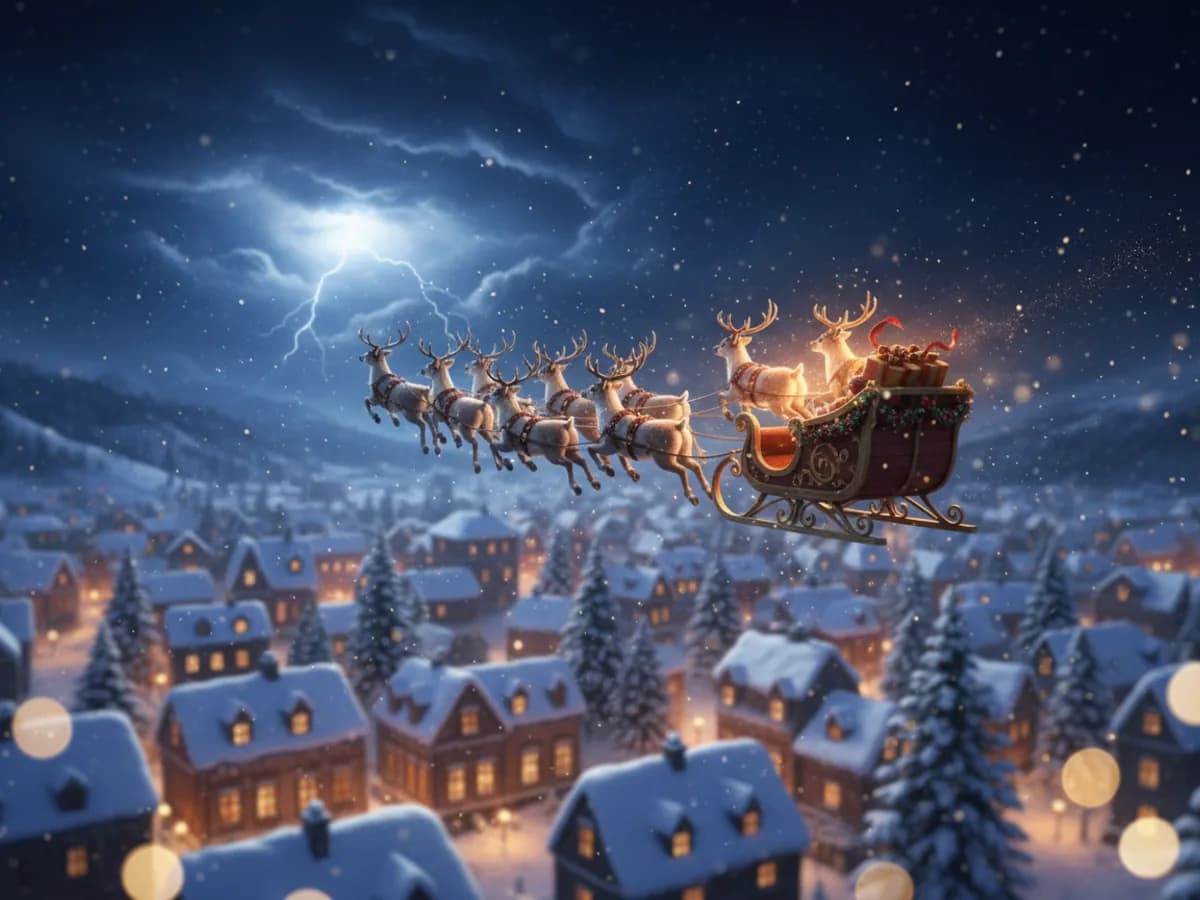
- a miniature sleigh and eight tiny reindeer landing on the roof;
- a trip down the chimney in a single bound;
- a bundle of toys, stockings filled in silence, and a finger laid beside the nose to rise back up;
- a takeoff into the air and a wish called out to everyone before he vanishes.
The chimney entrance deserves a file of its own, with roots in old beliefs about the hearth: we opened it in why does Santa come down the chimney. The poem also made the narrator a wakeful parent, witness to a scene children never see. That is still the point of view of most Christmas stories.
Finally, it drew a tiny character. The visitor of 1823 is “a right jolly old elf,” small enough to fit a miniature sleigh. It took Thomas Nast's engravings, from 1863 on, to give him a man's height. We look at that question in Is Santa Claus an Elf? The Story Behind a Word From 1823, which has a section on whether Santa is an elf.
How did the poem become a Christmas Eve ritual?
Pictures carried it. In 1855, Moore's daughter Mary C. Ogden drew Chelsea House for an illustrated edition. Around 1862, the New York publisher J. G. Gregory issued a version illustrated by F. O. C. Darley, a copy of which the Library of Congress keeps in its rare book collection. In 1912 Jessie Willcox Smith illustrated an edition you can still read free on Project Gutenberg. In 1931 it was the turn of Arthur Rackham, the English illustrator of fairy tales.
During the Great Depression, in 1934, the artist Helmuth F. Thoms produced a series of illustrations for the poem under a Public Works Administration project, the New Deal's federal public works agency.
At Columbia, Moore's university, the annual Yule Log celebration has long included a reading of the poem. In millions of homes the scene plays out again every December 24, often at bedtime. Some parents follow it with a quick look at the Santa tracker to see where the sleigh has got to.
Has the poem been translated?
Many times. In French it circulates as “Une visite de saint Nicolas” or “La Nuit avant Noël,” and the first line becomes “C'était la nuit avant Noël.” Wikipedia lists around twenty versions in other languages, from German to Japanese. In 2013 the young composer Alma Deutscher even set the original text to her own melody.
Where can you see the manuscripts?
Late in life, Moore copied out his poem by hand for friends. Four handwritten copies are known. Three are in museums, including the New-York Historical Society, the learned society John Pintard founded in 1804. The fourth, signed in 1860 as a gift for a friend, sold in December 2006 for $280,000 through Heritage Auctions, to a media-company chief executive who was not named.
Sources
- Wikipedia, A Visit from St. Nicholas
- Wikipédia (French), Une visite de saint Nicolas
- Wikipedia, Henry Livingston Jr.
- Columbia Magazine, The Story Behind the Most Famous Christmas Poem of All
- Mental Floss, The Mysterious Origins of the World's Most Famous Christmas Poem
- University of Toronto Libraries, Representative Poetry Online, Account of a Visit from St. Nicholas (Troy Sentinel, 1823)
- Hoxsie! (Carl Johnson, Troy local history), A Visit from St. Nicholas, 2022
- Library of Congress, Read.gov, A Visit From Saint Nicholas, illustrated by F. O. C. Darley, c. 1862
- Project Gutenberg, 'Twas the Night before Christmas, illustrated by Jessie Willcox Smith