On December 6, 343, tradition says, a bishop named Nicholas died in Myra, in Asia Minor. Fifteen centuries later, a New York illustrator sent him by sleigh into a Union army camp. In between come sailors from Bari, a relic carried off to Lorraine, Manhattan gentlemen in love with their Dutch past and a poem printed without a byline in an upstate newspaper.
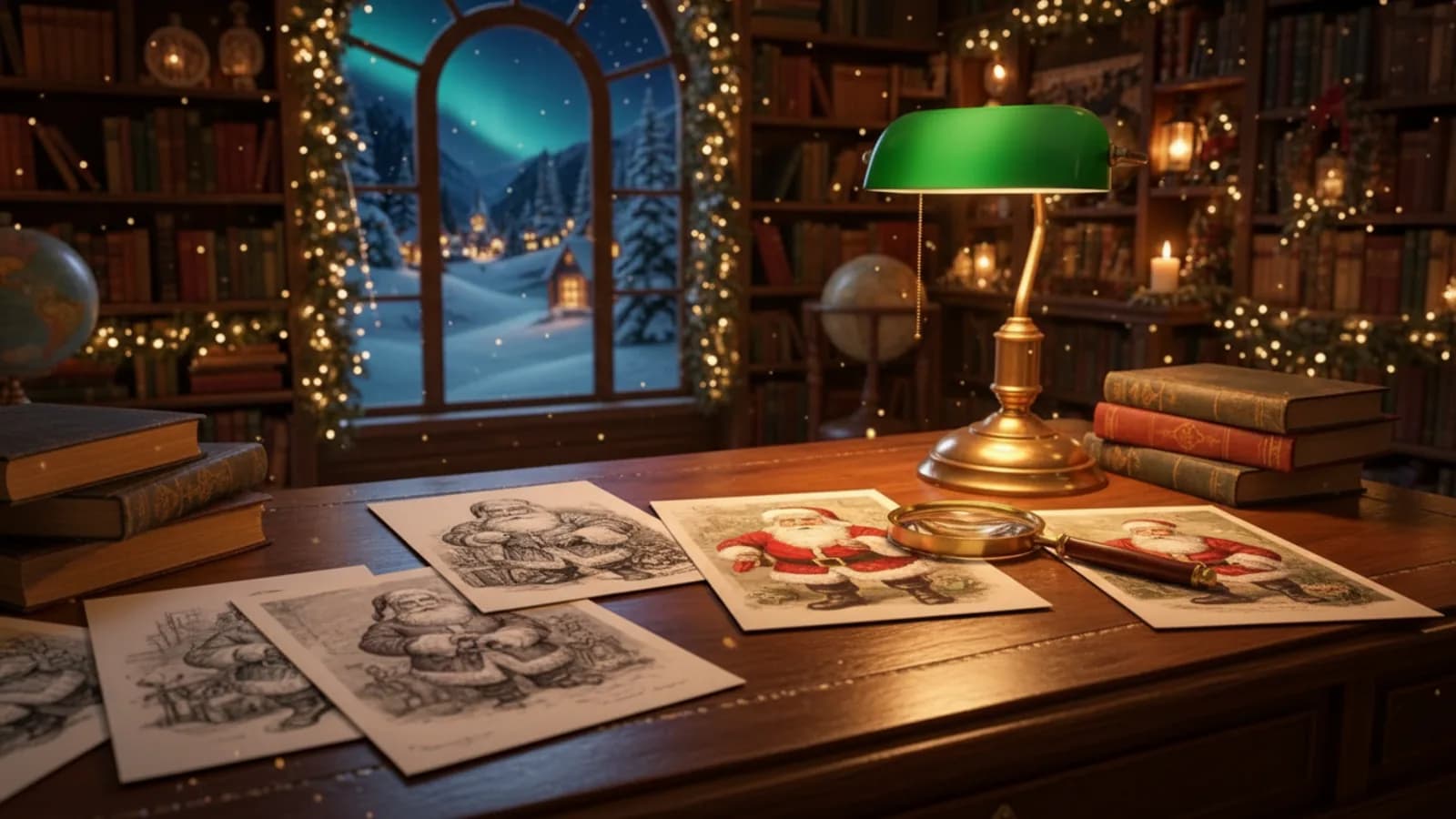
Santa Claus was not invented one morning. He was built up in layers, and each layer left a dated trace: a society ledger, a woodcut, a page of newsprint. Our archivists have gathered those traces here, in the order they appeared.
Who was the real Saint Nicholas?
Nicholas was born around 270, according to tradition, in Patara, a village in Asia Minor on what is now the southern coast of Turkey. He became bishop of Myra while still a young man. The St. Nicholas Center, which has spent years collecting the sources on him, reports that he attended the Council of Nicaea in 325 and died in Myra on December 6, 343. No exact birth date survives.
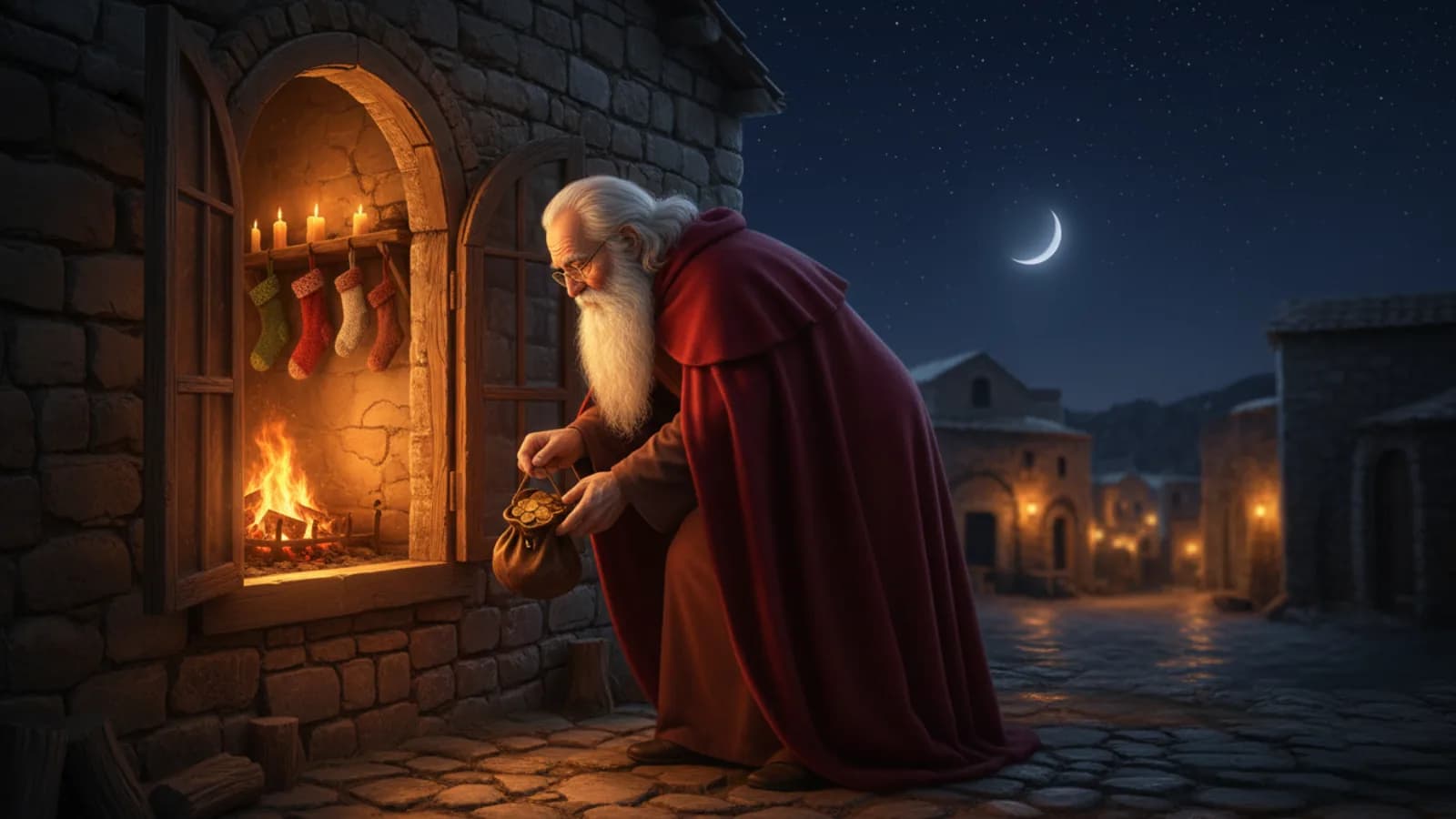
His reputation rests on stories of quiet generosity. The best known involves a ruined father who cannot pay dowries for his three daughters. Three times, gold lands in the house, and tradition says it fell into stockings or shoes left by the fire. That story is where the custom of hanging a stocking by the chimney comes from.
Nicholas became the protector of children, then of sailors. In the spring of 1087, sailors from Bari carried his bones from Myra to their port in southern Italy, where they still rest. A finger bone later reached Saint-Nicolas-de-Port in Lorraine, in eastern France, and the saint became patron of the whole region.
That is where December 6 comes from: the day he died became his feast day. For centuries in Europe, that was the morning children found treats in their shoes. The move to the night of December 24 came much later, and it happened on the other side of the Atlantic.

How did Saint Nicholas become Santa Claus in New York?
The American name was born in New York, the former New Amsterdam handed to the English in 1664. The etymology site Wordorigins explains that Santa Claus is a dialect form of the Dutch Sint Klaas, with “Sante” for saint in the local Dutch of early New York and Klaas as a pet form of Nicholas. The earliest known printed use dates from December 20, 1773, when the New York Gazette and Weekly Mercury reported that the anniversary of “St. Nicholas, otherwise called St. A Claus” had been celebrated.
In the early 1800s, a few New York gentlemen turned Saint Nicholas into a civic emblem. John Pintard founded the New-York Historical Society in 1804 and chose Nicholas as its patron. Washington Irving, who joined the society, published his History of New York on December 6, 1809, recasting Nicholas as a Dutch burgher with a clay pipe, nothing like a bishop in a miter.
- 1773First known printed mention of “St. A Claus” in a New York newspaper.
- 1804John Pintard founds the New-York Historical Society and chooses Saint Nicholas as its patron.
- 1809Washington Irving publishes his History of New York, with a pipe-smoking Nicholas.
- 1810Pintard commissions engraver Alexander Anderson for the first American image of the saint, with stockings hung at the fireplace.
- 1821The booklet The Children's Friend shows “Sante Claus” arriving from the North in a sleigh pulled by a reindeer, on Christmas Eve.
The 1821 booklet changed one essential thing: the visit no longer happened on December 6 but on the night before Christmas. It was also the first time a reindeer pulled the sleigh. The character now had a name, a date and a way to travel.
The St. Nicholas Center also notes, in that same year of 1821, a publication by New York publisher William B. Gilley titled Sancte Claus. The spelling still wavered between “Sante” and “Sancte,” but the idea was in place: a visitor from the cold, awaited by children, who rewards the good ones. All he lacked was a clear portrait.
Who gave Santa his sleigh and eight reindeer?
On December 23, 1823, the Troy Sentinel, a newspaper in upstate New York edited by Orville L. Holley, printed an unsigned poem called “Account of a Visit from St. Nicholas.” Clement Clarke Moore, a New York professor, was named as its author in 1837 and claimed it by including it in his collected poems in 1844. Some researchers credit Henry Livingston Jr. instead, but there is no proof Livingston ever claimed it himself.
The poem settled almost everything: Christmas Eve, the trip down the chimney, the miniature sleigh, eight reindeer called by name. In the 1823 version, the last two were Dunder and Blixem, Dutch for thunder and lightning. They later became Donder and Blitzen.
He was chubby and plump, a right jolly old elf, / And I laughed when I saw him, in spite of myself.
The visitor the narrator describes is small, dressed all in fur from his head to his foot, smudged with ashes and soot, with a pipe stump in his teeth and a round belly that shakes when he laughs. The poem never mentions the color of his clothes. It ends with the line millions of children still recite: “Happy Christmas to all, and to all a good-night.” You will find more of the season's classics on our Christmas songs page.
Success came fast. By 1824 the text had been reprinted in four almanacs, a year after it ran in Troy. It was then illustrated again and again, by T. C. Boyd in 1848 and by F. O. C. Darley in 1862. Each new edition filled in a visual detail the poem had left open.
How did Thomas Nast draw the modern Santa Claus?
Thomas Nast arrived in New York in 1846, at about six years old. He joined Harper's Weekly in 1862, in the middle of the Civil War. On January 3, 1863, the magazine's cover showed his first Santa: “Santa Claus in Camp.” The old man rides his sleigh into a Union camp and hands out gifts to soldiers. He wears a star-covered jacket and striped trousers, the colors of the flag.
The same issue carried a second, quieter engraving: a Christmas Eve scene with a woman and child at home, set against the husband and father out on the battlefield. At the end of 1865, with the war over, Santa came back with holly on his cap, wishing readers “Merry Christmas to all.”
The Massachusetts Historical Society counts 33 Christmas images by Nast for Harper's Weekly between 1863 and 1886. In 1866 he showed Santa in his workshop, getting the toys ready. The Delaware Art Museum, which holds a Nast collection, notes that his engravings are the first known references to Santa living at the North Pole. Abraham Lincoln called Nast “our best recruiting sergeant.”
On January 1, 1881, “Merry Old Santa Claus” appeared: a round, bearded Santa, pipe in mouth, arms full of toys. Every illustrator after him started from that image. One detail matters: Harper's Weekly was printed in black and white. Nast fixed the silhouette, not the color of the suit, a question we take up in Why does Santa wear red?.

How did the American Santa land in France?
In France, Saint Nicholas never went away. He still comes mostly to the east and north, to Alsace, Lorraine and Nord-Pas-de-Calais, around December 6. A little donkey carries the baskets of treats. Behind them walks Père Fouettard, the wicked butcher of the legend of three children the saint brought back to life. In Saint-Nicolas-de-Port, thousands of pilgrims follow the procession every year, and in Nancy the legend is projected onto the façade of city hall.
The Père Noël of magazines and shop windows, much closer to the American Santa, spread mainly after the Second World War. Not everyone welcomed him. On December 23, 1951, in front of Saint-Bénigne Cathedral in Dijon, an effigy of Father Christmas about three meters tall was burned before 250 children. Part of the clergy accused him of “paganizing” Christmas. The next day the city's mayor, Canon Kir, had a Père Noël appear on the rooftops of city hall.
The anthropologist Claude Lévi-Strauss turned the affair into an essay, “Le Père Noël supplicié” (Father Christmas Executed), published in 1952 in the review Les Temps modernes. He tied the character's rapid spread in France to American influence after the war.
Ten years later, in 1962, French postal minister Jacques Marette set up a service to answer children's letters. The very first official reply was written by his sister, the psychoanalyst Françoise Dolto. Letters are now handled in Libourne, in the Gironde, and children anywhere can still write to Santa.
Is Santa Claus a true story?
The man at the root of the story was real. Nicholas of Myra lived in the fourth century, sat at Nicaea in 325, and his relics have been in Bari since 1087. The rest was added over the centuries: the name in New York in 1773, Christmas Eve and the reindeer in 1821, the eight reindeer and the chimney in 1823, the North Pole and the workshop with Nast in the 1860s.
Who created Santa Claus?
No single person. Pintard picked the saint, Irving made him familiar, the author of the 1823 poem gave him reindeer and Nast drew his face. Twentieth-century advertisers, Coca-Cola included, then borrowed an image that was already set. We go through that last point in Did Coca-Cola invent Santa Claus?.
Is Santa based on Jesus?
No. Christmas celebrates the birth of Jesus, but Santa descends from someone else: Saint Nicholas, a bishop. His visit simply slid from December 6 to December 24, as the 1821 booklet shows. To follow his route on the night, open the Santa tracker, and for his own telling of the story, read Santa's story.
Sources
- St. Nicholas Center, Who is St. Nicholas?
- St. Nicholas Center, Origin of Santa Claus
- St. Nicholas Center, France customs
- Wordorigins.org, Santa Claus
- Wikipedia, A Visit from St. Nicholas
- Project Gutenberg, 'Twas the Night before Christmas: A Visit from St. Nicholas
- Massachusetts Historical Society, Santa Claus in Camp, Object of the Month, December 2020
- American Battlefield Trust, The Man Behind Merry Old Santa Claus
- Delaware Art Museum, Thomas Nast and the Making of the American Santa Claus
- macommune.info (AFP), Il y a 70 ans, le clergé brûlait le Père Noël à Dijon
- Bernard Quaritch, Lévi-Strauss, Le Père Noël supplicié, 1952
- The Connexion, Letters from Santa a French idea, 2017