In a fourth-century Roman almanac, in the middle of a list of martyrs and bishops, one line simply reads: “VIII kal. Ian. natus Christus in Betleem Iudeae.” Eight days before the calends of January, which is December 25: Christ born in Bethlehem of Judea. It is the oldest document that puts the feast on that date.
The rest arrived in stages: royal coronations, a living nativity in an Italian cave, a ban in England and in Massachusetts, fir trees cut in the forests of Alsace, a Dickens story printed in 6,000 copies and sold out before Christmas. Here are those stages, with what the sources let us say and what they leave open.
When was Christmas first celebrated?
The first Christians did not celebrate the birth of Jesus. Their great feast was Easter. The Gospels give no birth date, and for close to three centuries nobody seems to have marked Christ's birthday on a fixed day.
The first dated evidence is in the Chronography of 354, an illustrated compilation whose calligrapher, Furius Dionysius Filocalus, signed the dedication page. One section lists the days on which martyrs were commemorated. Its very first line gives the birth of Christ on December 25. Liturgical historians generally agree that this section was written in Rome in the year 336.
The same volume contains a pagan civil calendar. Under December 25 it reads “N·INVICTI·CM·XXX”: the birthday of the Unconquered, with games and thirty chariot races. It is the oldest literary reference to the feast of the Unconquered Sun. So the two celebrations sit side by side in one manuscript.
Why is Christmas on December 25?
Before December 25, other dates were in circulation. Around the year 200, Clement of Alexandria reported that some placed the birth on the 25th of the Egyptian month of Pachon, which is May 20, and others on the 24th or 25th of Pharmuthi, April 20 or 21. He does not mention December 25. Historian Andrew McGowan walks through these early guesses in an article for the Biblical Archaeology Society.
One old explanation runs through arithmetic. Around the same time, Tertullian stated that the 14th of Nisan, the traditional day of the crucifixion, matched March 25 in the Roman solar calendar. A belief held that Jesus had been conceived and had died on the same day of the year. March 25 became the Feast of the Annunciation; count nine months forward and you reach December 25.
In the East, the date first chosen was January 6. By the fourth century the two coexisted: December 25 in the West, January 6 in the East. January 6 later became Epiphany, which marks the arrival of the Magi in Bethlehem. The Armenian Church still celebrates Christmas on January 6.
None of these explanations is backed by a text that says, “We chose December 25 because.” Historians weigh clues. That is why two theories still stand side by side, the calculation theory and the borrowing from pagan feasts.
Is Christmas a pagan holiday? Saturnalia and the Unconquered Sun
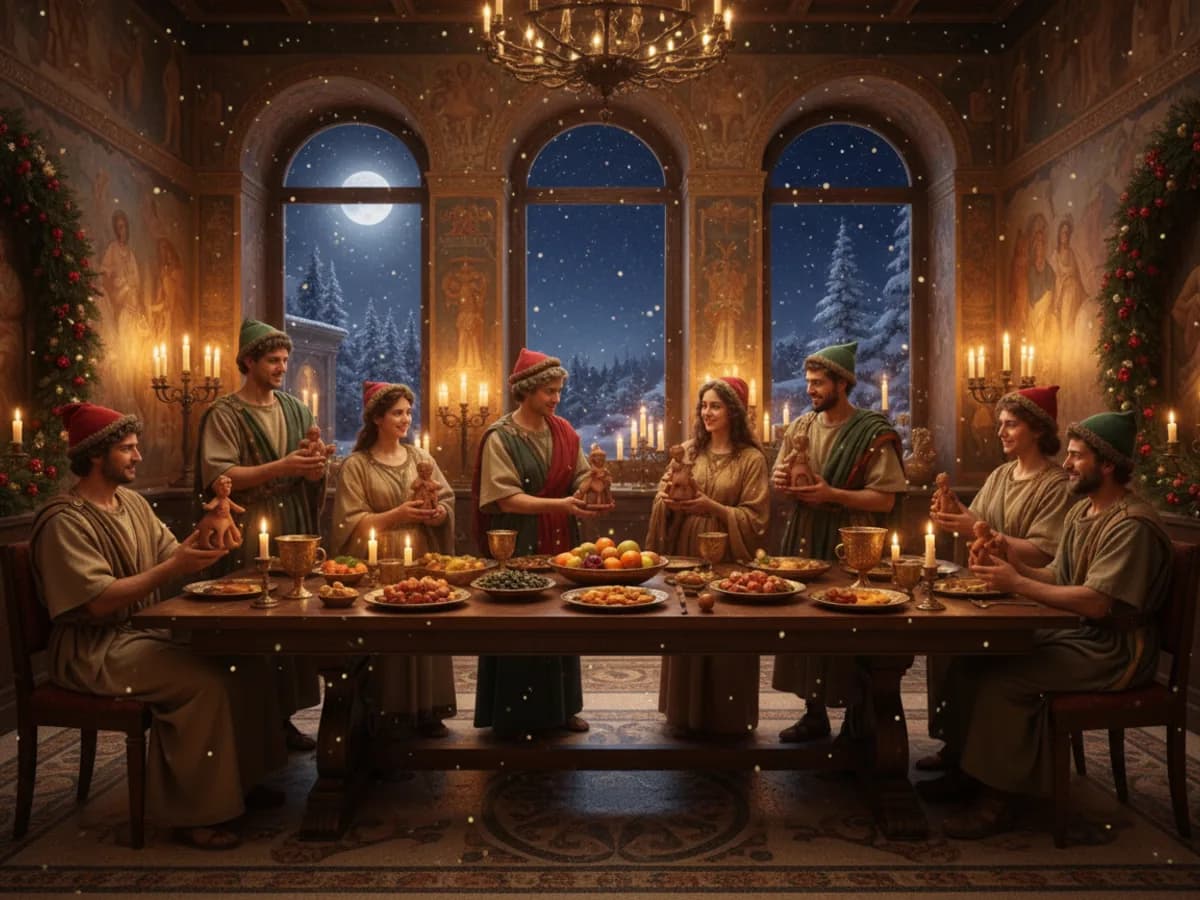
Saturnalia opened on December 17 in the Roman calendar. The festival grew until it lasted seven days, through December 23. Gifts were exchanged on the Sigillaria, December 19: candles, little wax or pottery figurines, joke presents. Enslaved people were invited to the banquet, everyone wore the pileus, the felt cap of freed slaves, and people greeted each other with a shout of “Io Saturnalia.”
The second festival sits even closer. In 274, Emperor Aurelian established a cult of the Unconquered Sun, Sol Invictus, whose birth was celebrated on December 25. As we saw, the Chronography of 354 records it. The idea that Christians put Christmas on that date to replace it is an attractive one.
Andrew McGowan points out its weak spots: no early Christian writer mentions such a borrowing, and December 25 appears before the period when the Church openly adopted pagan customs. As for Saturnalia, most specialists speak of influence rather than origin. The gifts of December 19 look like ours, and the mock king elected during Saturnalia recalls the Lord of Misrule of medieval English Christmases.
Io Saturnalia!
What was Christmas like in the Middle Ages?
In the Middle Ages, Christmas became a political date. Charlemagne was crowned emperor on Christmas Day in the year 800. William the Conqueror was crowned king of England on Christmas Day 1066. Choosing that day placed a reign under the sign of the Nativity.
The celebration stretched out. Around the twelfth century, the festivities spread over the twelve days from December 25 to January 5, the Twelve Days of Christmas of the English carol. Excess was part of it: gambling, drinking, role reversals, sometimes with a Lord of Misrule appointed to preside over the chaos. That side of the holiday is what the Puritans would later attack.
The manger scene was born in the same era. At Christmas 1223, Francis of Assisi staged the Nativity with living people in a cave near Greccio, in central Italy. Saint Bonaventure told the story around 1260 in his Life of Saint Francis. The ox and the donkey, which appear in no Gospel, come from a much older tradition: Origen of Alexandria is the first Christian writer to place them in the stable.
In Provence, nativity scenes later filled with hand-painted clay figures called santons. Seasonal customs from around the world, from the crèche to the Christmas table, are gathered on our Christmas traditions page.
Was Christmas really banned?
Yes, at least twice, and by Christians. The Puritans distrusted a holiday tied to the excesses of the twelve days. In 1647, England's Puritan rulers banned Christmas. Riots broke out in its defense, and half-hidden church services carried on for as long as the ban lasted.
Across the Atlantic, the Massachusetts Bay Colony did the same. On May 11, 1659, its General Court passed a law fining anyone five shillings for “observing any such day as Christmas,” whether by not working, by feasting or in any other way. The law was repealed in 1681 under pressure from London. As late as 1687, the minister Increase Mather still called Christmas a “profane and superstitious” custom.
- 1647England's Puritan Parliament bans Christmas.
- 1659Massachusetts fines anyone who keeps Christmas five shillings.
- 1681The Massachusetts law is repealed.
- 1856Massachusetts makes Christmas a legal holiday.
- 1870On June 28, Christmas becomes a federal holiday in the United States.
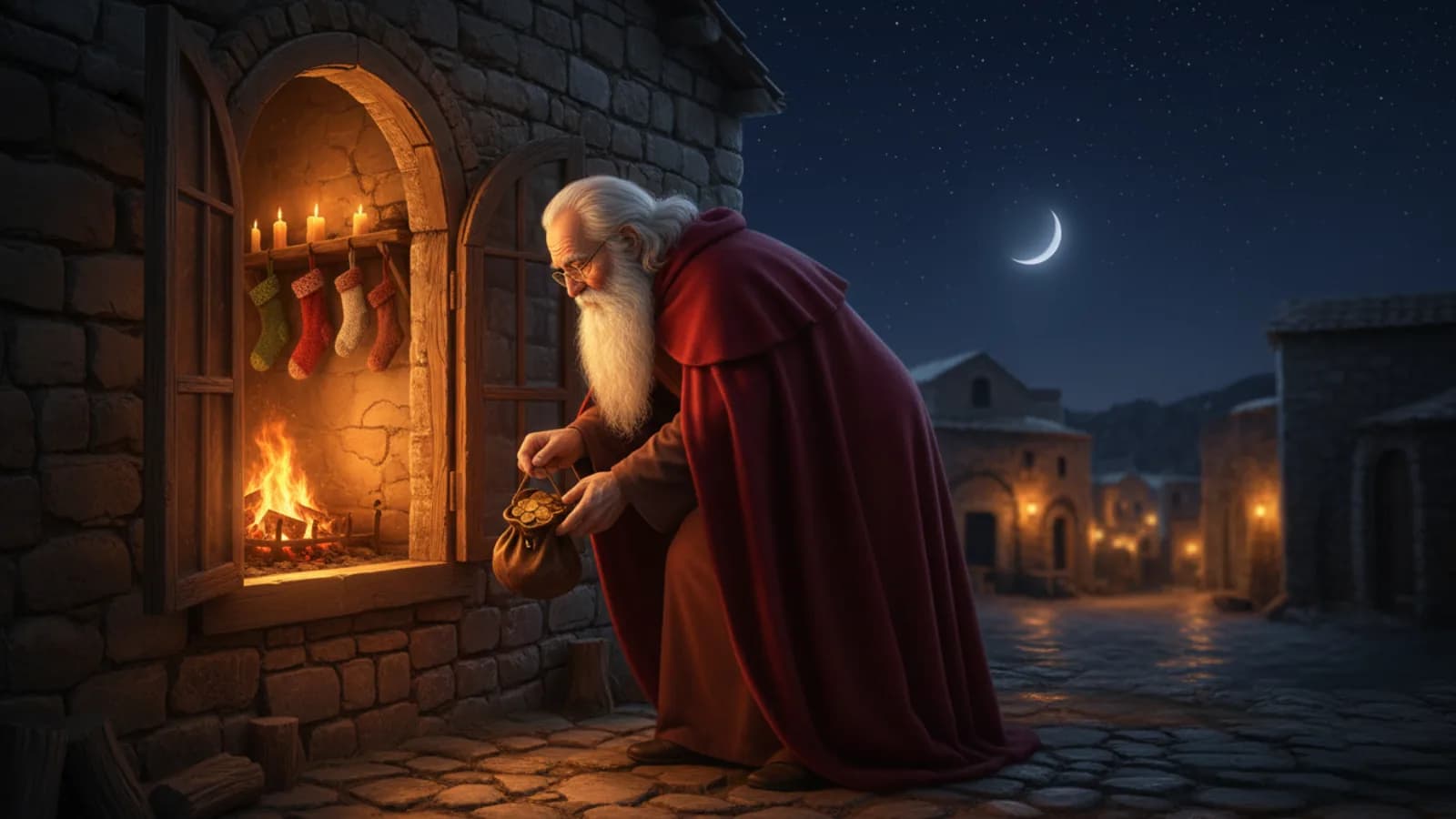
Repeal did not change habits overnight. In Boston, many people kept going to work and school on December 25. Massachusetts made Christmas a legal holiday only in 1856, and it became a holiday across the United States on June 28, 1870. In the meantime, in New York, an 1823 poem had already settled Santa Claus into the night of the 24th, as we tell in The true story of Santa Claus.
Where did the Christmas tree come from?
The tree has several ancestors. In the Middle Ages, mystery plays staged on December 24, the feast day of Adam and Eve, used a paradise tree hung with apples, for the forbidden fruit, and round white wafers. In Livonia, the Brotherhood of Blackheads set up trees in its guild houses in Reval, today's Tallinn, and in Riga in 1441, 1442, 1510 and 1514, then danced around them in the town hall square.
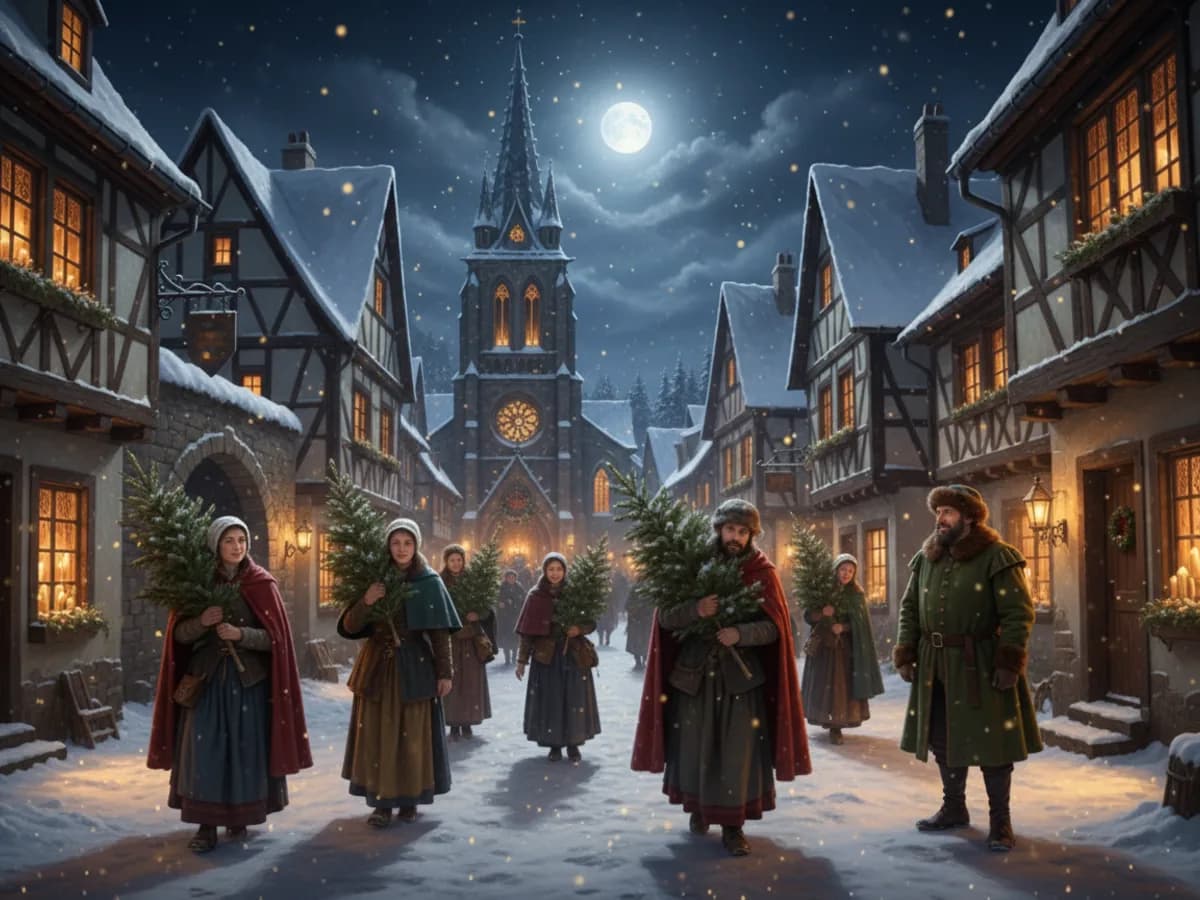
Alsace, now in eastern France, holds the oldest traces of a Christmas tree in our sense of the word. According to the City of Paris, the first written mention of the fir as a “Christmas tree” is in an account book from Sélestat, dated 1521. The entry concerns the forest wardens, paid to watch over the town's fir trees ahead of the holiday. In Turckheim, a carved keystone on a private house, dated 1576, is the oldest firmly dated image of a Christmas tree.
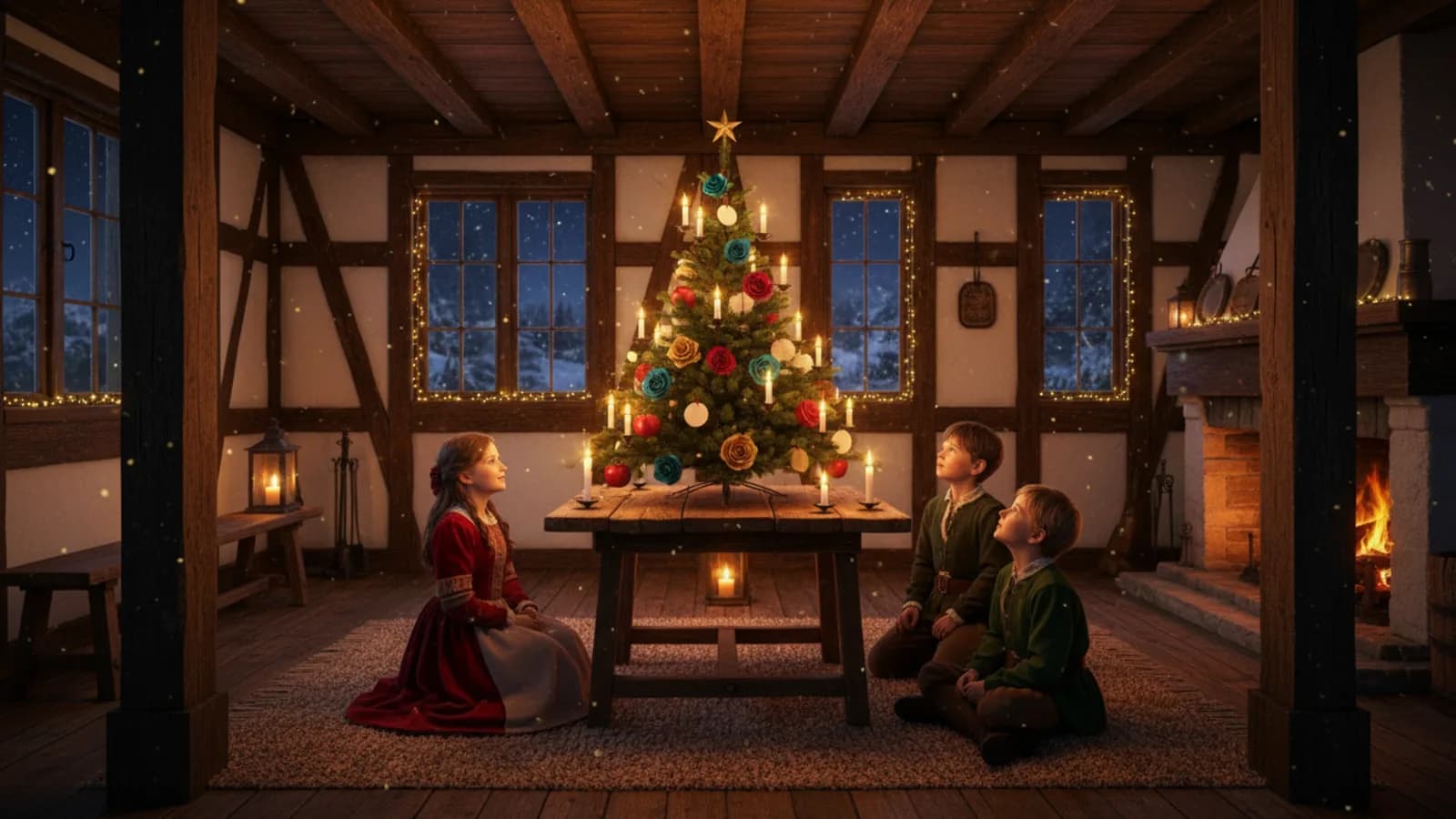
In 1605, a source from Strasbourg describes the fir trees that townspeople set up at home for Christmas. They hung them with roses cut from colored paper, apples, flat wafers, gilded sweets and sugar figures. Apples stayed the main ornament for a long time. According to the City of Paris, a drought in the Vosges in 1858 led a glassblower from Goetzenbruck, in Moselle, to make red glass balls to replace them.
Royal courts adopted the tree later. In France, Marie Leszczynska, wife of Louis XV, had one set up at Versailles in 1738, and the German-born Duchess of Orléans, Helene of Mecklenburg-Schwerin, is said to have brought it to the court of Louis-Philippe in 1837. In England, it was another German-born queen who led the way.
How did Christmas become the family holiday we know?
The Christmas built around children, home and presents took shape in the nineteenth century, above all in England and the United States. Queen Charlotte, wife of George III and born in Germany, set up a tree for a children's party as early as 1800. But it was Queen Victoria and Prince Albert who turned it into a fashion.
In 1848, The Illustrated London News described the trees at Windsor Castle in detail and printed an engraving of the royal family gathered around one. At Christmas 1850, the American magazine Godey's Lady's Book ran the same engraving after removing the Queen's tiara and Albert's moustache: the royal family became an ordinary American family, gathered around its tree.
In between, on December 19, 1843, Charles Dickens published A Christmas Carol. The first printing of 6,000 copies sold out before Christmas, and a second printing of 2,000 followed at once. Dickens, who had paid for the costly production himself, made very little from it. The book helped revive the “spirit” of Christmas and its seasonal merriment.
All that was missing was the night visitor. He was taking shape in New York, between an 1821 booklet and the engravings of Thomas Nast. To meet him as he is today, you can write a letter to Santa or follow his route on the evening of the 24th with the Santa tracker.
Sources
- Wikipedia, Chronography of 354
- Wikipedia, Christmas
- Biblical Archaeology Society, Andrew McGowan, “How December 25 Became Christmas”
- Wikipedia, Saturnalia
- Wikipedia, Nativity scene (Greccio, 1223)
- Mass Moments, Mass Humanities, Christmas Celebration Outlawed, 1659
- Wikipedia, Christmas tree
- Wikipedia (French), Sapin de Noël
- City of Paris, “Petites et grandes histoires du sapin de Noël”
- Oxford University Press Blog, This Day in World History, A Christmas Carol, December 19, 1843