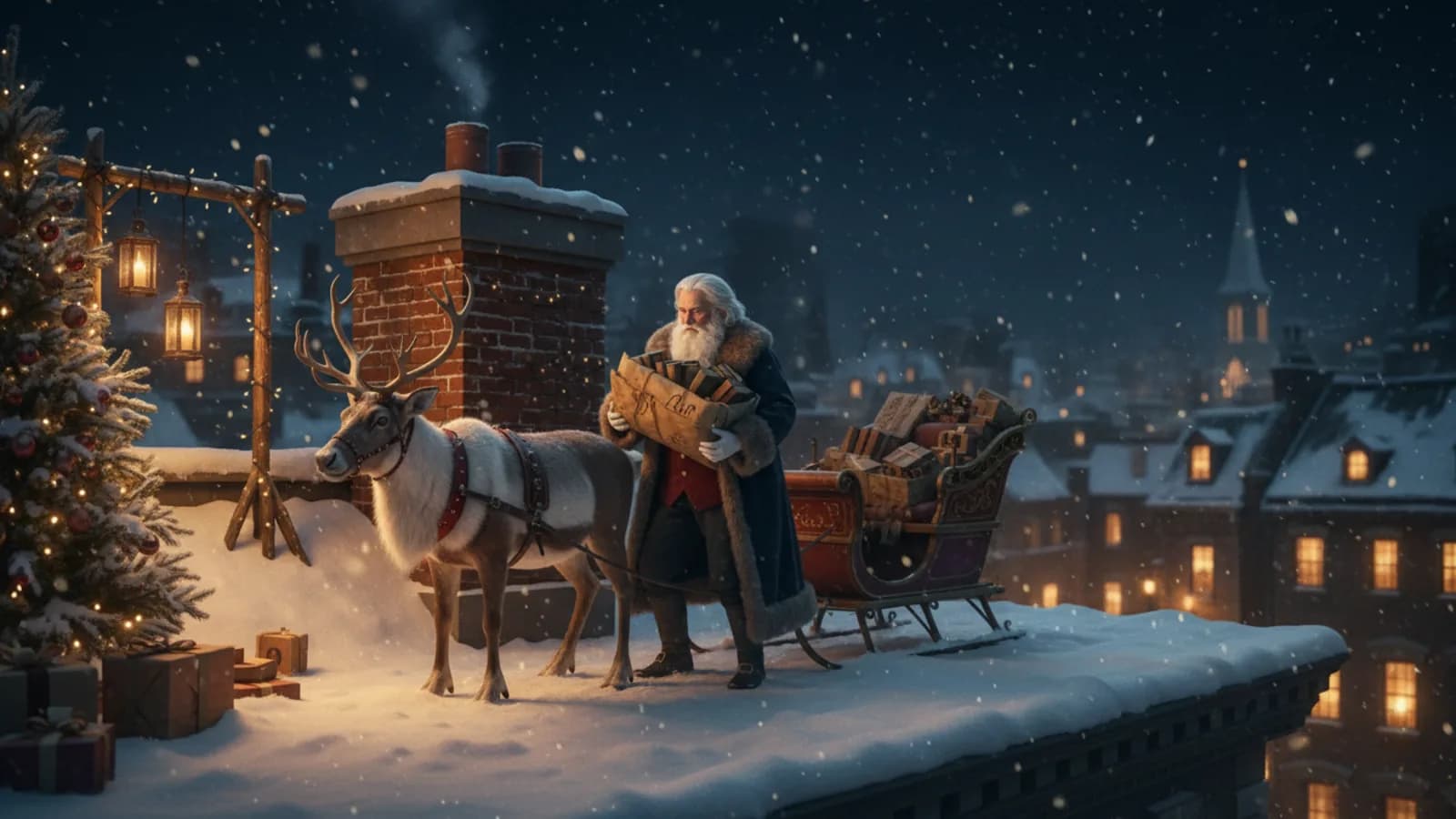
For fifteen centuries, Saint Nicholas traveled on foot, on horseback or on a donkey. Then, in 1821, a little booklet sold in New York showed him sitting in a sleigh pulled by a reindeer, above the rooftops. Nobody knows whose idea it was. Two years later, a poem gave him eight reindeer and their names, and the team never left him again.
The reindeer themselves are anything but imaginary. They have pulled sleds in Lapland for centuries, a Norwegian chieftain owned six hundred of them around 890, and Sámi herders drove several hundred all the way to Alaska in 1898. Our archivists have put those files back in order, from the first reindeer ever drawn to the most famous of them all.
When did a reindeer first appear with Santa Claus?
In 1821, the New York printer William B. Gilley published a small paperback called The Children's Friend: A New-Year's Present, to the Little Ones from Five to Twelve. It held an anonymous poem, known today by its first line, “Old Santeclaus with Much Delight,” and eight hand-colored engravings. It is the oldest known publication in which a reindeer pulls Santa's sleigh. Yale's Beinecke Library holds a copy.
Old SANTECLAUS with much delight / His reindeer drives this frosty night, / O'er chimney-tops, and tracks of snow
In the first engraving, a single unnamed reindeer pulls a sleigh with a sign on it that reads “REWARDS.” The old man brings presents to good children. For the others he leaves a birch rod, which the verse presents as a tool God himself approves for correcting the young. He is a long way from the easygoing figure we know now.
The booklet also moved the date. The visit no longer happens on December 6, Saint Nicholas Day, but on Christmas Eve. Neither the author nor the artist has ever been identified. The attribution scholar Don Foster has argued for Clement Clarke Moore's hand, but the idea is still disputed. We trace the birth of the character in the true story of Santa Claus.
How did Santa end up with eight reindeer?
On December 23, 1823, the Sentinel of Troy, New York, printed “A Visit from St. Nicholas” without a byline. It was credited to Clement Clarke Moore in 1837, and he claimed it in his Poems in 1844; others credit Henry Livingston. The narrator sees “a miniature sleigh, and eight tiny reindeer,” which then fly “up to the house-top” with the load of toys.
Now, Dasher! now, Dancer! now, Prancer and Vixen! / On, Comet! on, Cupid! on, Donder and Blitzen!
In the version printed in Troy, the last two reindeer are Dunder and Blixem, Dutch for “thunder” and “lightning,” a nod to New York's Dutch past. Moore renamed them Donder and Blitzen in his 1844 edition, to bring them closer to German. The spelling Donner only took over in the early twentieth century.
Eight did not become a fixed number overnight. In 1902, L. Frank Baum, the author of The Wonderful Wizard of Oz, published The Life and Adventures of Santa Claus with a team of ten reindeer, led by a pair named Flossie and Glossie. Still, the 1823 list is the one children learned by heart. We go through each name, and the versions used in other languages, in what are Santa's reindeer names.
Why reindeer and not horses?
Neither the 1821 booklet nor the 1823 poem explains the choice. What we do know is that the reindeer had long been the signature animal of the far North for European readers, and a visitor from the cold could hardly arrive by buggy. Two old documents show how far back that picture goes.
Around 890, a wealthy Norwegian named Ohthere, or Ottar, described his travels to King Alfred the Great in England. He lived farther north than any other Norwegian, in Hålogaland. He still had six hundred tame reindeer he had not sold, six of them prized “decoys” that the Sámi used to catch wild reindeer. Next to that, he owned only twenty cattle, twenty sheep and twenty pigs. His account, inserted into an English translation of the historian Orosius, contains the first appearance of the word reindeer in Old English, as hranas.
In 1673, Johannes Schefferus, a professor at Uppsala, published Lapponia in Frankfurt. The book was commissioned by the university's chancellor, Magnus De la Gardie, partly to quash a rumor: people in Europe said Sweden's military victories owed something to Sámi magic. Schefferus never went to Lapland. He relied on accounts from clergymen in northern Sweden and on Sámi objects in private collections.
The book came out in English at Oxford in 1674, in German in 1675, in French in 1678 and in Dutch in 1682. Among its 26 woodcuts is one of a man sitting in a sledge pulled by a reindeer. For generations of readers, that was Lapland: snow, a low sledge and a reindeer in harness.
Where does the word reindeer come from?
Reindeer is borrowed from the Scandinavian languages, such as Old Icelandic hreindýri or Swedish rendjur. The first element, rein, comes from a Germanic root of uncertain origin, probably tied to the antlers. The second, deer, originally meant any animal at all. After Ohthere's account, the word does not reappear in English until around 1440.

Who raises real reindeer? The Sámi herders of Lapland
The Sámi live in the north of Norway, Sweden and Finland and on Russia's Kola Peninsula. Nordregio, the research institute of the Nordic Council of Ministers, puts their number at 65,000 to 100,000: some 40,000 in Norway, 15,000 to 25,000 in Sweden, about 10,000 in Finland and about 2,000 in Russia. The figures are estimates, because none of these countries records ethnicity. Nordregio counts ten Sámi languages. Only some Sámi herd reindeer.
In Norway, herders work together in a siida, a group of reindeer owners who share the practical herding of an area. In 2006-2007 the country counted 556 siida units and 2,936 people in reindeer husbandry. Herding changed in the 1960s with what the International Centre for Reindeer Husbandry calls the snowmobile revolution, followed by ATVs, motorbikes and helicopters. Meat is the main product, alongside skins, bones and antlers.
- Norway: about 241,000 reindeer in 2007, a herd that hovers around 200,000 head.
- Sweden: about 220,000 reindeer in 2007, swinging between 150,000 and 300,000 over the twentieth century.
- Finland: about 207,000 reindeer in 2004-2005, after a peak above 250,000 in the 1970s and 1980s.
- Earmarks: every calf must carry its owner's registered mark by October 31 of its first year; in Sweden there are about 20 approved cuts, combined in some thirty ways, each with its own name.
In Norway, the Reindeer Husbandry Act of 2007 ties the right to own reindeer in the Sámi grazing area to an earmark, which requires being Sámi and having herding as the main occupation of oneself, a parent or a grandparent. In Sweden, the county administrative board sets a maximum herd for each Sámi village, but not for individual owners. Counts are made in spring, before the calves are born.
How did real reindeer get to America?
In Alaska, the word reindeer means only the domestic animals; their wild cousins, the same species, are called caribou. In 1891, the missionary Sheldon Jackson and William T. Lopp brought the first reindeer over from Siberia. The results disappointed, so Jackson turned to Lapland: he recruited herders through ads in Scandinavian newspapers, and a first group arrived in 1894.
- 1891Sheldon Jackson and William T. Lopp bring the first Siberian reindeer to Alaska.
- 1894A first group of Sámi herders arrives to train Alaska Native apprentices.
- 1898A government expedition brings more than 500 reindeer and their herders through New York and Seattle on the way to Alaska.
- 1900The contracts end: some herders stay, some join the gold rush, some go home to Lapland.
- 1926The Lomen Company and Macy's start Christmas parades with Santa Claus and real reindeer teams.
The 1898 expedition followed an act of December 18, 1897, that set aside $200,000, because Jackson feared famine among the Klondike gold seekers. The contract signed on January 24, 1898, promised two years of work, free medical care and schooling for the children. With wives and children, the party numbered 170 people: Sámi, Norwegians, Swedes and Finns.
By the 1920s, Alaska's herds had grown well past 100,000 head, and the Lomen brothers' company wanted to sell reindeer meat and fur across the country. In 1926 it teamed up with Macy's to stage Christmas parades in which Santas arrived on sleighs pulled by real reindeer, driven by Sámi and Alaska Native herders. The first parade Santa was Matthis Ivar Klementsen Nillika. Portland, St. Paul, Boston, Chicago and Brooklyn all got one, into the 1930s.
The Lomens also placed fake children's letters in newspapers, asking whether Santa would come with his reindeer. The International Centre for Reindeer Husbandry, which tells the story, credits Carl Lomen, known as “the Reindeer King,” with shaping the commercial version of Santa and his team. To send a real letter, with no sales pitch attached, use our letter page.
Where did Rudolph the Red-Nosed Reindeer come from?
Rudolph was born in a Chicago office. In 1939, the Montgomery Ward department store chain asked one of its copywriters, Robert L. May, Dartmouth class of 1926, for a Christmas booklet to give away to children. May picked a reindeer and made him an ugly duckling with a big heart. He later said he drew on his own childhood as a shy, small boy who was never picked first for teams.
He wrote the text in about fifty hours, in a terrible year: his wife Evelyn, who had cancer, died on July 28, 1939. Denver Gillen, an artist in the store's art department, went to the zoo with May and his daughter Barbara to study reindeer. Giveaways began on November 1, 1939, and 2.4 million copies went out that season. Wartime paper shortages held up a reprint until 1946, when 3.6 million more were handed out.
On January 1, 1947, Montgomery Ward signed the copyright over to May, who was in debt from his first wife's hospital bills. His brother-in-law, Johnny Marks, wrote a song in 1949. Gene Autry recorded it on June 27, 1949, Columbia released it in September and it reached No. 1 in the United States at Christmas 1949: 1.75 million records the first season, 12.5 million in all for his version.
On December 6, 1964, NBC aired a stop-motion special made by Videocraft International, the company later renamed Rankin/Bass, as part of The General Electric Fantasy Hour. Burl Ives narrates. It introduced Hermey, an elf who wants to be a dentist, and the Island of Misfit Toys. It has aired every year since 1964, the longest continuous run of any Christmas special on American television. Sing along on our Christmas songs page.
Are Santa's reindeer female?
The question comes back every winter, and it rests on solid ground. According to the Alaska Department of Fish and Game, the reindeer, or caribou, is the only member of the deer family in which both sexes grow antlers. Adult bulls carry large, massive racks; cows have shorter, slimmer ones.
It all comes down to when the antlers drop. The biggest bulls shed theirs in late October, after the rut. Young bulls and cows that are not pregnant keep theirs until April, and pregnant cows until their calves are born in late May or early June. A reindeer still wearing a full set of antlers on December 24 is most likely a female, or a young male. The big bulls are already bareheaded by then.
What is a real reindeer like?
- Weight: 175 to 225 pounds (80 to 120 kg) for an adult cow, 350 to 400 pounds on average for a bull, with records at 700 pounds.
- Hooves: large and concave, they spread wide to hold the animal up on snow and work as paddles when it swims.
- Travel: some herds migrate up to 400 miles between summer and winter ranges, and can cover 50 miles in a day.
- Winter diet: lichens, the so-called reindeer moss, along with dried sedges and small shrubs such as blueberry.
- Eyes: the reflective layer at the back of the eye turns from gold in summer to deep blue in winter, according to a 2013 study by University College London and the University of Tromsø.
Can reindeer fly?
No surviving text says so of Santa's reindeer before 1821, when it is already flying “o'er chimney-tops.” Much further back, the “deer stones” of Mongolia and the Altai, grave markers at least 3,000 years old, often show deer with long, swept-back antlers that seem to be taking off. You may read that flying reindeer come from shamans eating fly agaric mushrooms: the International Centre for Reindeer Husbandry calls most of that material fanciful and inaccurate. At the village, the explanation is simpler, and you can find it on the village map.
Sources
- Wikipedia, Old Santeclaus with Much Delight
- University of Toronto Libraries, Representative Poetry Online, Old Santeclaus, 1821
- Academy of American Poets, A Visit from St. Nicholas
- Wikipedia, Santa Claus's reindeer
- Wordorigins.org, Reindeer, 2024
- Viking.no, Othere's Voyage to the White Sea
- Worcester College, University of Oxford, Schefferus, The History of Lapland, 1674
- International Centre for Reindeer Husbandry, Reindeer husbandry in Norway
- International Centre for Reindeer Husbandry, Reindeer husbandry in Sweden
- International Centre for Reindeer Husbandry, Reindeer husbandry in Finland
- Nordregio (Nordic Council of Ministers), Sámi languages and dialects
- Library of Congress, In Custodia Legis, The Teaching Contract That Brought Sámi Reindeer to Alaska, 2020
- International Centre for Reindeer Husbandry, Flying Reindeer and Santa Claus: Fact, Fiction and Myth, 2008
- Báiki, Alaska Chronology, 1920s
- Wikipedia, Robert L. May
- Dartmouth College, Rauner Special Collections Library, Rudolph in Rauner, 2009
- Wikipedia, Rudolph, the Red-Nosed Reindeer (song)
- Wikipedia, Rudolph the Red-Nosed Reindeer (TV special)
- ScienceDaily, Why Rudolph's nose is red (BMJ, 2012)
- Alaska Department of Fish and Game, Caribou, Wildlife Notebook Series
- ScienceDaily, Reindeer eyes change colour with the Arctic seasons (Proceedings of the Royal Society B, 2013)