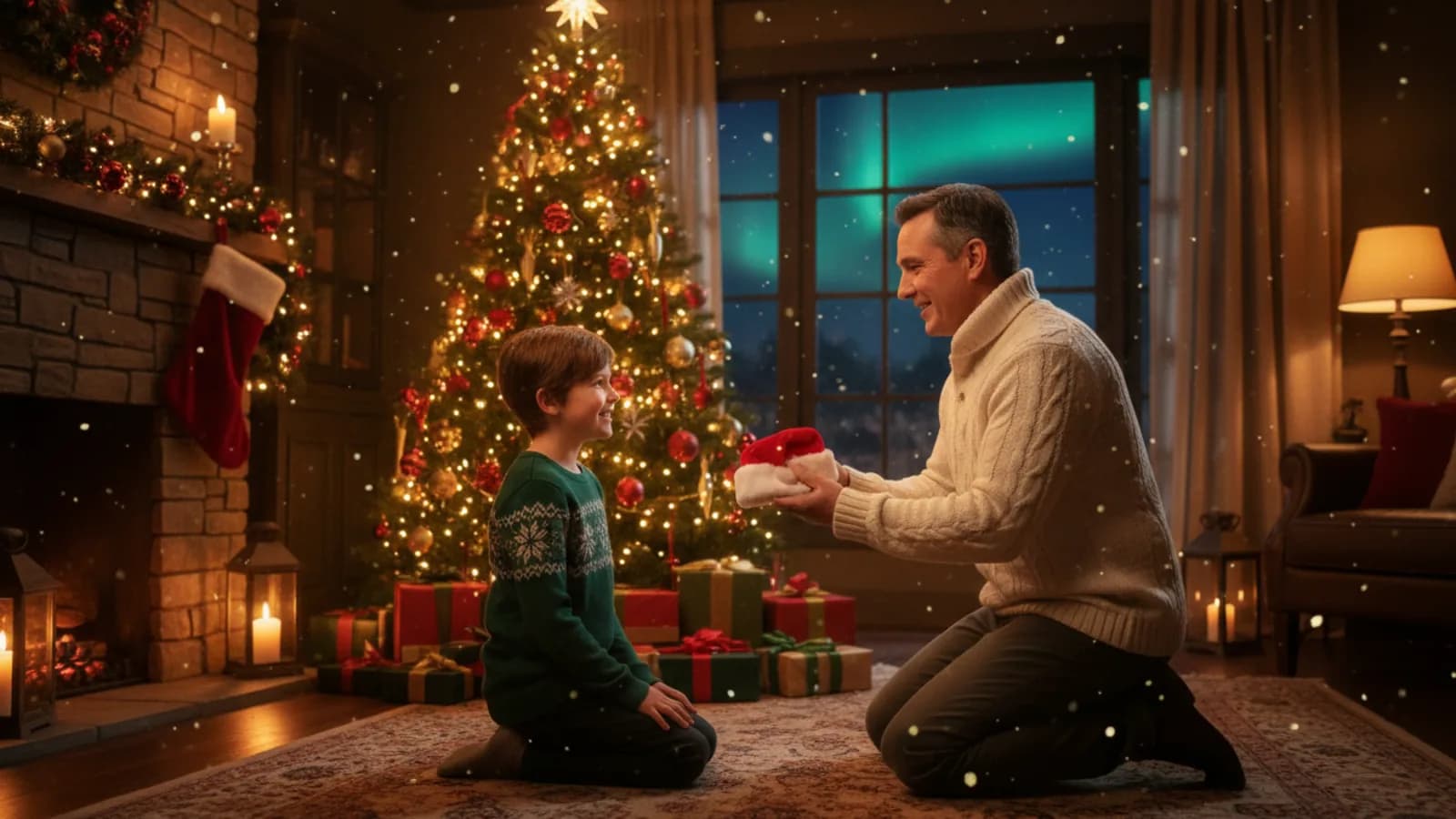
You heard the question over breakfast, or you have felt it coming ever since your child started counting the chimneys on your street. You will have to answer, and you would like the moment to leave a good memory rather than a sense of betrayal. The good news is that, for most families, it goes well.
Psychologists who have studied the end of belief, from the University of Texas in 1994 to the study by Candice Mills and Thalia Goldstein published in 2023, offer a few concrete markers. This guide turns them into decisions and into lines you can use as they are. For the numbers on age, see our article on what age kids stop believing.
When should you tell your child the truth about Santa?
Research does not set an age. The average age at which belief ends sits around 8 in recent studies, with wide differences. Candice Mills, a psychologist at the University of Texas at Dallas, advises parents to “follow your child’s lead” as they near the age when skepticism usually appears, rather than picking a date in advance.
Parents themselves are divided. Among the 39 parents interviewed in 2012 by Karl Rosengren’s team, 46 percent thought the child should discover the truth alone, 39 percent thought parents should tell, and 13 percent wanted the two to work together. The ten parents who had planned an age to stop encouraging the myth named 7.3 on average, within a range of 5 to 10.
What matters most, according to the Mills and Goldstein study in Developmental Psychology, is avoiding three circumstances. Adults who remembered the discovery only negatively had learned the truth later than others, abruptly, and from a third party rather than by working it out. A gradual reveal, close to the average age, coming from you or from your child’s own reasoning, ticks every good box.
What to say when your child asks, “Is Santa real?”
Your first answer can be a question. That is the researchers’ most consistent advice: ask your child what they think, or mention what “some people” believe. You find out whether they want reassurance or the truth, and you give them time to reach their own conclusion.
The dilemma is real for many families. In the University of Exeter survey released in 2018, 31 percent of parents said they had denied that Santa was not real when their child asked them directly, and 40 percent had not. Mills suggests first asking yourself what your goal is: do you want your child to believe for as long as possible, at all costs?
- “What do you think?” lets your child lay out their reasoning.
- “What made you ask?” tells you whether they heard something at school.
- “Some people think… other people think…” opens the door without pushing it.
- “Do you really want to know?” gives your child the final say on timing.
If the answer is “yes, I want to know,” say it simply, with no detour and no speech. A child who asks the same direct question twice, looking you in the eye, has usually already figured it out. What they are checking is whether they can count on you to tell the truth.
What to say to your child at each age
The lines below do not come from a study: they are examples to adapt, built on the research markers (follow the child, avoid abruptness, praise their reasoning). Mills notes that some children take the feeling of having been deceived more personally than others. You know yours better than anyone.
Around 6 or 7: answer without settling it
At this age many children ask without really wanting a final answer. You can say: “That’s a great question. What do you believe?” Then: “Some kids in your class don’t believe, some do. Santa is a story lots of families love to tell.” If your child heads off reassured and moves on to something else, they have given you their answer.
Around 8 or 9: praise the detective
This is the age of math and clues. Praise the method: “You noticed the handwriting on the tag looks like mine? You think like a real detective.” Then, if they push: “Yes, parents put out the presents. Santa is the spirit of Christmas, and the big kids and grown-ups keep it alive for the little ones.” In the Mills study, some children said they felt proud of working it out on their own. Give your child that pride.
At 10 and up: talk as equals
An older child needs to hear you acknowledge that they know, sometimes for a while. You can say: “I think you figured it out a while ago. Thanks for playing along, that was generous.” Explain why you did it too: “We wanted you to have the same magic we had at your age.” The adults in the Mills and Goldstein study who learned late and abruptly had the worst memories of it: being honest about your reasons defuses that risk.

How to keep the magic: bring your child onto Santa’s team
Many families turn the reveal into a promotion. Your child does not just learn that Santa does not come down the chimney: they learn that they are moving to the other side, with the people who make the magic. In 1952, in his essay “Le Père Noël supplicié” (Father Christmas Executed), the anthropologist Claude Lévi-Strauss had already observed that adults do not believe in Santa but encourage children to believe. Joining the adults in that role has something of a rite of passage.
The idea holds up for a simple reason: most people stay attached to the tradition once they know. In the Mills and Goldstein work, between 87 and 95 percent of adults wanted to celebrate Santa with their own children, or already did. Your child is not losing Christmas, just changing seats.
- Choose an anonymous gift together for a relative, or for a toy drive, and never say who it came from.
- Give them an elf’s mission: filling stockings, hiding presents, taking a bite of the carrot left for the reindeer.
- Help them write a reply from Santa for a little cousin, or guide a younger child through our letter to Santa page.
- Show them backstage: our pages on the elves and the Santa tracker become tools they use for others.

How do you handle younger siblings?
This is often the real worry: that the older one spills it to the younger one. The data are fairly reassuring about children’s ability to keep a secret. In the Exeter survey, 65 percent of respondents said they kept playing along after they already knew the truth. An older child who can keep quiet for their own sake can do it for someone else.
What works best is giving the older child an explicit role rather than a bare prohibition. “You’re on the team now, and your little brother is counting on you” works better than “Whatever you do, don’t say anything.” Prepare with them what to say if the younger one asks: “Go ask Mom and Dad” is an honest exit that betrays no one.
What do you do with the Elf on the Shelf once your child knows?
The Elf on the Shelf comes from an American picture book self-published in 2005 by Carol Aebersold and her daughter Chanda Bell. The premise: an elf sent by Santa watches children during the holiday season, flies to the North Pole each night to report, and must never be touched or it loses its magic. On Christmas Eve it goes home.
The concept has its critics. In 2014, the academic Laura Pinto argued that it gets children used to the idea that being watched is normal. Others, such as psychologist Judith Tellerman, see it instead as a simple visual cue to behave. When your child learns the truth about Santa, the question comes up right away: who was moving the elf every night?
- Hand it over to the older child: they now move it each night for the younger one, their first mission on Santa’s team.
- Keep it as a family decoration, without the watchman role, sitting in the same spot all December.
- Give it a “retirement”: a last letter from the elf thanking your child and announcing it is going back to the North Pole for good.
If the elf was mostly a way to get good behavior, the reveal is a chance to change approach. Talk to your child directly about what you expect, with no go-between. Our nice detector stays a game to share, not a monitoring tool.
What if your child is sad or angry?
Prepare for the possibility without dreading it. About a third of the children and half of the adults interviewed by Mills and Goldstein remembered at least one negative feeling at the moment of discovery. In the Exeter survey, 15 percent of respondents had felt betrayed by their parents and 10 percent had been angry.
Those feelings usually pass quickly. Fewer than a third of the Mills and Goldstein participants described distress lasting more than a couple of weeks, and the study found no “drastic loss of trust” in parents. In 1994, the 52 Texas children studied by Anderson and Prentice described mostly positive reactions, while their parents felt sad. You may well find the moment harder than your child does.
- Welcome the feeling without correcting it: “You’re disappointed, I understand. I was sad too when I found out.”
- Explain the intention: “We weren’t trying to fool you, we wanted to give you something joyful.”
- Reassure them about what comes next: the presents, the stockings, the dinner and the traditions all stay.
- Give it time: come back to the subject a day or two later, once your child has taken it in.
Sources
- Mills, Goldstein et al., “Debunking the Santa myth,” Developmental Psychology, 2024 (online 2023)
- University of Texas at Dallas, “Yes, Virginia, About Santa…”: Expert Explores Shifts in Belief, 2023
- University of Exeter, First international academic Santa survey, 2018
- Anderson and Prentice, “Encounter with reality,” Child Psychiatry and Human Development, 1994
- Yoo, Jiang and Rosengren, “Why Santa but not witches?,” Frontiers in Developmental Psychology, 2025
- Wikipedia, The Elf on the Shelf
- Bernard Quaritch, catalogue note on “Le Père Noël supplicié,” Claude Lévi-Strauss, Les Temps modernes, 1952
- CBS News, “Yes, Virginia”: The story behind the letter about Santa Claus