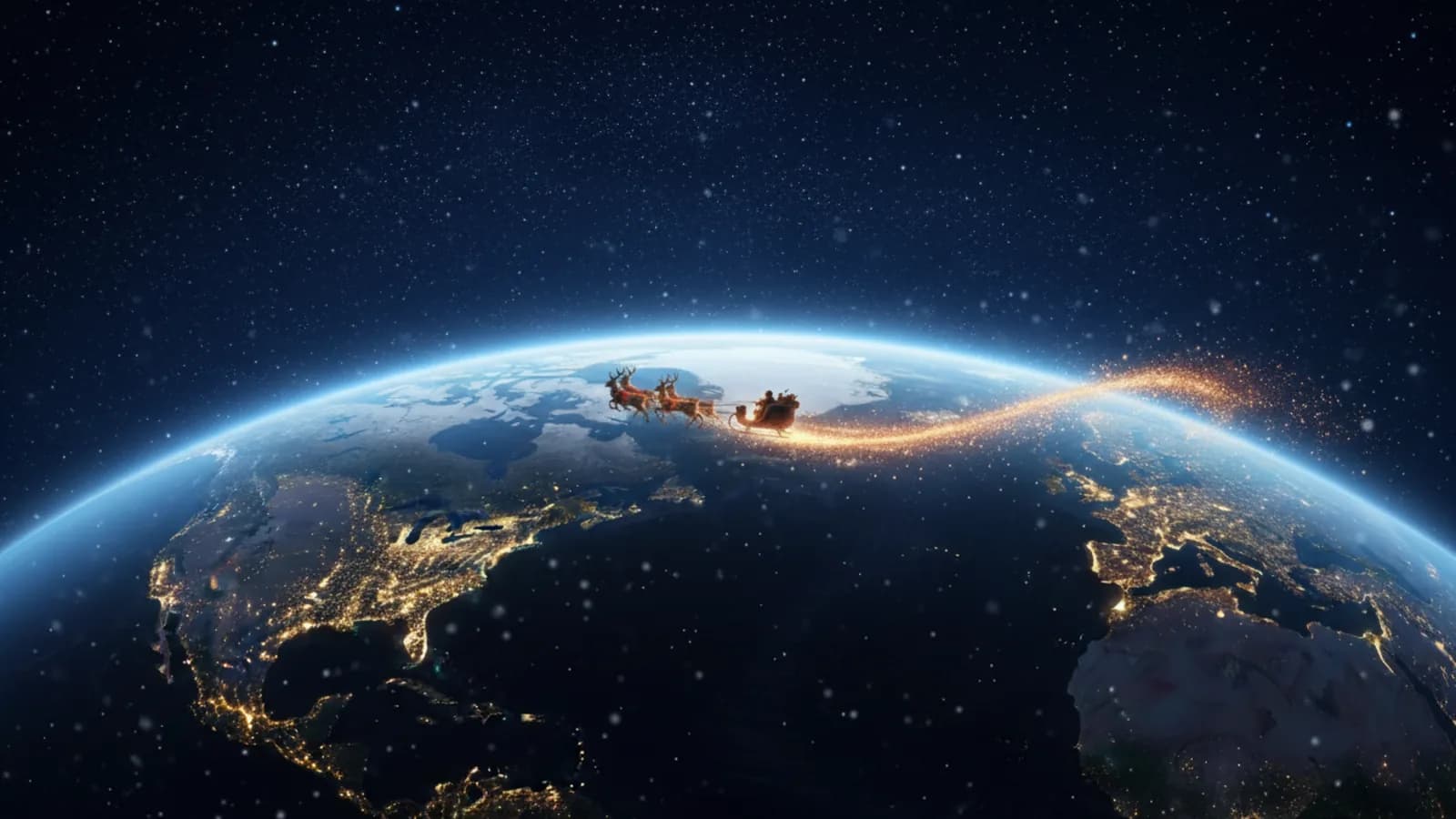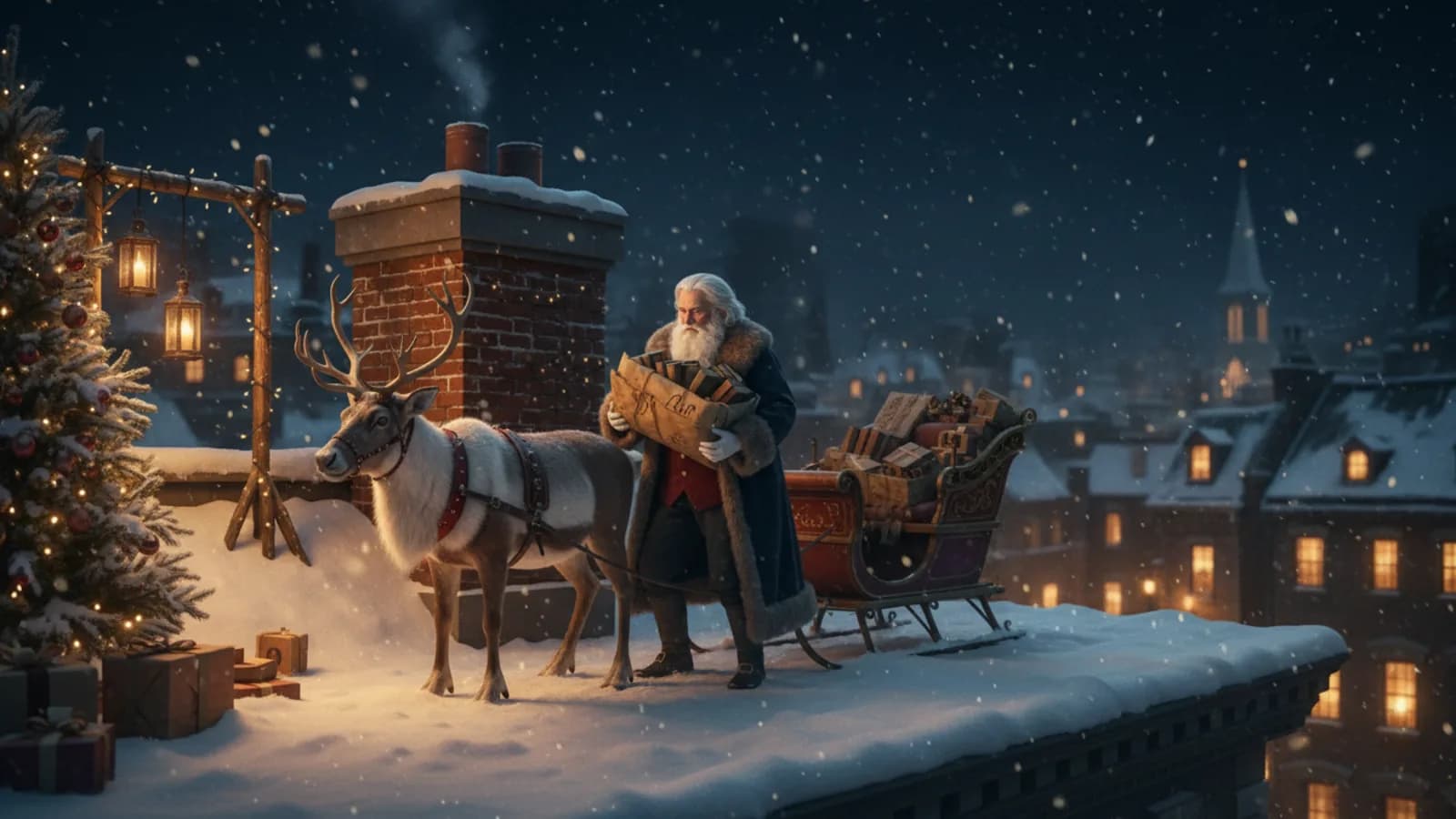
In 1821, a small New York booklet with eight hand-colored engravings showed an old man in a sleigh pulled by a single reindeer, perched on a snowy roof. It is the oldest known picture of Santa Claus in a sleigh. Two years later, a poem gave him eight reindeer and sent him flying “like the down of a thistle.”
Before that, the children's saint traveled differently: on a donkey in eastern France, on a horse in the Netherlands, in a wagon in a New York writer's imagination. Here is how the sleigh won out, document by document, all the way to a U.S. Air Force radar report.
How did Saint Nicholas travel before the sleigh?
Europe's Saint Nicholas never needed reindeer. He did not live anywhere near the Arctic Circle. In Lorraine, in eastern France, newspapers from 1898, 1914 and 1921 preserved in the French national library's Gallica archive show him riding a donkey, a she-donkey or a mule, and the Fondation Napoléon describes a saint who came back every year “with a donkey staggering under its load of treats.”
In the Netherlands, Sinterklaas arrives by boat and then rides a horse. Children put a carrot or some hay in their shoes for his mount. Either way, the traveler stays on the ground, or nearly: he goes from house to house at the pace of a pack animal.
The first Saint Nicholas to fly is American, and he has no sleigh. Washington Irving published his History of New York in 1809, and in the second edition, in 1812, he added a dream: a Dutch settler sees the saint come “riding over the tops of the trees,” in the very wagon in which he brings his yearly presents to children. The saint lights his pipe, lays his finger beside his nose, climbs back into his wagon and returns over the treetops.
Remember that finger beside the nose: it turns up again eleven years later, just as Santa rises back up the chimney. For the full story of the French donkey and the Dutch horse, read Who was Saint Nicholas?.
What year did Santa get his sleigh?
The answer fits in one date: 1821. That year, New York publisher William B. Gilley issued a booklet titled The Children's Friend, “a New-Year's present, to the little ones from five to twelve.” The anonymous poem inside is called “Old Santeclaus with Much Delight.” Its eight colored engravings were the first use of lithography in the United States.
Old Santeclaus with much delight / His reindeer drives this frosty night.
The visitor, called Santeclaus, arrives “from the North” every Christmas Eve. He drives a sleigh pulled by a single reindeer that skims over the chimney tops. One engraving shows him landed on a roof. It is the first known publication to mention and picture Santa's sleigh and reindeer, and, as the St. Nicholas Center points out, the visit now falls on December 24 rather than December 6.
Why a sleigh? The booklet never says, and no document from the time tells us what its anonymous author had in mind. All we know is that in the nineteenth-century Northeast, the horse-drawn sleigh was part of winter, to the point of having its own races and songs, as we will see below. The question of the reindeer is covered in Where did Santa's reindeer come from?.
- 1812In the second edition of Washington Irving's book, Saint Nicholas flies over the trees in a wagon.
- 1821The first sleigh, pulled by a single reindeer, in the booklet The Children's Friend.
- 1823“A Visit from St. Nicholas”: a miniature sleigh and eight named reindeer.
- 1863Thomas Nast draws the sleigh on the cover of Harper's Weekly.
- 1939Rudolph the Red-Nosed Reindeer guides the sleigh through the fog.
Who made Santa's sleigh fly?
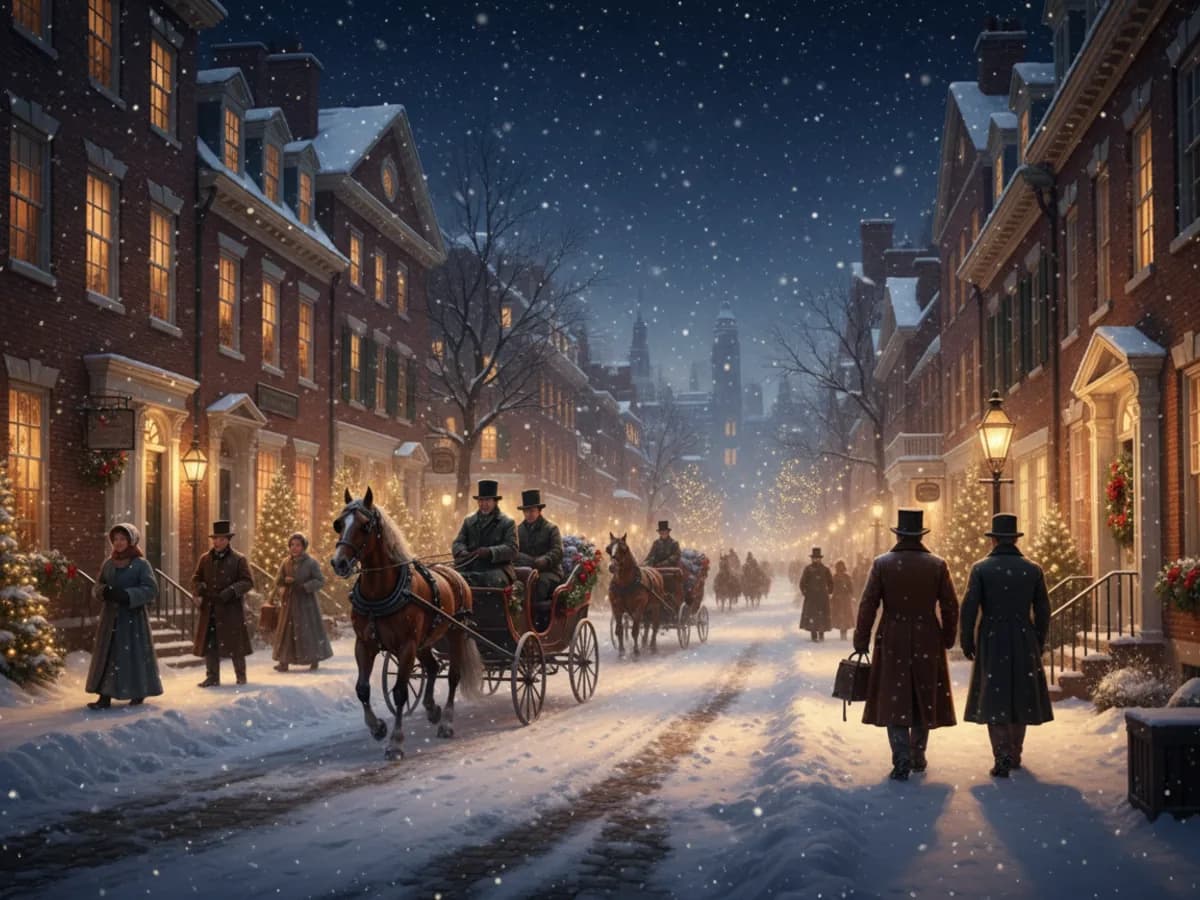
On December 23, 1823, the Troy Sentinel printed “Account of a Visit from St. Nicholas” without a byline. It was credited to Clement Clarke Moore in 1837, and he claimed it in his Poems of 1844; some researchers credit Henry Livingston Jr. instead. The narrator, woken by a clatter on the lawn, throws open the window and sees “a miniature sleigh, and eight tiny reindeer,” driven by “a little old driver, so lively and quick.”
But a miniature sleigh, and eight tiny reindeer, / With a little old driver, so lively and quick.
The poem adds what the 1821 booklet lacked: the flight itself. The reindeer rise to the housetop like dry leaves lifted by a hurricane, “with the sleigh full of Toys.” Once the work is done, the visitor lays his finger aside of his nose, just as in Irving, rises up the chimney, springs to his sleigh and whistles to his team. Away they all fly “like the down of a thistle.”
The word “miniature” matters. In 1823 the sleigh is small because Santa is too: the poem calls him a “right jolly old elf,” slight enough to fit down the flue. He grew larger with the illustrations, and his sleigh grew with him. The eight names of the team and their variants are covered in What are Santa's reindeer names?.
How did sleighs and sleigh bells end up in Christmas songs?
In nineteenth-century New England, the horse-drawn sleigh was for getting around, but also for racing. In September 1857, Boston publisher Oliver Ditson issued “The One Horse Open Sleigh,” a song by James Lord Pierpont. Old local histories of Medford, Massachusetts, say it was inspired by the town's sleigh races. It does not mention Christmas at all.
It became tied to Christmas only in the 1860s and 1870s, under the title everyone knows: “Jingle Bells.” The horse's bells became the bells on Santa's team. On December 16, 1965, Gemini 6 astronauts Wally Schirra and Tom Stafford played it from their capsule in orbit, one on harmonica, the other shaking sleigh bells.
In 1864, in New Paris, Ohio, Benjamin Hanby wrote “Up on the Housetop.” Carol researcher William Studwell calls it the first Christmas song to focus mainly on Santa Claus. The reindeer pause on the roof while their master climbs down with his toys, a scene Hanby most likely borrowed from the 1823 poem. To sing more of them, visit our Christmas songs page.
How did the sleigh get into the pictures?
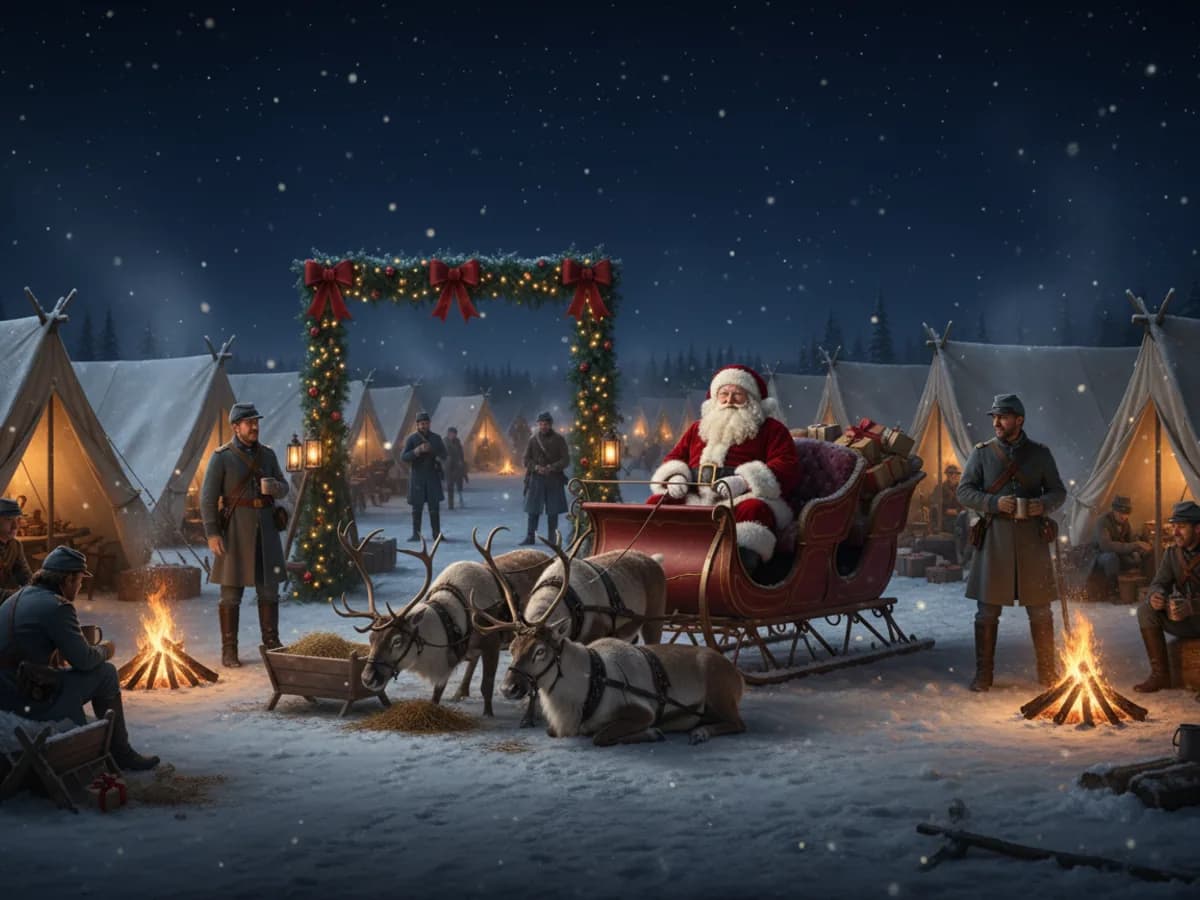
On January 3, 1863, in the middle of the Civil War, the cover of Harper's Weekly showed Thomas Nast's first Santa Claus. The Homestead Museum in California describes it this way: Santa sits on the back edge of his sleigh, his reindeer waiting patiently beneath an arch that reads “Welcome Santa Claus,” beside a large American flag. He is handing out gifts to Union soldiers.
The Massachusetts Historical Society counts 33 images of Santa drawn by Nast for Harper's Weekly between 1863 and 1886. The magazine was printed in black and white: readers imagined the color of the sleigh, just as they imagined the color of the coat.
The team then crossed the Atlantic. According to the Library of Congress, the mythology of the sleigh and flying reindeer reached Britain in the 1860s, and Father Christmas took it on as he merged with Santa Claus in the 1870s. In 1889, poet Katharine Lee Bates even had Mrs. Claus demand a seat in the sleigh, a story we tell in Does Santa Claus have a wife?.
The sleigh has its authors too. From 1920 to 1943, J. R. R. Tolkien wrote his children a letter each year signed by Father Christmas. In them he describes a Father Christmas who delivers presents down the chimney, with a sleigh drawn by flying reindeer.
The sleigh in the twentieth century: Rudolph, radar and children's questions
In the twentieth century, the sleigh picked up passengers and copilots. In 1902, L. Frank Baum, author of The Wonderful Wizard of Oz, published The Life and Adventures of Santa Claus and hitched up ten reindeer, among them Flossie and Glossie. In 1939, Robert L. May wrote the story of Rudolph for the Montgomery Ward stores: on a foggy night, Santa puts the reindeer with the glowing nose at the head of the team to light the sleigh's way.
The sleigh even made it into military records. On December 24, 1948, the U.S. Air Force issued a communique reporting an unidentified sleigh pulled by eight reindeer at 14,000 feet, heading 180 degrees. Seven years later, in 1955, a misprinted ad gave Colorado Springs children the number of an air defense center, and NORAD's yearly Santa tracking was born. We tell that story in How does Santa deliver presents in one night?.
Children, for their part, take the sleigh very seriously. In 2015, psychologists Andrew Shtulman and Rachel Yoo of Occidental College questioned 47 children aged 3 to 9. Ninety-six percent of them said Santa flies in a reindeer-drawn sleigh. It was also the feat they found hardest to explain: only 12 of the 47 children offered a mechanism for the flight.
The others answered that the sleigh flies, plain and simple. In the village, we think that is a very good answer. On the evening of the 24th, you can check its course on the Santa tracker, and visit the team on the reindeer page.
Sources
- Wikipedia, Old Santeclaus with Much Delight (1821)
- St. Nicholas Center, Origin of Santa Claus
- Wikipedia (French), Rennes du père Noël (Gallica sources on Saint Nicholas's donkey)
- Fondation Napoléon, Napoleon.org, “Pain d'épice et chocolat pour la Saint-Nicolas”
- Project Gutenberg, Washington Irving, Knickerbocker's History of New York
- Project Gutenberg, 'Twas the Night before Christmas: A Visit from St. Nicholas
- Wikipedia, Jingle Bells
- Wikipedia, Up on the House Top
- Homestead Museum, “Christmas Cartoons by Thomas Nast in Harper's Weekly, 1863,” 2018
- Massachusetts Historical Society, Santa Claus in Camp, Object of the Month, December 2020
- Library of Congress, Folklife Today, Stephen Winick, “Christmas Cousins: Father Christmas and Santa Claus,” 2018
- Wikipedia, Santa Claus's reindeer
- Wikipedia, NORAD Tracks Santa
- Shtulman and Yoo, “Children's understanding of physical possibility constrains their belief in Santa Claus,” Cognitive Development, 2015
- Internet Archive, Washington Irving, A History of New York, second edition with alterations, 1812