The question turns up in the mail every year, often in colored pencil: “Are you an elf too?” It is a fair one. The text that shaped the American Santa, a poem printed without a name on December 23, 1823, in the *Sentinel* of Troy, New York, calls him in so many words “a right jolly old elf.”
We gave the short answer in our article on Santa’s wife. Here is the whole file: what *elf* meant in 1823, what the poem really says about his size, how illustrators made him grow, and why northern Europe found him cousins about two feet tall.
Why do people say Santa is an elf?
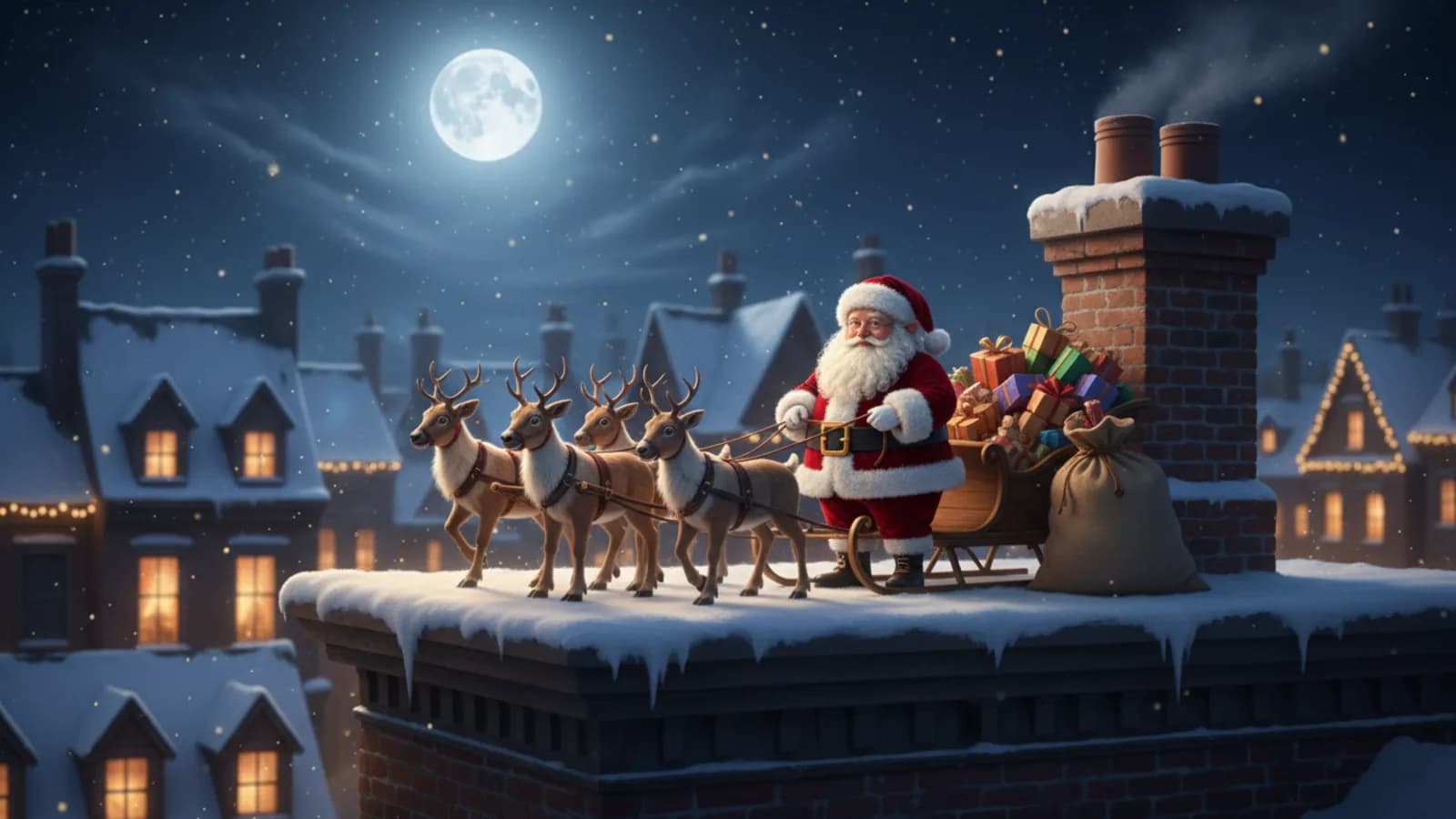
It all comes down to one line, but the rest of the poem points the same way. Before the word *elf* even appears, the narrator, woken in the night, sees “a miniature sleigh, and eight tiny reindeer.” The driver is “a little old driver, so lively and quick.”
The portrait that follows is of a slight figure. He is “dressed all in fur, from his head to his foot,” smudged with ashes and soot, and looks like a peddler opening his pack. He has “a little round belly,” a “droll little mouth” drawn up like a bow, and the stump of a pipe clenched in his teeth. The poem piles up *little*, *tiny* and *miniature* as if to shrink everything to the scale of a rooftop.
He was chubby and plump, a right jolly old elf, And I laughed when I saw him, in spite of myself.
Then comes the exit. The visitor lays a finger beside his nose, gives a nod and rises up the chimney. For an old man of ordinary build, that would be absurd. For an elf, it is almost routine. In 2014 a piece from Canisius University in Buffalo summed up the poem’s Santa as “a little guy,” able to move up and down chimneys with a wraith-like agility.

What did the word “elf” mean in 1823?
The English word comes from Old English *ælf*. It has cousins across the Germanic languages: Old Norse *álfr*, and Old High German *alp*, where it means an evil spirit. Linguists tie it to a root meaning “white,” the same one behind Latin *albus*. The first elves may have been “the white ones,” “the shining ones.” The word survives in names like Alfred, literally “elf counsel.”
Those early elves were not small. In 1590, in *The Faerie Queene*, Edmund Spenser still wrote of human-sized beings. The shift came in the same years, on stage. In *A Midsummer Night’s Dream*, around 1595, Shakespeare made his elves tiny and airy. Together with the poet Michael Drayton, he fixed for two centuries the idea that an elf, like a fairy, is a pocket-sized creature.
That is the sense the 1823 author had in mind: a small, quick, slightly mischievous being from another world. Eleven years earlier, in 1812, the Brothers Grimm had published “The Elves and the Shoemaker,” in which two little men, *Wichtelmänner* in the German original, secretly finish a poor cobbler’s shoes every night. When the couple sews them clothes as thanks, they dance out of the house and never return. A small being who works at night to please people without being seen: the picture suited a Christmas poem.
And in French, where Santa is a “lutin”?
On our French pages, Moore’s line reads *un vrai joyeux vieux lutin*, and *lutin* has a stranger history. According to the Trésor de la langue française, it descends from Latin *Neptunus*, the sea god, who became a pagan demon in late antiquity. Chrétien de Troyes wrote *netun* around 1176, and Wace wrote *luitun*. The word was probably pulled toward *nuit*, night, because these spirits came out after dark. Du Bellay wrote *lutin* in 1558, and by 1680 it could also mean a lively, mischievous child.
Was Santa already small before 1823?
Two years before the poem, in 1821, the New York printer William B. Gilley put out a small paperback, *The Children’s Friend*, a New Year’s present for “the little ones from five to twelve.” It contained *Old Santeclaus with Much Delight*, an unsigned poem with eight colored engravings. They are the earliest published pictures of a Santa figure, and the first use of lithography in the United States.
This Santeclaus comes on Christmas Eve rather than December 6, Saint Nicholas’s feast day. He drives a reindeer over the rooftops and snowfields, and he already wears red. He also keeps a sterner side: to bad children he leaves a long, black birch rod. The booklet never states his size. The engravings show him up on the roofs, at the scale of the chimneys.
Old Santeclaus with much delight / His reindeer drives this frosty night, / O’er chimney tops, and tracts of snow
Earlier still, in 1809, Washington Irving had made Saint Nicholas a New York character in his *History of New York*. Canisius University points out that Irving’s Nicholas is not yet the jolly old elf we know. For the full road from the bishop to the New York figure, read the true story of Santa Claus.
How did Santa grow to full size?
The man mostly responsible is Thomas Nast. He arrived in the United States at about six, in 1846, and drew for *Harper’s Weekly* during the Civil War. On January 3, 1863, his first Santa appeared on the cover, handing out gifts in a Union camp in a star-covered coat and striped pants. Between 1863 and 1886, Nast published 33 Christmas images in the magazine.
Drawing by drawing, he settled the character. According to Canisius University, Nast took Santa from Moore’s jolly old elf, “a little guy,” to the large, jovial, white-bearded giant of a man, drawing him larger than life because that is how we expect him. In 1866 he showed Santa in his workshop, making rocking horses and sewing doll clothes, with an account book of children’s behavior close at hand.
- 1821*The Children’s Friend*: the first engravings of a Santeclaus, on the rooftops with one reindeer.
- 1823The Troy poem describes a “jolly old elf” with a miniature sleigh.
- 1863Thomas Nast’s first Santa on the cover of *Harper’s Weekly*.
- 1866Nast shows him in his workshop, surrounded by toys.
- 1881“Merry Old Santa Claus,” Nast’s best-known portrait.
The Delaware Art Museum, which holds Nast material, also credits him with the first known references to Santa living at the North Pole and running a toy workshop. A man who runs a toy factory for the whole world could hardly fit in a miniature sleigh. The tiny elf of 1823 faded from the pictures, as we tell in how old is Santa Claus.
Nisse and tomte: Santa’s Nordic cousins
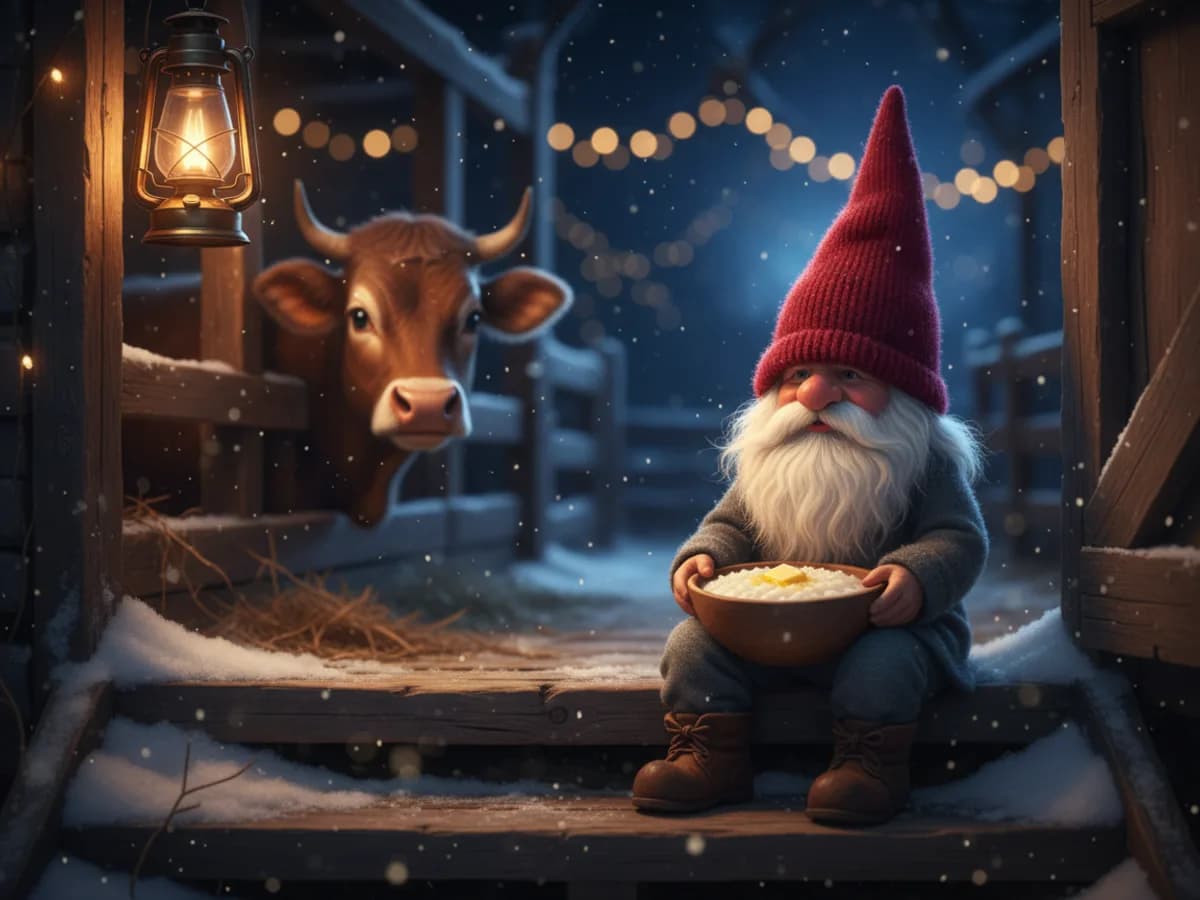
In Scandinavia the family tie between Santa and the little folk is even closer. The Danish and Norwegian *nisse*, the Swedish *tomte* and the Finnish *tonttu* are household spirits from folklore. They live under the floorboards of the farmhouse, the stable or the barn, watch over the animals and help with the work if they are treated well. Offend one and it plays tricks on you.
Their size varies with the teller. One Swedish tradition gives one *aln*, about 60 centimeters, roughly two feet; a Swedish-American source says 60 to 90 centimeters. They are pictured in a red cap and gray wool clothes. The traditional Danish nisse is beardless like a child: the beard came later. On Christmas Eve families leave them a bowl of porridge, topped with butter or honey, or in Norway *rømmegrøt*, a sour cream porridge.
In the nineteenth century these farm guardians became gift bringers. In the 1840s Danish artists were already showing the nisse carrying Christmas presents. In Sweden, Jenny Nyström illustrated Viktor Rydberg’s *Little Vigg’s Christmas Eve Adventure* in 1875, then his poem *Tomten* in 1881. The Nationalmuseum in Stockholm calls her the first Swedish artist to give the traditional Santa Claus a distinct character. The *jultomte*, the Christmas tomte, was born.
The names tell the story of that meeting. One theory traces *nisse* to Niels, the Danish form of Nicholas, which would make him a small relative of Saint Nicholas. *Tomte* comes from *tomt*, the plot of land a house stands on. To see what Santa is called across the north, read Santa Claus names around the world.
Where do Santa’s workshop elves come from?
If Santa grew up, who took over the elf part? A whole crew. You will often read that Louisa May Alcott, the future author of *Little Women*, was the first to write about Christmas elves, in a collection called *Christmas Elves* written around 1855. The Library of America urges caution: Alcott was twenty-three, the collection was never published, and the manuscript was lost or destroyed. Nobody knows what her elves were like.
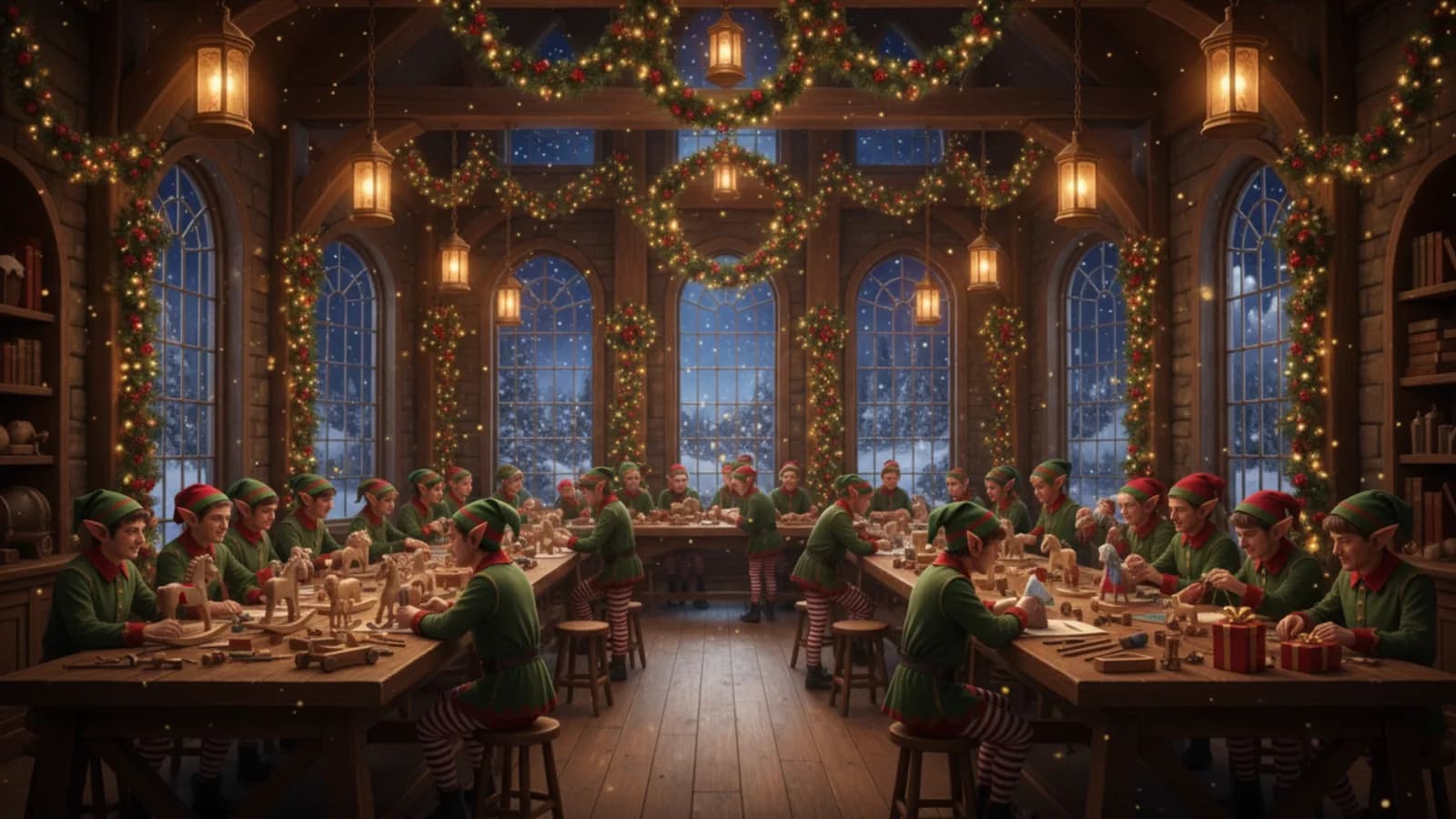
The first widely seen picture is better documented. In 1873 the Christmas cover of *Godey’s Lady’s Book*, the Philadelphia women’s magazine, showed Santa surrounded by toys and elves, with this caption: “Here we have an idea of the preparations that are made to supply the young folks with toys at Christmas time.” In 1876 Austin Thompson published *The House of Santa Claus*, a Christmas fairy show for Sunday schools, which took up the idea.
- 1932: Walt Disney releases the short *Santa’s Workshop*, with Santa and his elves getting ready for Christmas.
- 1964: the stop-motion *Rudolph the Red-Nosed Reindeer* gives the elves a starring role.
- 1985: *Santa Claus: The Movie* shows them as a craft guild making toys by hand.
- 1994: *The Santa Clause* casts children and teenagers as the elves.
Since then the roles have stayed put: a full-sized Santa, and around him elves who build, wrap and look after the reindeer. Our elves have their own page, and their trade is laid out in who are Santa’s elves.
A man raised by magical beings
Several stories settled the question their own way: Santa is not an elf, but he grew up among magical folk. The first is by L. Frank Baum, author of *The Wonderful Wizard of Oz*. In *The Life and Adventures of Santa Claus*, published in 1902 with pictures by Mary Cowles Clark, a baby is found in the Forest of Burzee by Ak, “Master Woodsman of the World.” The wood nymph Necile adopts him and names him Neclaus, which she shortens to Claus.
Baum is clear on one point: Claus is mortal, growing up day by day among the immortals. The text even notes that he “had never been a very tall man.” The ryls, guardians of the flowers, give him their pigments to paint his toys. The knooks, guardians of the beasts, eventually let two deer, Glossie and Flossie, pull his sleigh, but only on Christmas Eve. When he grows old, Ak proposes giving him the Mantle of Immortality. The immortals agree, and the mantle becomes part of his being.
The pattern returned on television in 1970: in Rankin/Bass’s *Santa Claus Is Comin’ to Town*, baby Kris is taken in by the Kringles, a family of toymaking elves. In 2003, Jon Favreau’s film *Elf* turned it around. A baby from an orphanage crawls into Santa’s sack, ends up at the North Pole and grows up among the elves, adopted by Papa Elf, played by Bob Newhart. Buddy, played by Will Ferrell, thinks he is an elf until adulthood. The film used forced perspective rather than computer effects to make him tower over them.
Sources
- Academy of American Poets, A Visit from St. Nicholas (full text)
- Library of Congress, Neely Tucker, “A Visit from Santa… Who You Might Not Recognize,” 2020
- Canisius University, Santa Claus: Image of a Tradition, 2014
- Wikipedia, Elf (etymology and early modern elves)
- CNRTL, Trésor de la langue française, etymology of “lutin”
- Wikipedia, Old Santeclaus with Much Delight, 1821
- American Battlefield Trust, The Man Behind “Merry Old Santa Claus”
- Delaware Art Museum, Thomas Nast and the Making of the American Santa Claus
- Wikipedia, Nisse (folklore)
- Nationalmuseum (Stockholm), Christmas spirit around the turn of the 20th century
- Library of America, Louisa May Alcott and “Christmas Elves”
- Wikipedia, Christmas elf
- L. Frank Baum, The Life and Adventures of Santa Claus, 1902 (Project Gutenberg)
- Wikipedia, Elf (2003 film)
- D. L. Ashliman, University of Pittsburgh, Brothers Grimm, “The Elves” (Die Wichtelmänner, KHM 39, 1812), text and notes