A good share of what the world associates with Christmas came through Germany. The Advent wreath was invented in Hamburg in 1839. The printed Advent calendar came out of a Munich publishing house. The oldest documented Christmas markets are in Saxony and Bavaria, and the song *O Tannenbaum* was published in Leipzig.
Yet Germany doesn't celebrate Christmas in just one way. In the north, the Weihnachtsmann brings the presents; in the south, the Christkind. The big night is the 24th, not the 25th, and the country has two public Christmas holidays. Our Christmas traditions page mentions the markets and the cookies; here is what lies behind them, week by week.
Who invented the Advent wreath and the Advent calendar?
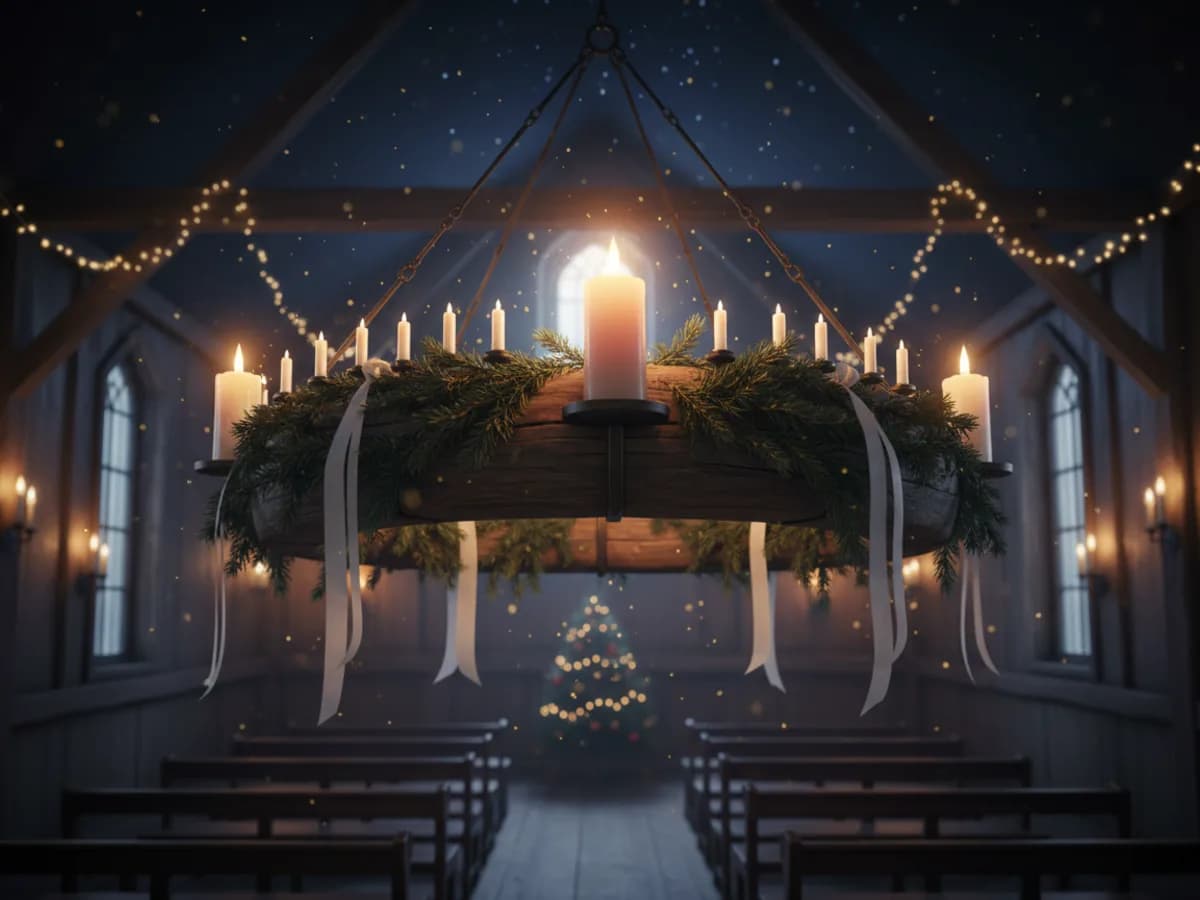
In Germany, December is counted in Sundays. On the first Sunday of Advent, families light the first candle on the Adventskranz, the Advent wreath, then one more every Sunday until Christmas. The object has a date and an author: Johann Hinrich Wichern, founder and director of the Rauhes Haus in Hamburg-Horn, lit the first one in 1839, hanging from the ceiling of its prayer hall.
Wichern's wreath looked nothing like today's. It was made of wood, about the size of a wagon wheel, and held a candle for every day between the first Sunday of Advent and Christmas Eve. The children could watch Christmas come closer, one day at a time. Fir branches and white ribbons were only added from 1860 on. The four-candle version is a compromise, so the wreath would fit in a living room.
The Advent calendar has a family story too. The mother of Gerhard Lang (1881-1974), Selma, a pastor's wife, fixed 24 little meringue cookies from the Hohenlohe region, called *Wiebele*, to a piece of cardboard: one to eat each day. Once he became a publisher in Munich, Lang brought out a printed calendar in 1908, after several attempts, titled *Im Lande des Christkindes*, "In the Land of the Christ Child." Today's 24-door calendars are its heirs. Ours is on the Advent calendar page.
What happens on December 6 in Germany?
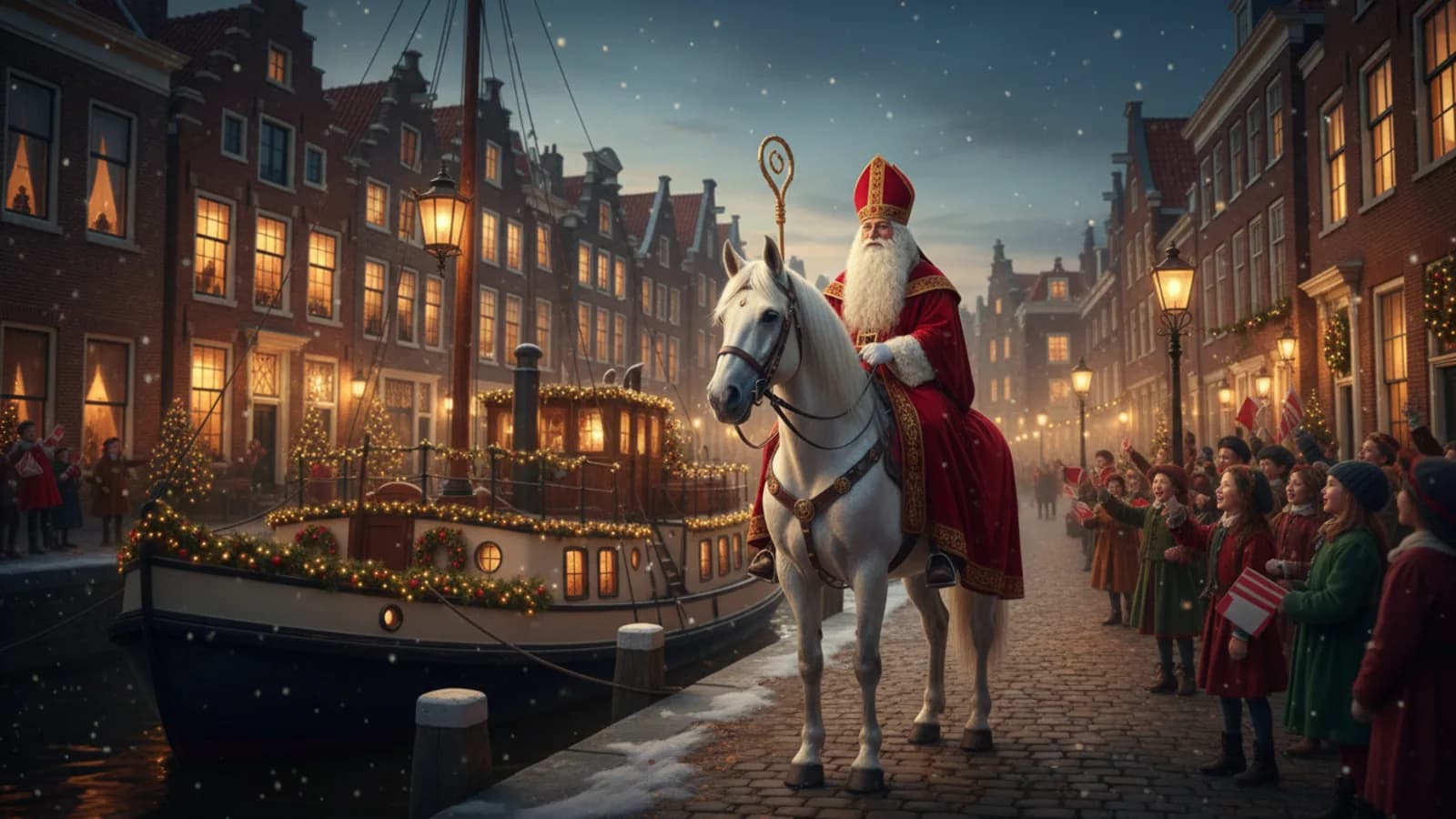
On the evening of December 5, German children put their shoes or boots outside the door. During the night, Nikolaus fills them with nuts, tangerines, chocolate and gingerbread. On the morning of the 6th there is often a little figure baked from sweet yeast dough as well, called a Stutenkerl in some regions. It is the first present of the season, weeks before Christmas.
In many families, Nikolaus also comes in person, dressed as a bishop: a volunteer or an actor hired for the occasion. He gives the children a gentle lecture, sometimes reading from a Goldenes Buch, a "golden book" recording the good and bad deeds of the year, then leaves a small gift.
In the north and center of the country, and generally in Protestant regions, he travels with Knecht Ruprecht, a dark servant who threatens disobedient children and sometimes even replaces him. In Bremen, children in costume go *Sunnerklauslaufen*: they walk from shop to shop, recite a short verse in Low German and ask for sweets. Knecht Ruprecht's cousins, from Krampus to Père Fouettard, appear in Christmas gift bringers around the world, and the bishop himself in who was Saint Nicholas.
What is the oldest Christmas market in Germany?
The title usually goes to Dresden's Striezelmarkt. It was first mentioned in 1434, under Frederick II, Elector of Saxony, as a one-day market on the Altmarkt square on the Monday before Christmas. Its name comes from *Strüzel* or *Stroczel*, the old name for the cake now called stollen.
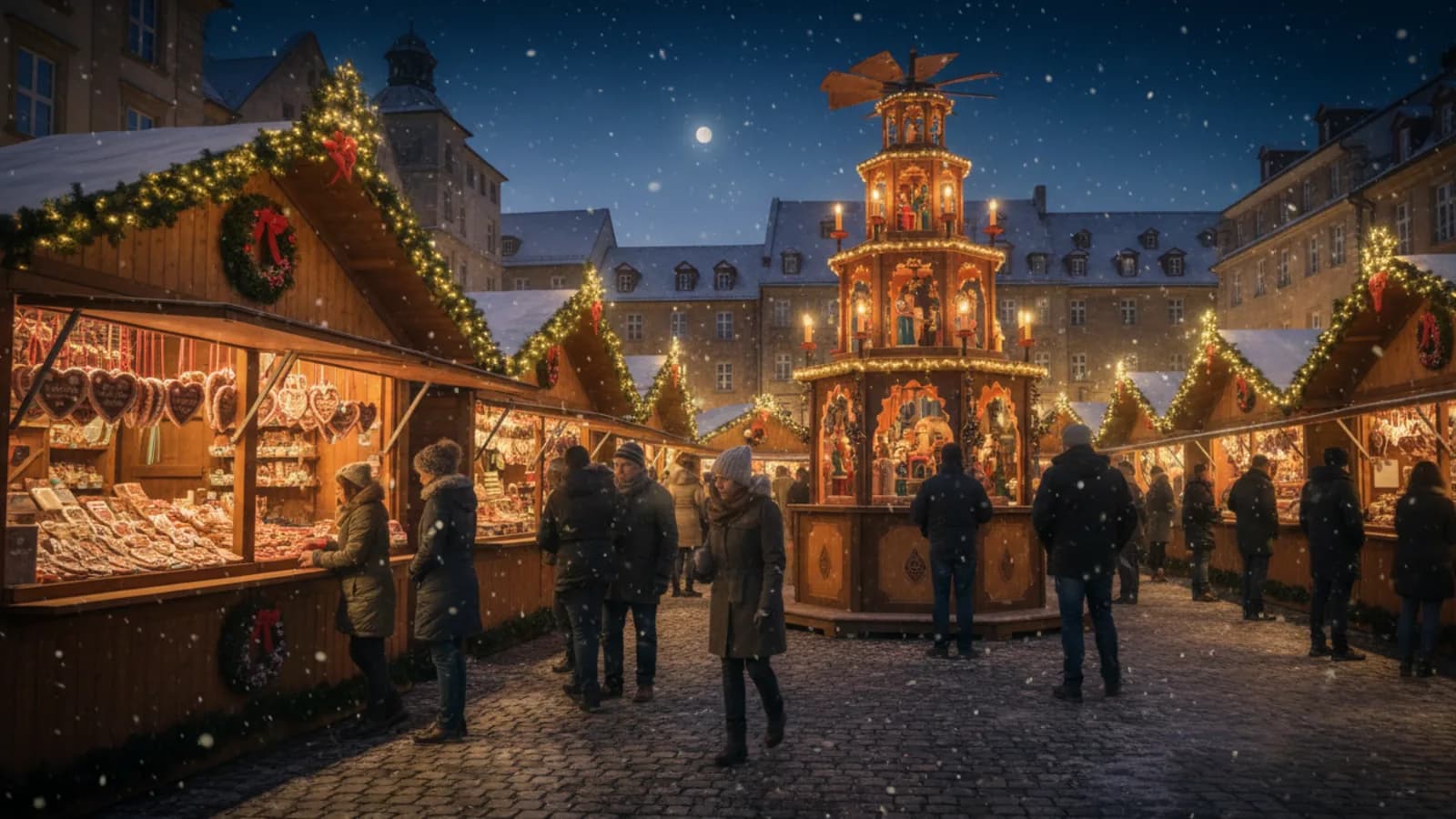
Today the market has some 240 stalls. It features a 14-meter (46-foot) Christmas pyramid from the Ore Mountains, one of those tiered wooden carousels turned by the heat of candles, and Pflaumentoffel, little figures made of prunes that depict chimney sweeps. The name, oddly enough, means "plum devil."
The other big name is Nuremberg's Christkindlesmarkt, on record since 1628. Every year it opens when the city's Christkind, elected every two years, recites a prologue from the gallery of the Frauenkirche. The Nuremberg and Dresden markets each draw about two million visitors a year. We tell the story of the Christkind election in Christmas gift bringers around the world.
Markets look much alike from town to town: wooden huts, mulled wine, Lebkuchen, glass and wooden ornaments. Across the Rhine, Strasbourg has kept the same tradition since 1570, as our article on Christmas in France explains.
What do Germans eat at Christmas: stollen and Lebkuchen?
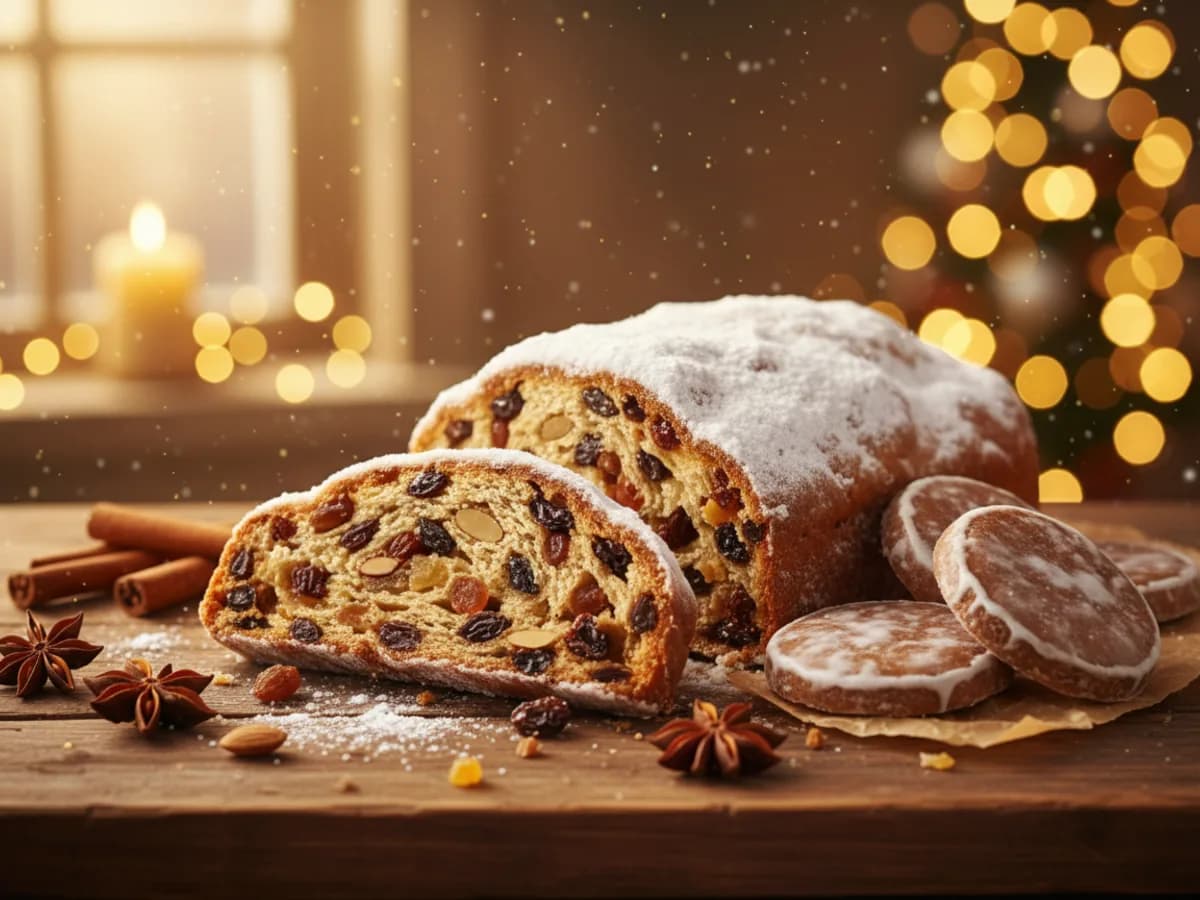
Dresden stollen, once called Striezel, appears in an official document as early as 1474. Butter was a problem for a long time. In 1490, Pope Innocent VIII sent the Elector of Saxony's successor a letter remembered as the *Butterbrief*, the "Butter Letter": it allowed butter for the prince and his household, and for everyone else if they paid a yearly fee toward Freiberg Minster.
King Augustus II the Strong gave stollen its moment of glory. In 1730 he ordered the Dresden bakers' guild to make a giant stollen for about 24,000 guests. The city replays the scene every year at the Stollenfest: a cake of three to four metric tons is paraded to the market and cut with a 1.6-meter (5-foot) knife, a replica of the lost 1730 original. Genuine Dresdner Stollen carries a seal showing Augustus the Strong and is made by only 110 bakeries in the city.
Lebkuchen, German gingerbread, is the season's other pillar. Its bakers are recorded in Ulm as early as 1296 and in Nuremberg in 1395, and in Nuremberg only members of the bakers' guild were allowed to make it. Since 1996, Nürnberger Lebkuchen has been a protected designation: it must be made within city limits. The finest grade, Elisenlebkuchen, contains less than 10 percent wheat flour and at least 25 percent nuts, baked on a thin wafer called an *Oblate*.
Who brings presents in Germany: the Weihnachtsmann or the Christkind?
It depends on the region. In the north, center and east, it is the Weihnachtsmann, "the Christmas Man," a white-bearded Santa made popular in the 19th century by the song *Morgen kommt der Weihnachtsmann*. In southern Germany, Austria and Switzerland, it is the Christkind, the Christ Child, pictured as an angel in a white robe with curly hair. Where both names come from is covered in Santa Claus names around the world.
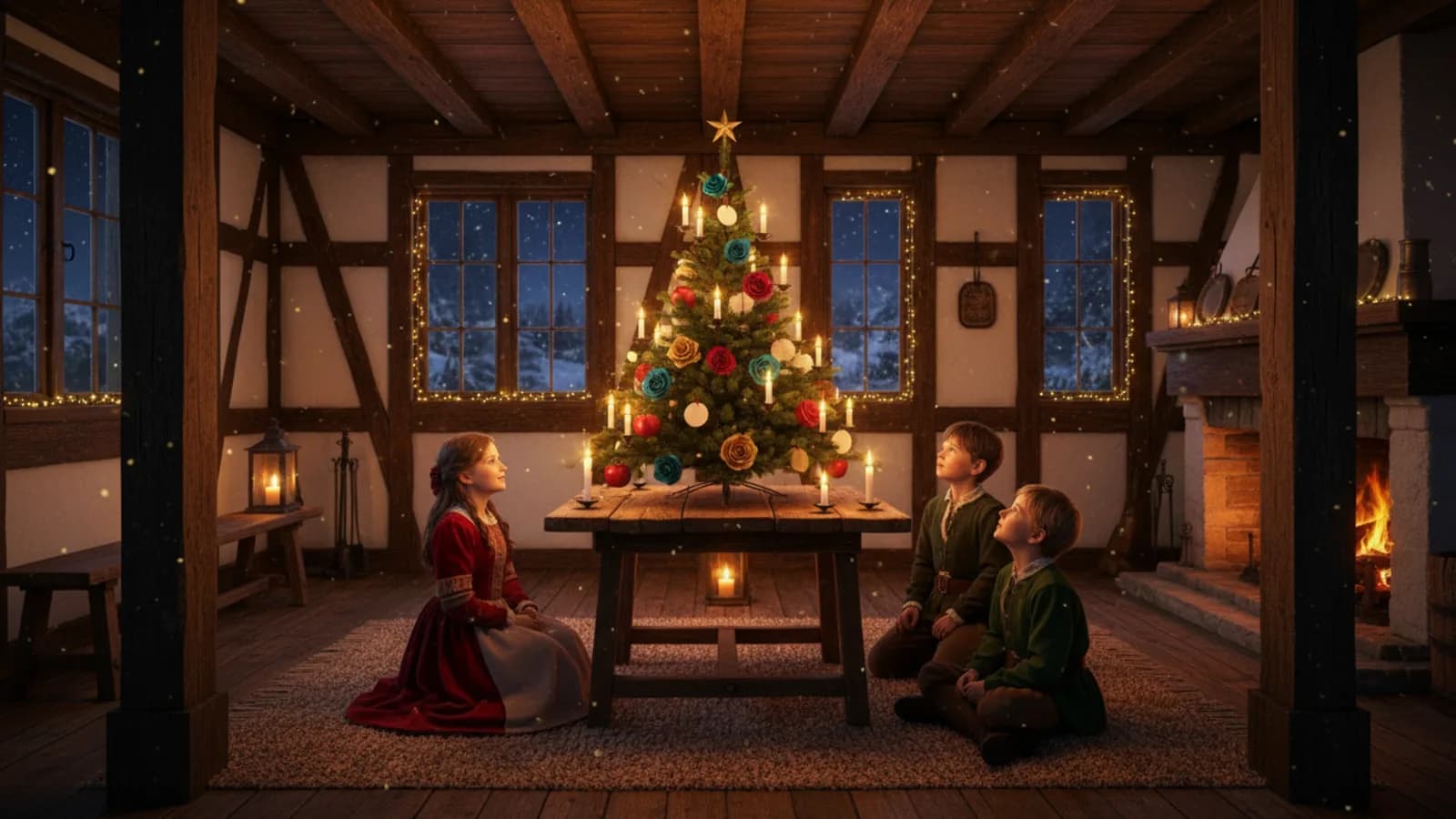
The big moment is Heiligabend, the evening of December 24. The tree often goes up and gets decorated that very afternoon, and it stays until January: real trees are put out for collection after the second week of the month. Children wait outside the room until a little bell rings, a sign that the gift bringer has just left. Then they see the lit tree and the presents. That moment is called the Bescherung.
Dinner on the 24th is often simple. In polls, Germans put sausages with potato salad at the top, ahead of carp, fondue or raclette. The feast comes the next day, with roast goose or duck. December 25 and 26 are public holidays, the second called *Zweiter Weihnachtstag*, but the 24th is not.
Where do O Tannenbaum and glass ornaments come from?
*O Tannenbaum* wasn't a Christmas carol. It began as a folk song in which the evergreen fir stands for faithfulness. One of its melodies is already quoted in 1605 in a musical medley, *Nun fanget an*. In 1820, August Zarnack published a version in which a lover laments an unfaithful sweetheart. In 1824, Ernst Anschütz, a teacher and organist in Leipzig, published the version we know in a school songbook. Even then, the lyrics don't explicitly mention a Christmas tree: custom tied the song to the holiday.
Glass ornaments come from Thuringia. According to the German Historical Museum, blown-glass tree decorations were made from about 1850 in Lauscha and nearby villages. The first baubles were mirrored on the inside with molten lead, to reflect candlelight. In the 1860s and 1870s, silver nitrate gradually replaced the lead.
One ornament, however, isn't German at all: the Christmas pickle. In the United States, the story goes that German families hide a glass pickle in the tree and the child who finds it gets an extra present. In a YouGov poll reported by *The New York Times*, 91 percent of the 2,057 Germans surveyed had never heard of this "tradition."
Sources
- Hamburg Tourismus, Der Adventskranz: vier Kerzen erobern die Welt
- evangelisch.de, Neue Erkenntnisse zum Adventskranz, 2020
- Schwäbische Zeitung, Gerhard Lang machte den Adventskalender groß
- Wikipedia (German), Nikolaustag
- Wikipedia, Striezelmarkt
- Wikipedia, Christkindlesmarkt (Christmas markets, Nuremberg 1628)
- Wikipedia, Stollen
- Wikipedia, Lebkuchen
- Wikipedia, Christmas in Germany
- Wikipedia, O Tannenbaum
- German Historical Museum, LeMO, Christmas tree bauble, 1870/1879
- Wikipedia, Christmas pickle