Santa doesn't get millions of presents ready on his own. Every child knows that, and most of them know who helps him: elves, small and quick, in pointed caps, working all year in a workshop hidden under the snow. What fewer people know is how long the elves have been around, and what each of them actually does.
The North Pole Archives have pulled the file together. Inside are an 1857 story from Harper's Weekly in which the elves vanish into a frosty mist the moment anyone spies on them, an 1866 engraving by Thomas Nast, four helpers with odd names in a story from 1902, and the records of real post offices that put real elves to work every winter. Here is their story, workshop by workshop.
Who are Santa's elves?
They are Santa's helpers. In the tradition, they make the toys in the North Pole workshop and look after his reindeer. They are pictured small, dressed in green or red, with pointed ears and pointed hats. The stories give them long lives: several hundred years, sometimes thousands.
Their family is an old one. The English word *elf* goes back to the Old Norse *álfar*, beings from Germanic mythology that existed long before Christmas did. The French word for them, *lutin*, comes from the Latin *Neptunus*, according to the Trésor de la langue française, and in the Middle Ages meant a small night demon, more mischievous than wicked. In Scandinavia, the Christmas helpers go by other names: *nisse* in Denmark and Norway, *tomte* in Sweden. Those farm spirits, who get a bowl of porridge on Christmas Eve, have their story told in is Santa Claus an elf.
Their outfits owe a lot to television. In 1964 the Rankin/Bass special *Rudolph the Red-Nosed Reindeer* dressed the elves in colorful clothes and cone-shaped hats. The movie *Elf* copied that costume down to the last detail in 2003, filming its actors in forced perspective so they would look smaller.
Not all elves work in a workshop. In Iceland, thirteen visitors come down from the mountains one after another during the thirteen days before Christmas, and children set a shoe on the windowsill to get a treat. We introduce them in Christmas gift bringers around the world.
When did Santa get his elves?
The 1823 poem “A Visit from St. Nicholas” calls Santa himself “a right jolly old elf,” but gives him no helpers at all. The working elves arrive a generation later. The oldest account we have found ran in the 1857 Christmas issue of Harper's Weekly under the title “The Wonders of Santa Claus.” The local history site Morristown Green, drawing on the collections of the North Jersey History & Genealogy Center, calls it the earliest detailed account of Saint Nick's daily life.
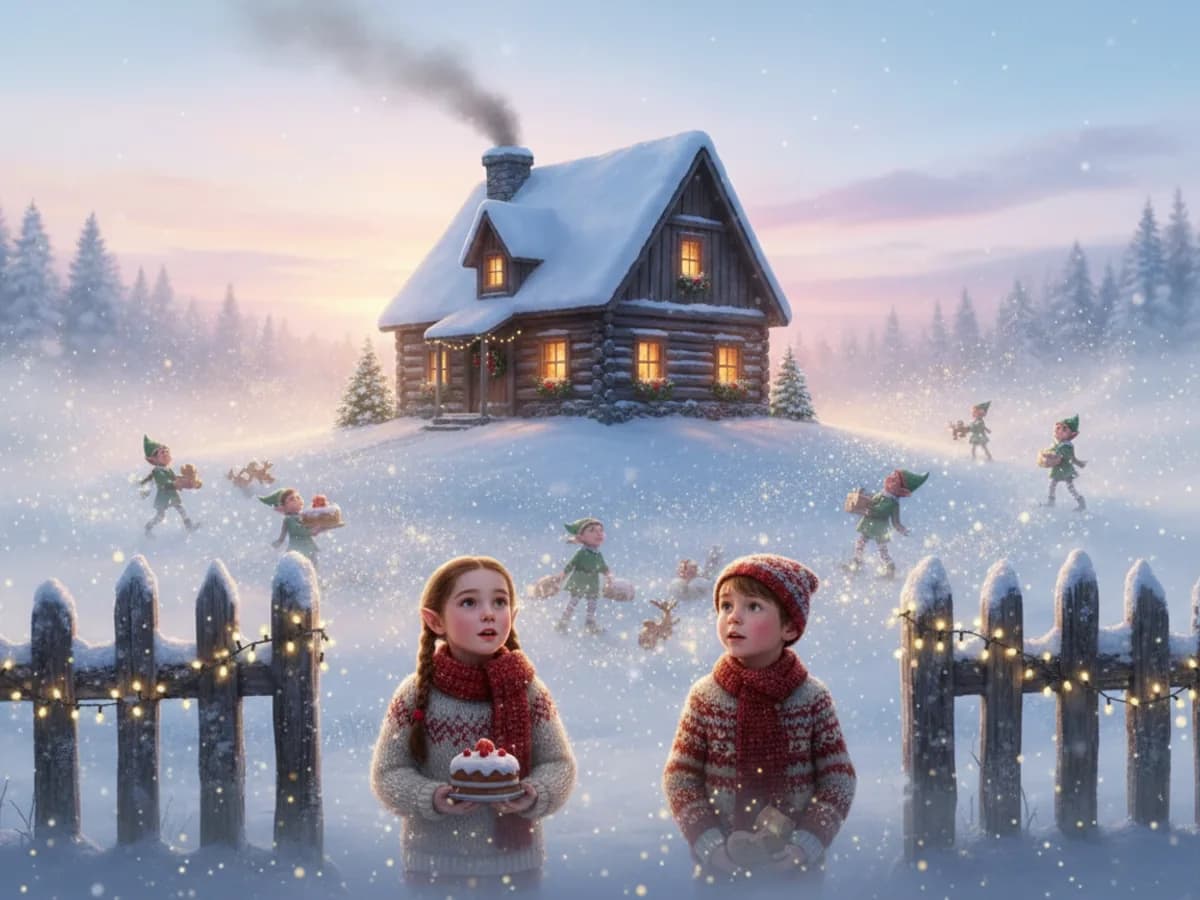
In that story, the saint lives at the top of a hill, in a house where elves make “cakes, sugar-plums, and toys to fill the stockings”: wagons and dolls, whistles, birds and elephants. A sign at the gate warns that nobody can ever enter who lies abed too late. And if children come to spy on the workshop, the elves stop dead and vanish “in a frosty mist.” A curious detail: in 1857 he doesn't live at the North Pole yet, and the story has him born in Germany.
- 1812The Brothers Grimm publish “The Elves and the Shoemaker,” two little men who work at night, shortly before Christmas.
- ca. 1855Louisa May Alcott writes a collection, “Christmas Elves,” never published and now lost.
- 1857Harper's Weekly describes elves making toys and sweets in the saint's house.
- 1866Thomas Nast draws Santa's workshop in “Santa Claus and His Works.”
- 1873The Christmas cover of Godey's Lady's Book shows Santa surrounded by toys and elves.
- 1902L. Frank Baum gives Santa four magical deputies.
- 1932Walt Disney releases the short film “Santa's Workshop.”
The Alcott story and the 1873 cover are covered in detail in is Santa Claus an elf. What matters here is the date: by around 1860, in New York, the idea of a team of helpers was in place.
What do Santa's elves do?
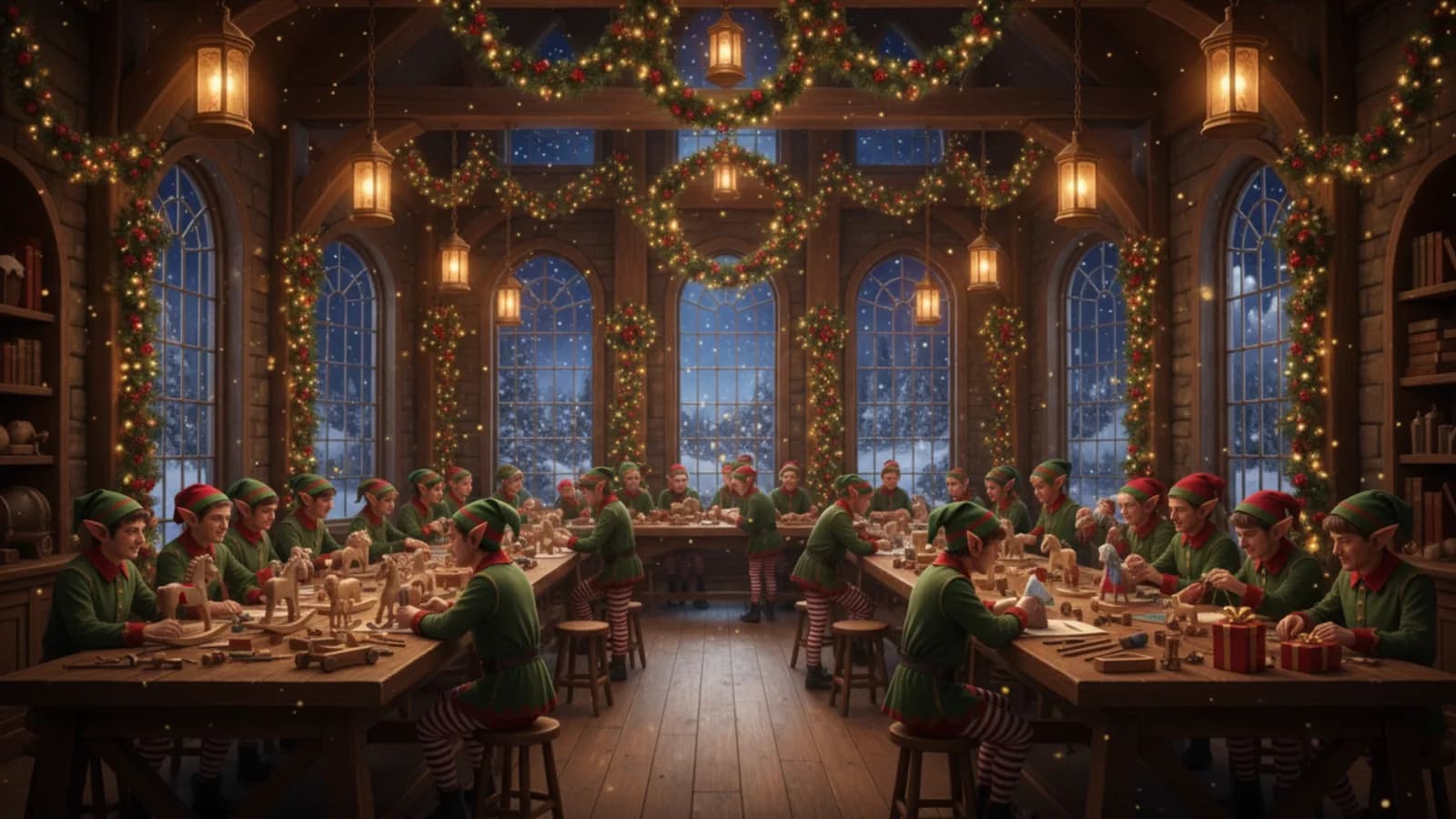
The first job is the workshop. On December 29, 1866, Thomas Nast published a double-page spread in Harper's Weekly, “Santa Claus and His Works.” When his drawings were collected in a book in 1890, the captions came with them: “Work-shop,” but also “Santa Claus stable” and “Account book, record of behaviour.” The three departments of the modern workshop are already there: making things, caring for the animals, keeping the books.
Seven years later, the cover of the December 1873 Godey's Lady's Book shows the workshop in full swing, with this caption: “Here we have an idea of the preparations that are made to supply the young folks with toys at Christmas time.” The elves are skilled workers. Twentieth-century movies would add new positions, from electronic toys to escort pilots.
The village's main workshops
- The toy shop: rocking horses, dolls, trains and games, based on the list drawn up with the children. Our toy list gives you a peek.
- The stable: feeding the reindeer, checking the harnesses, getting the sleigh ready for the night of the 24th.
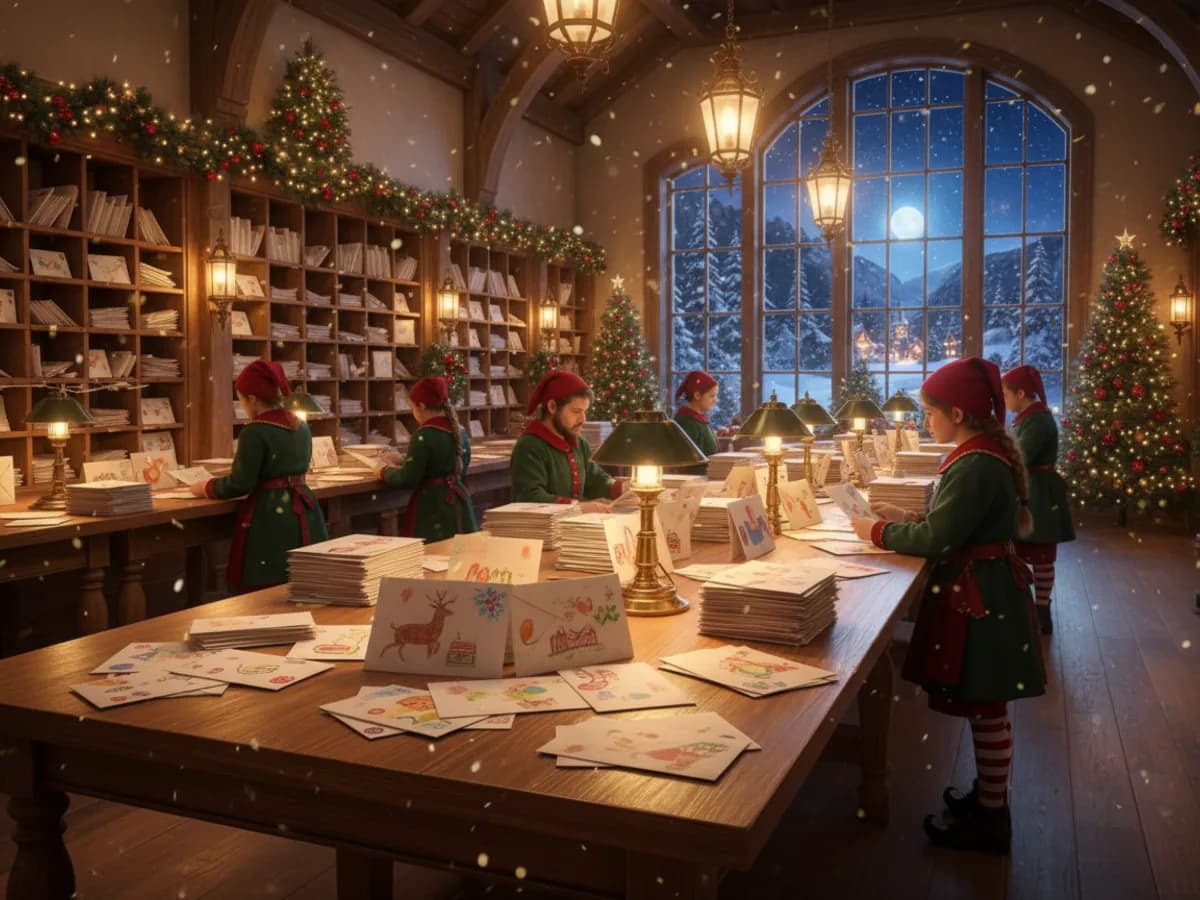
- The mailroom: opening, sorting and filing every letter to Santa.
- The ledger: recording the year's good deeds, with help from the nice detector.
- Wrapping: paper, ribbons and tags, the last station before takeoff.
You can tour the workshops on the village map, then stop by to say hello to the team on the elves page.
What are Santa's helpers called in Baum's story?
In 1902, L. Frank Baum, the author of The Wonderful Wizard of Oz, published “The Life and Adventures of Santa Claus,” illustrated by Mary Cowles Clark. In his story, Claus is a foundling raised by the wood nymph Necile in the Forest of Burzee. For his first toys, the whole magical world pitches in: the Ryls supply his paints, the Knooks pick out soft wood for him, and the Fairies bring him saws, chisels and other tools.
By the end of the book, Santa has four permanent deputies, one from each people. Baum doesn't call them elves, but they are clearly the ancestors of today's crew, with the jobs already divided up.
- Kilter, the pixie, a gift from Ak, the Master Woodsman of the World. Baum calls him “the silent and swift,” and he is the one who gathers children's letters.
- Peter, a Knook, sent by the Prince of the Knooks, guardians of the wild beasts.
- Nuter, a Ryl, sent by the Prince of the Ryls, guardians of the flowers.
- Wisk, a fairy, sent by the Fairy Queen. She is the one who suggests going through the walls of houses with no chimney.
The story even records a toy idea that came from a magical being: it is Necile who suggests that dolls should say “papa” and “mama.” The other talents Baum gives Santa are gathered in what powers does Santa have.
Are there real-life Santa's elves?
Some of them even get a paycheck. In France, the national post office, La Poste, reopens its Santa Secretariat every fall in Libourne, near Bordeaux. In 2025, according to its press release of November 18, Santa and his 60 elves went back to work on November 19 to answer hundreds of thousands of letters from all over the world. Children had until December 20 to write. The elves answer in English too.
In Canada the team is much bigger. In 2013 Canada Post announced 9,000 postal elves, current and retired employees who volunteer, and who had already given more than 226,000 hours to the program. Since 1982 they had received more than 21.8 million letters, and they can answer in more than 30 languages, Braille included.
In the United States, the small town of Santa Claus, Indiana, has had its own post office since 1856. Volunteers known as Santa's Elves answer every child who writes, a tradition that goes back at least to 1914. The whole story of that mail is in the history of letters to Santa.
Who are the most famous elves?
The most lovable may be Hermey. In *Rudolph the Red-Nosed Reindeer*, the stop-motion special first broadcast on NBC on December 6, 1964, as part of The General Electric Fantasy Hour, this elf leaves the workshop because he dreams of becoming a dentist. The scripts spell his name “Hermey,” even if some books call him “Herbie.”
On the big screen, the head elf is Bernard in *The Santa Clause*, released in 1994. He was played by David Krumholtz, then sixteen, because the film series casts children and teenagers as elves. In 2003, the movie *Elf* tells the story of Buddy, a human raised among the elves. His journey is covered in is Santa Claus an elf.
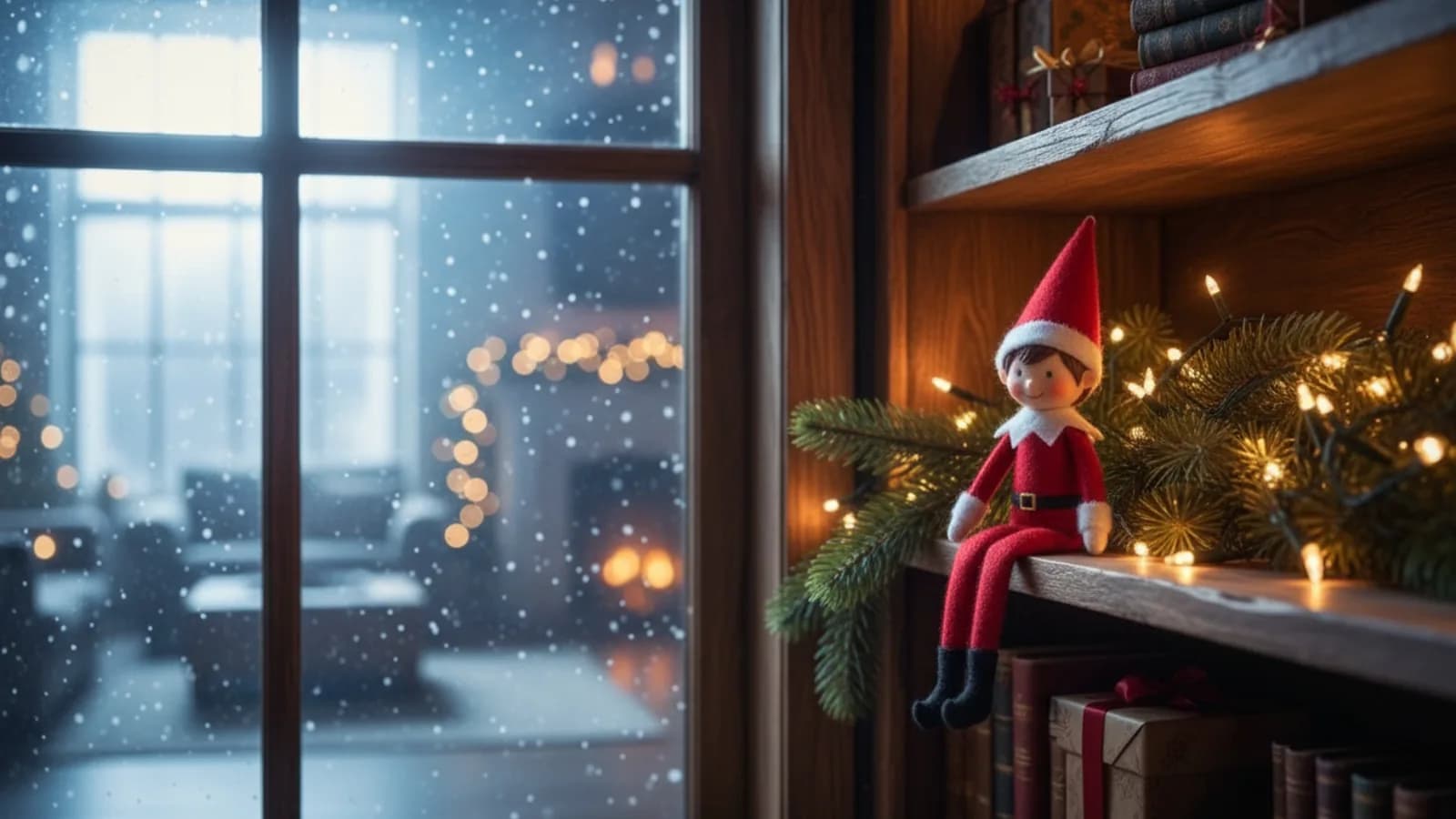
The newest arrival lives in people's homes. The Elf on the Shelf was born in 2005: that year Carol Aebersold published a book sold with an elf figure, in which the elf watches children and reports back to Santa. The French science site Futura notes that the same year, in Quebec, a grandfather was drawing footprints in the snow to convince his grandchildren that an elf had come by. Parents will find rules and ideas in our Elf on the Shelf guide.
Sources
- Wikipedia, “Christmas elf”
- Morristown Green, “The Wonders of Santa Claus: Images of Saint Nick before Thomas Nast,” December 23, 2020
- Colgate University, Picker Art Gallery, Thomas Nast, “Santa Claus and His Works,” Harper's Weekly, December 29, 1866
- Project Gutenberg, Thomas Nast, “Thomas Nast's Christmas Drawings for the Human Race,” Harper & Brothers, 1890
- Project Gutenberg, L. Frank Baum, “The Life and Adventures of Santa Claus” (full text)
- Wikipedia, “The Life and Adventures of Santa Claus” (Bowen-Merrill, 1902)
- Library of America, “Louisa May Alcott and Christmas Elves”
- CNRTL, Trésor de la langue française, etymology of “lutin”
- La Poste, “Le Secrétariat du Père Noël rouvre ses portes,” press release, November 18, 2025
- Canada Post, “Postal elves ready to help Santa's post office,” November 12, 2013
- Wikipedia, “Santa Claus, Indiana”
- Wikipedia, “Rudolph the Red-Nosed Reindeer (TV special),” 1964
- Futura, Alexandra Arquey, “L'incroyable histoire des lutins farceurs,” December 13, 2024
- NPR (via WWNO), “Whiskey and fufu: what kids around the world leave out for Santa,” December 22, 2017
- D. L. Ashliman, University of Pittsburgh, Brothers Grimm, “The Elves” (Die Wichtelmänner, KHM 39, 1812), text and notes