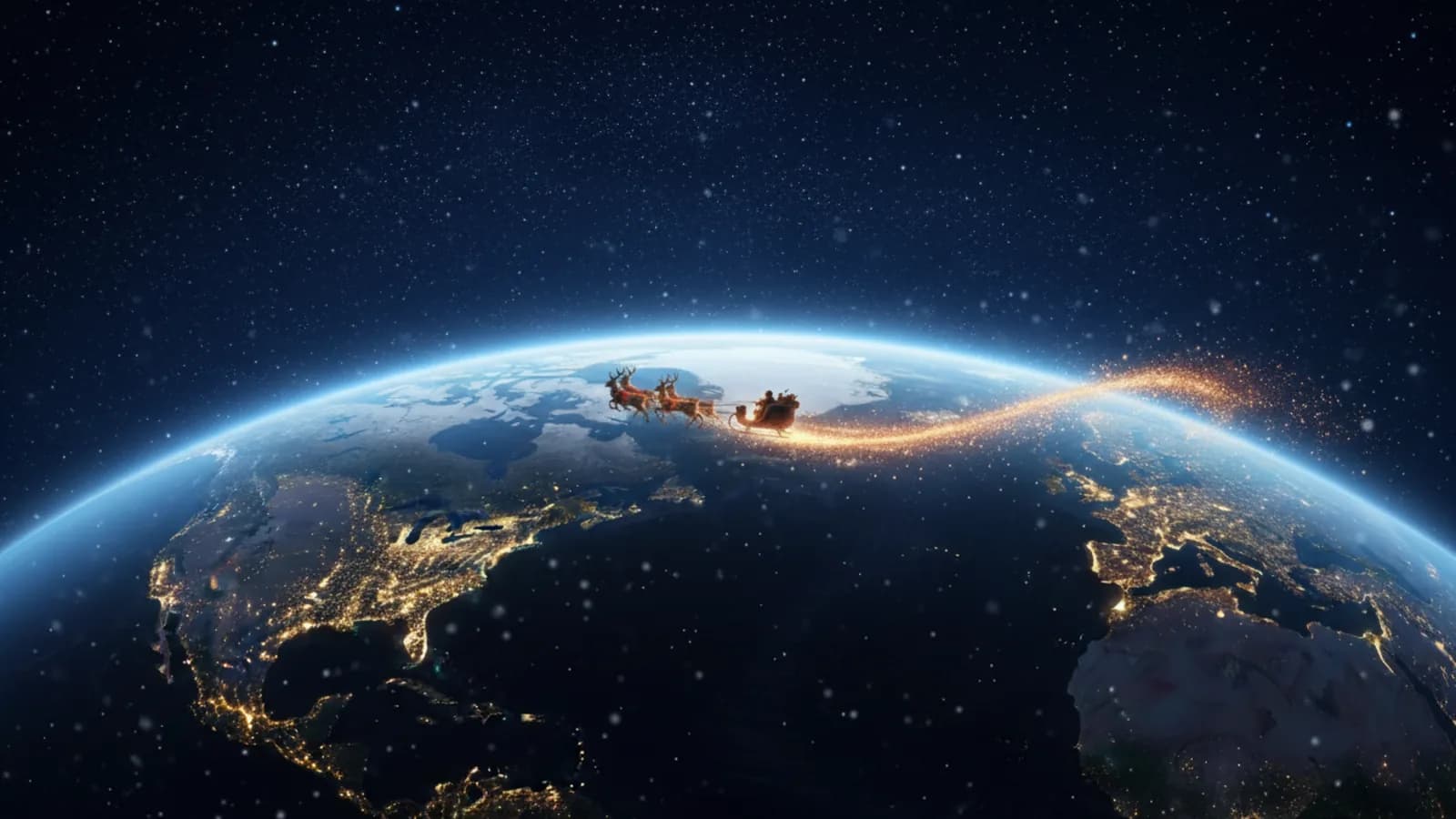
“How can Santa Claus get around to all the houses in one night?” Children have been asking it in their letters for generations. Psychologists have even singled it out in emails sent to Santa, as the classic question older kids ask, while the little ones want to know where he lives.
In the village, we answer first with a smile, then with a world map. Christmas Eve does not begin at the same moment everywhere, the sleigh follows a very precise route, and part of the trip takes place in full view of an air defense command center. The rest belongs to magic, and we leave it where it is.
How can one sleigh reach every home in a single night?
Children believe in him deeply, and they still wonder. In 2015, Andrew Shtulman and Rachel Yoo, psychologists at Occidental College in Los Angeles, questioned 47 children aged 3 to 9. Eighty-three percent said Santa travels around the world in a single night, and 96 percent said he flies in a reindeer-drawn sleigh.
The same researchers read emails sent to Santa. The youngest children ask where he lives or whether the North Pole is cold. The older ones want to know how he fits down a narrow chimney or how he can see everyone in the whole wide world. When asked to explain his feats, 14 percent of the answers relied on magic alone, with no other detail. The feat that inspired the most attempts at an explanation was making every toy in a single workshop, offered by 24 of the 47 children. The one that inspired the fewest was the flying sleigh: only 12 children tried.
We would not tell them they are wrong. But Santa's magic does not rule out planning, and the Christmas Eve route is probably the best-prepared job of the year. His other talents, like rising back up the chimney or knowing who has been good, are covered in What powers does Santa have?.
How long does Christmas Eve really last?
The first secret is geography. The Earth is divided into time zones, and they do not stop at twelve hours apart. The first inhabited places to start a new day are islands of Kiribati in the Pacific set to UTC+14, such as Kiritimati, also called Christmas Island. The last are Baker and Howland Islands, uninhabited, set to UTC−12.
Between the two lie 26 hours. When midnight strikes on Christmas Eve in Kiritimati, there are still 26 hours to go before the same midnight reaches Baker and Howland. Add the fact that a child's night runs roughly from 10 p.m. to 6 a.m., and the delivery window stretches to about 34 hours.
- 10 p.m. in Kiritimati (UTC+14): the first children are asleep and the route can begin.
- Midnight in New Zealand, then Australia, then Asia: the sleigh heads west.
- Midnight in London (UTC+0): Britain enters the window, fourteen hours after Kiritimati.
- Midnight in New York (UTC−5): the U.S. East Coast, five hours later.
- 6 a.m. on Baker and Howland Islands (UTC−12): the window closes, about 34 hours after takeoff.
The calendar itself has moved over the years. Kiribati deleted Saturday, December 31, 1994, jumping straight from Friday, December 30, to Sunday, January 1, 1995, to bring the whole country onto the same side of the International Date Line. Samoa did the same in 2011, skipping Friday, December 30. The elves in charge of routes had to redraw their maps both times.
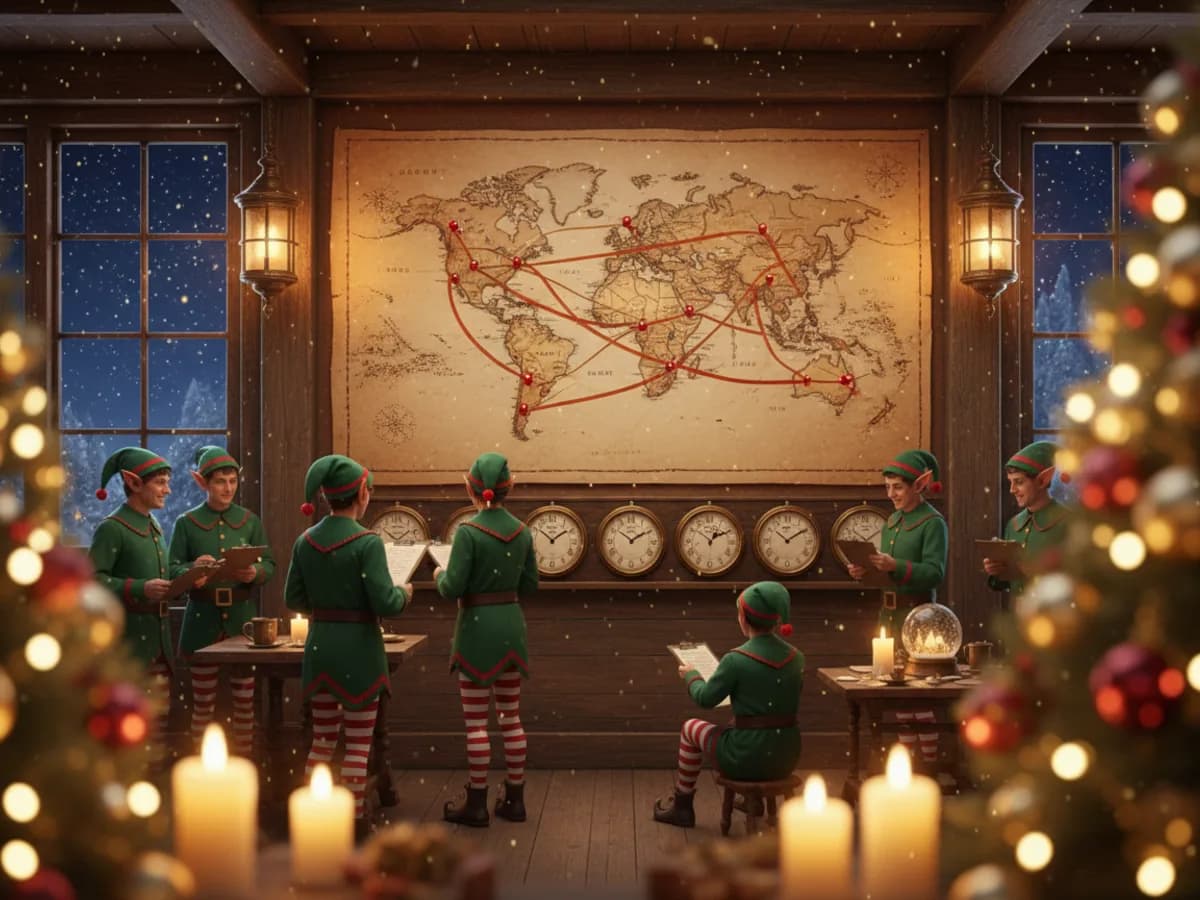
Which way does Santa travel on Christmas Eve?
To stay in the dark, you have to follow the dark. The Earth spins from west to east, so night moves westward from one time zone to the next. A traveler who leaves from the Pacific and heads west keeps the night around him far longer than if he stayed put.
That is why the route begins near the International Date Line in the Pacific, then crosses Oceania, Asia, Africa and Europe before heading over the Atlantic to the Americas. Children in the islands of Kiribati are among the first served, those in Hawaii and the eastern Pacific islands among the last.
The sleigh does not fly in a straight line. It goes where children are sleeping, which means detours: a mountain village where bedtime runs late, a city where the Christmas Eve dinner drags on. The 1823 poem already gave the method: the visitor arrives, goes straight to work “without a word,” fills the stockings and is off again, “like the down of a thistle.”
He spoke not a word, but went straight to his work, / And filled all the stockings; then turned with a jerk.
What we know about the sleigh itself, from its first model in 1821 to the radar screens of the twentieth century, is told in When did Santa get his sleigh?.
How does NORAD track Santa?
It all started with a typo. In December 1955, a Sears ad in a Colorado Springs newspaper gave children a number to call Santa. One digit was wrong, and the number rang a secret line at the Continental Air Defense Command. According to his children, interviewed by NPR's StoryCorps in 2014, only a four-star general at the Pentagon and their father had that number.
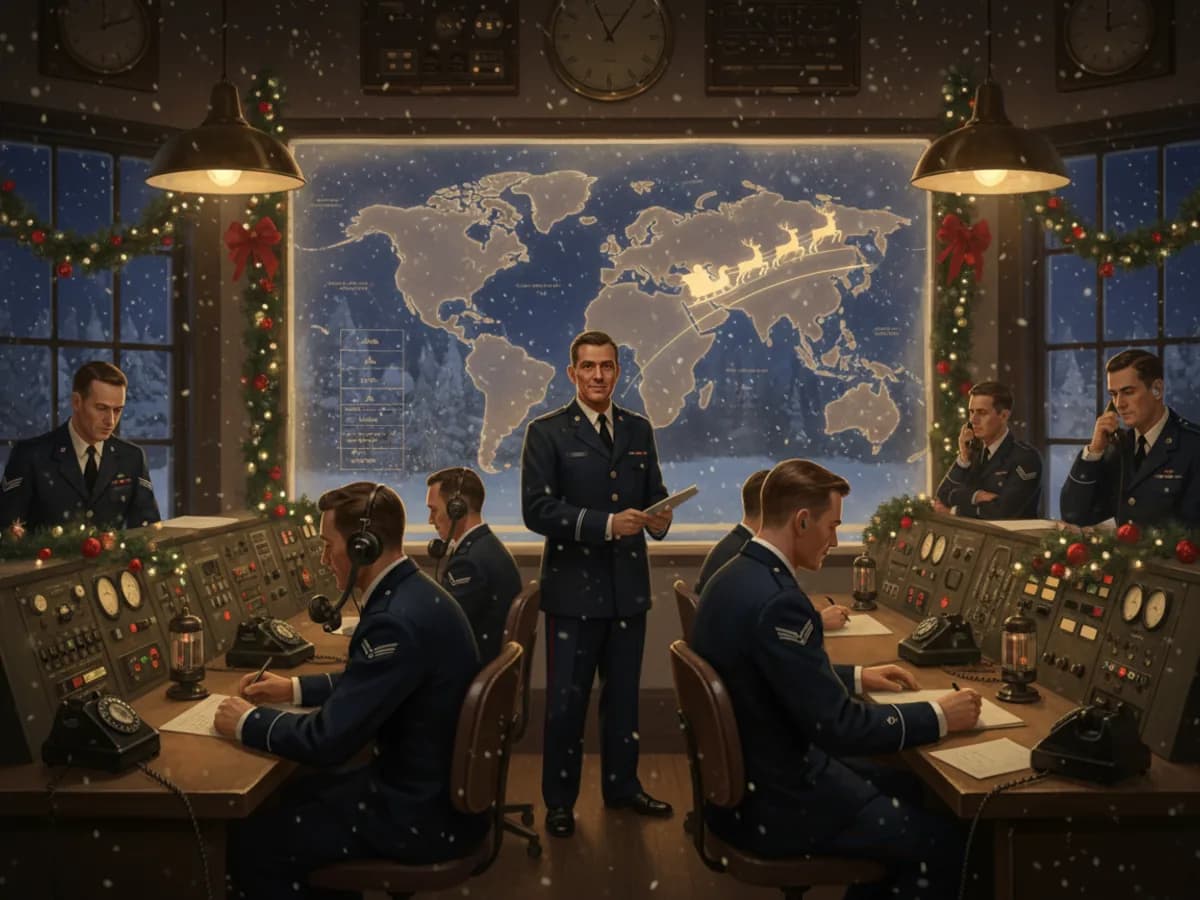
That father was Colonel Harry Shoup. He picked up, annoyed, thinking it was a prank. On the line, a small child in tears asked, “Is this Santa Claus?” The colonel played along, asked to speak to the child's mother, then had his airmen answer the calls. They drew a sleigh and eight reindeer on their tracking board. Shoup called a radio station to report a flying object that “looks like a sleigh,” and stations called him back every hour for its position.
- 1955A misprinted Sears ad rings Colonel Harry Shoup's line.
- 1956The colonel agrees to do it again, and the tradition becomes yearly.
- 1958NORAD, the joint U.S.-Canadian command, takes over the tracking.
- 1997Santa tracking goes online.
- 2004Google launches its own tracker, inspired by NORAD's.
Today the operation draws about a thousand American and Canadian volunteers, many of them service members. In 2013, about 1,200 volunteers answered 117,371 calls. Each one handles around forty calls an hour. Most calls come in during a 25-hour window, from 2 a.m. on December 24 to 3 a.m. on December 25, Mountain Time. The calls come from more than 200 countries and territories, and the team also handles more than 12,000 emails. Some volunteers are famous: Michelle Obama took calls every Christmas Eve from 2009 to 2016. That same 2013 season, the tracking website drew 19.58 million unique visitors on Christmas Eve alone, proof that grown-ups like watching the sleigh as much as children do.
Families who want to follow the sleigh on the evening of the 24th have options. Ours is on the Santa tracker page, with stopovers and an estimated arrival time. Practical tips for turning it into a family ritual are gathered in How to track Santa on Christmas Eve.
Does Santa have more time than we do?
Even 34 hours sounds short for every child in the world. NORAD has its answer, delivered with a straight face and quoted in the American press: according to its “intelligence reports,” Santa does not experience time the way we do. What feels like a single night to us could last much longer for him.
The village archives agree, without going into technical detail. They note only that on December 24 the workshop clocks do not chime, the hot cocoa never cools in the sleigh's thermos, and Santa is always home before the first rooster in Lapland crows.
The work starts long before the 24th
The second secret is that Christmas Eve is only the last step. Letters start arriving in the fall. The elves sort them by country and time zone, the workshop builds the toys on the list, and the packages are loaded into the sleigh in the exact order of the route: first deliveries on top, last ones at the bottom.
What time does Santa come to your house?
According to NORAD reports picked up by the press, Santa generally reaches homes between 9 p.m. and midnight, local time. There is one condition, and it is not up for negotiation: the children must be asleep. If he finds a house still awake, he moves on and comes back later.
That is why it is best to go to bed early on Christmas Eve, even when the grown-ups' dinner runs late. One family trick is to watch the sleigh on the Santa tracker: when it gets close to your state, it is time for bed.
- Send your letter to Santa early enough to be sorted before takeoff.
- Check your status on the nice detector.
- Leave a small snack near the tree, and a carrot for the reindeer.
- Turn off the lights and go to sleep: that is the signal the sleigh is waiting for.
As for the snack, every country has its habits, from American milk and cookies to British mince pies. We go through them in What to leave out for Santa and his reindeer.
Sources
- Shtulman and Yoo, “Children's understanding of physical possibility constrains their belief in Santa Claus,” Cognitive Development, 2015
- Wikipedia, International Date Line
- Wikipedia, NORAD Tracks Santa
- MPR News / NPR StoryCorps, “NORAD's Santa tracker began with a typo and a good sport,” 2014
- CBS News Pittsburgh, “Where's Santa? Tracking when he'll arrive in Pittsburgh”
- Project Gutenberg, 'Twas the Night before Christmas: A Visit from St. Nicholas