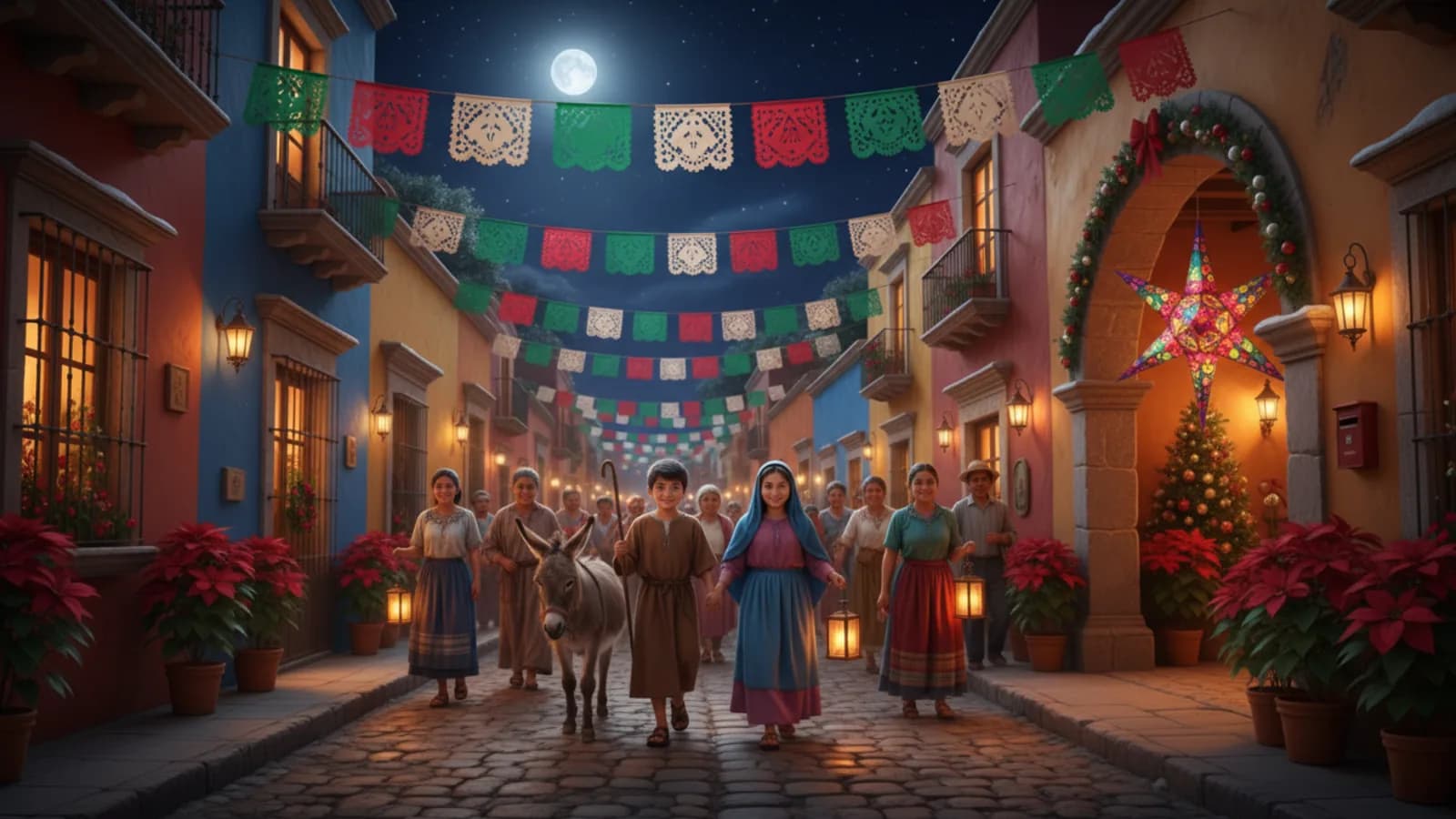
On the evening of December 16, on a street in Mexico City, a small group knocks on a door, candles in hand. Two children are playing Mary and Joseph. From inside, a voice sings back and refuses to let them in. The procession moves on to another house, and another, until the last one, where the door finally opens onto tamales, hot ponche and a star-shaped piñata. The next night, they do it again. For nine nights.
That is the posada, the most Mexican of Christmas traditions, but it is only one stop in a season that starts on December 12 and doesn't end until February 2. Our Christmas traditions page gives it a single line; here we follow the calendar day by day, with the dates and sources behind it.
When does Christmas start and end in Mexico?
The season opens with the feast of the Virgin of Guadalupe on December 12, after a novena of prayers that begins on the 3rd. That is often the day families set up their nacimiento, the nativity scene, which stays out until February 2. Mexican nativity scenes like to add local details: nopal cactus, turkeys, a woman making tortillas.
- Dec. 12Feast of the Virgin of Guadalupe; the nativity scene goes up.
- Dec. 16-24Nine nights of posadas, with songs, ponche and piñatas.
- Dec. 23Noche de Rábanos in Oaxaca, the radish-carving contest.
- Dec. 24Nochebuena: Misa de Gallo, a late dinner, the Christ Child laid in the manger.
- Dec. 28Día de los Santos Inocentes, Mexico's April Fools' Day.
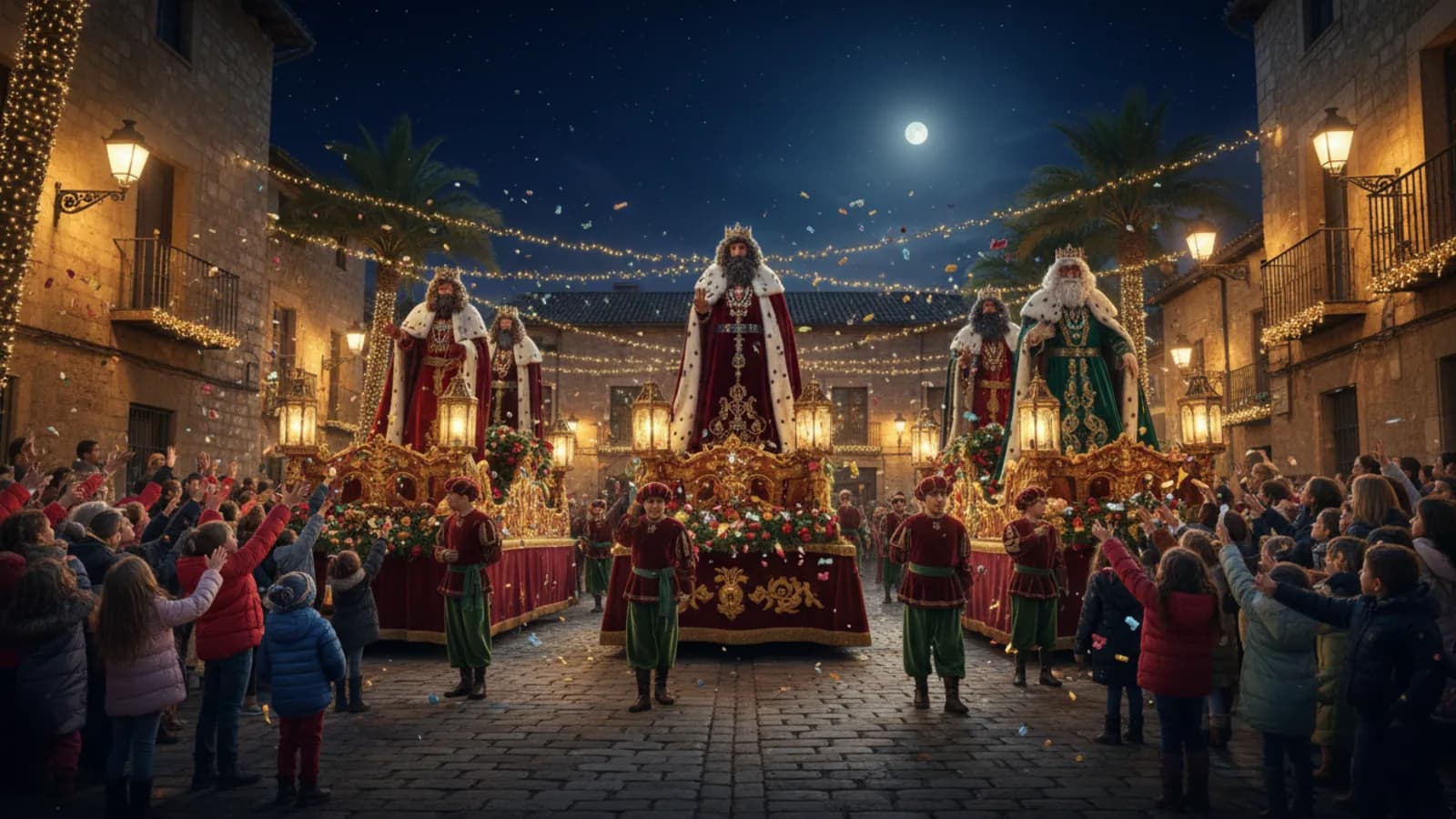
- Jan. 6Día de Reyes: presents from the Three Kings and the rosca.
- Feb. 2Día de la Candelaria: the Christ Child is blessed, and tamales are shared.
For children, that calendar changes everything. A Mexican child may get a present on the night of the 24th, another on January 6, and share tamales with the whole family on February 2.
What is Las Posadas in Mexico?
*Posada* means "inn" or "lodging." The posadas re-enact Mary and Joseph's search in Bethlehem, knocking from door to door without finding a place to sleep. They take place every evening from December 16 to 24, nine nights in all: each one, by tradition, stands for a month of Mary's pregnancy.
Their origin is unusually precise. Sources place it at the Augustinian monastery of San Agustín de Acolman, near Mexico City. In 1586 or 1587, depending on the author, its prior, Fray Diego de Soria, obtained permission from Pope Sixtus V to celebrate *misas de aguinaldo*, "Christmas gift Masses," from December 16 to 24. Over time the celebration left the church and moved from house to house, into streets and courtyards.
How does a posada work?
- Two people, often children, play Mary and Joseph; Mary sometimes rides a real donkey. Other processions simply carry statues.
- The leader carries a candle inside a paper shade, and everyone follows with a light of their own.
- The group splits in two: one half sings outside to pedir posada, ask for lodging, and the other answers from inside and refuses.
- At the last door, the "innkeepers" recognize the pilgrims and open up. Everyone prays at the nativity scene, often the rosary.
- Then comes the party: villancicos (carols), tamales, atole, buñuelos, ponche, and the piñata.
Guests often go home with an aguinaldo, a small bag of treats. The custom has traveled: in San Antonio, Texas, a large posada has followed the River Walk to San Fernando Cathedral every year since 1966, and the Philippines turned it into a pageant of its own, the *Panunulúyan*.
Why does a Christmas piñata have seven points?
A Christmas piñata isn't a donkey or a cartoon character: it is a seven-pointed star, traditionally built around a clay pot. Each point stands for one of the seven deadly sins. Breaking it symbolically "destroys" the sins, and the fruit and candy that fall out are shared by everyone.
It is part of every posada night, and it's the moment children wait for all evening. The points are wrapped in colored paper with long streamers that fly at every swing.
Today the star sits alongside character piñatas, and many are made of cardboard instead of clay. The ritual hasn't changed: each child takes a turn swinging while the adults sing and pull the rope to make the star rise and fall.

What happens on Nochebuena, Christmas Eve in Mexico?
December 24 is called Nochebuena, "the good night." Families attend the Misa de Gallo, the "Rooster's Mass," held late in the evening, then gather for a big dinner. That night the figure of the Christ Child, the Niño Dios, is finally laid in the nativity scene, where the manger has stood empty since December 12.
On the table: bacalao, a salt cod stew; romeritos, a plant with fleshy green leaves that is boiled and then served in a mole, often with dried-shrimp fritters; and a turkey or a ham. Children play with sparklers called *luces de Belén*, "lights of Bethlehem." According to El Universal, romeritos were eaten long before the Spanish arrived, and because the dish contains no meat it became a fixture of vigil meals, and December 24 was a vigil day. Presents are often opened at midnight, and Christmas Day itself is fairly quiet.
The Nochebuena flower
The plant the rest of the world calls a poinsettia carries the name of the holiday in Mexico: flor de Nochebuena. Before the Spanish conquest it was called *cuetlaxochitl* in Nahuatl, which Gaceta UNAM translates as "flower that withers." It was used in ceremonies, and rulers grew it in their gardens.
The English name comes from Joel R. Poinsett, named the first U.S. envoy to Mexico in 1825. He left the country in 1828, and Bartram's Garden in Philadelphia presented the "Poinsettia" at the end of 1829. In 2018, according to Gaceta UNAM, Europe grew about 110 million plants, the United States 50 million and Mexico 19 million.
What is Oaxaca's Night of the Radishes?
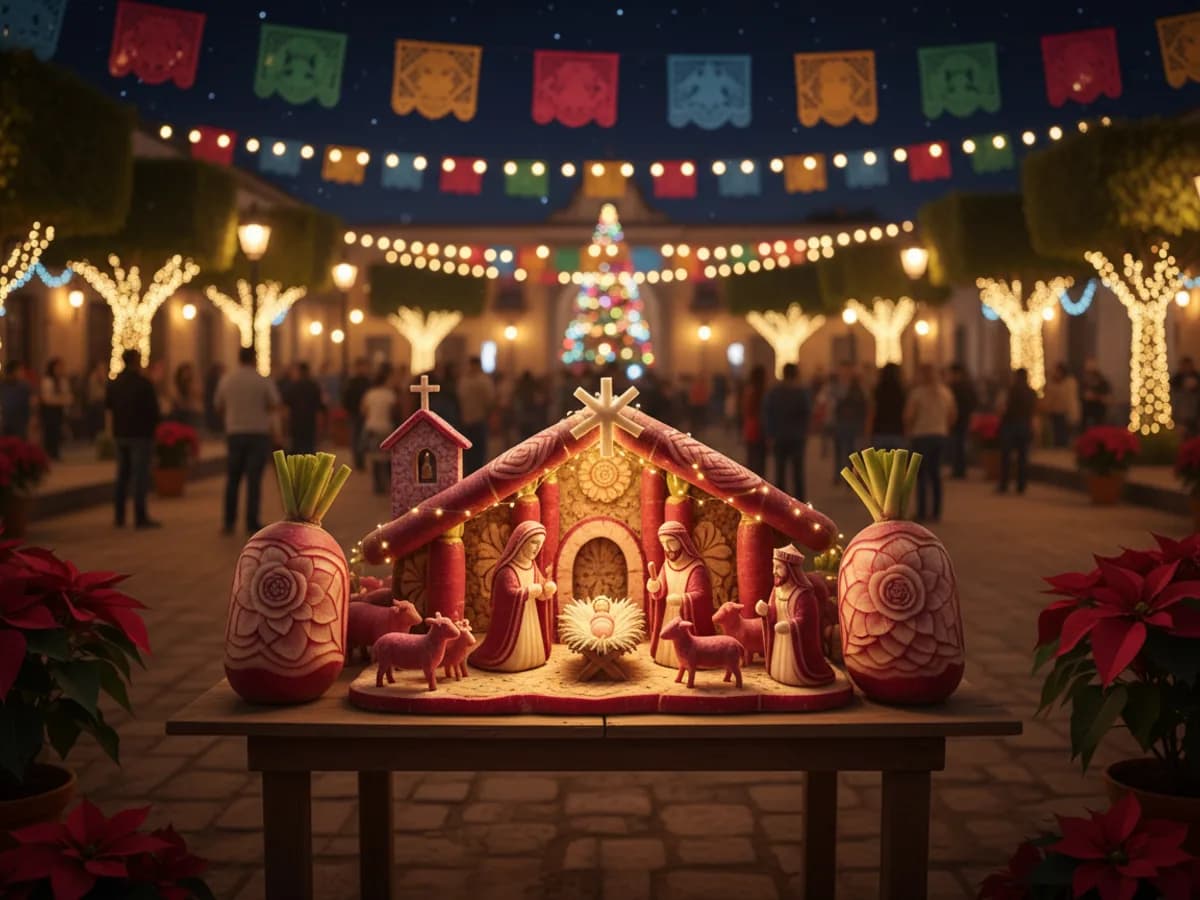
Every December 23, the main square of Oaxaca, in southern Mexico, fills with carved radishes. Nativity scenes, dancers, churches, animals: more than a hundred competitors carve entire scenes out of giant radishes. The city has held the contest since 1897.
According to Mexico News Daily, the radishes all come from a single field in Santa Cruz Xoxocotlán. They are planted in three rounds to get different sizes, using techniques that make them unfit to eat, and harvested on December 19. The show lasts only a few hours: once carved, the radishes wilt and lose their shape. Other categories use dried flowers and corn husks.
A legend says that in the 18th century, friars found some forgotten radishes in December and took them to market as curiosities. What is certain is that before the contest existed, growers were already carving overgrown radishes into figures to draw shoppers at the Christmas market.
Pastorelas and Holy Innocents' Day
All over the country, the season is also the time of pastorelas, shepherds' plays featuring the Archangel Michael, the devil Luzbel and a comic hermit on the road to Bethlehem. On December 28, Día de los Santos Inocentes, people play pranks, much like April 1 in the US: the classic trick is borrowing something under false pretenses.
Who brings presents in Mexico: Santa Claus, the Niño Dios or the Three Kings?
All three, depending on the family. In Mexico people simply say Santa Claus, keeping the English name, and he comes on the night of the 24th. In many homes it is the Niño Dios, the Christ Child, who brings the Christmas presents. And on January 6 the Reyes Magos, the Three Kings, arrive, and they often bring the most gifts. Their names are covered in Santa Claus names around the world.
These habits are younger than you might think. An article in UNAM Global, the outlet of Mexico's National Autonomous University, points out that giving children presents on Three Kings' Day is not a colonial tradition: it took hold in the 19th century. An academic quoted there calls Santa Claus "the Anglo-Saxon tradition."
On the night of January 5, children leave a shoe by the door and sometimes tie their letter to the Kings to a helium balloon. On the 6th, families share the rosca de Reyes, a ring-shaped sweet bread hiding a tiny figure of the Christ Child. Whoever finds it provides the tamales on February 2, Candlemas, when the family's Christ Child figure is taken to church to be blessed, often dressed for the occasion. The Three Kings get a full section in Christmas gift bringers around the world.
The Christmas tree came later, first in the homes of foreigners living in Mexico, then in Mexican families. It went on to break records: in 2009, Mexico City put up a 110.35-meter (362-foot) tree recognized by Guinness as the world's largest at the time. To write to Santa before his visit on the 24th, use our letter page.
Sources
- Wikipedia, Christmas in Mexico
- Wikipedia, Las Posadas
- Mexico News Daily, Joseph Sorrentino, December's posadas, 2020
- Mexico News Daily, Christmas in Oaxaca means it's time for radishes, 2019
- Gaceta UNAM, Rafael López, Nochebuena, la flor que México le regaló a la Navidad, 2019
- UNAM Global, Leonardo Huerta Mendoza, Los Reyes Magos seguirán existiendo
- El Universal, La historia detrás de los romeritos que comemos en Navidad y Año Nuevo