December 24 is the longest day of the year for a five-year-old. It starts at breakfast, drags through an endless afternoon and is supposed to end with a child falling asleep fast, while everything in the house says stay awake. Plenty of families go through it without a plan, and that is usually where the evening falls apart.
Elsewhere in the world, Christmas Eve comes with clear rules. A set time for television in Sweden, a star to watch for in Poland, a book to open in Iceland, a bell in Germany. These rituals have one thing in common: they give the evening a rhythm. Here are the ones you can borrow, and how to fit them to your children's ages.
Why does Christmas Eve matter so much?
In much of Europe, Christmas happens on the evening of the 24th, not the morning of the 25th. In Germany, presents are opened on Heiligabend, Christmas Eve. In Poland, the Wigilia supper is the high point of the holidays. In France, réveillon brings the family together before Père Noël comes, and in Mexico presents are often opened at midnight. In the United States and the UK, by contrast, the big moment is the morning of the 25th, and the night before is for getting ready for the visitor.
For parents, that changes the question. The point isn't to fill the evening but to give it a shape: a beginning, a few steps the kids look forward to, and a clear ending. The traditions below are sorted by country, but each one can be translated into half an hour in any living room.
What is Jólabókaflóð, Iceland's Christmas Eve book tradition?
In Iceland, Christmas Eve is book night. Families give each other books, then spend the rest of the evening, and often the next day, reading them. The tradition has a name, Jólabókaflóð, "the Christmas book flood."
According to Iceland's tourism board, it is tied to a catalog, the Bókatíðindi, published every year since 1944 and sent to every household in mid-November, around the Reykjavík Book Fair. Icelanders use it to choose the books they will give. The country has plenty to read: Reykjavík has been a UNESCO City of Literature since 2011, and the writer Halldór Laxness won the Nobel Prize in 1955.
Why do Polish families wait for the first star?
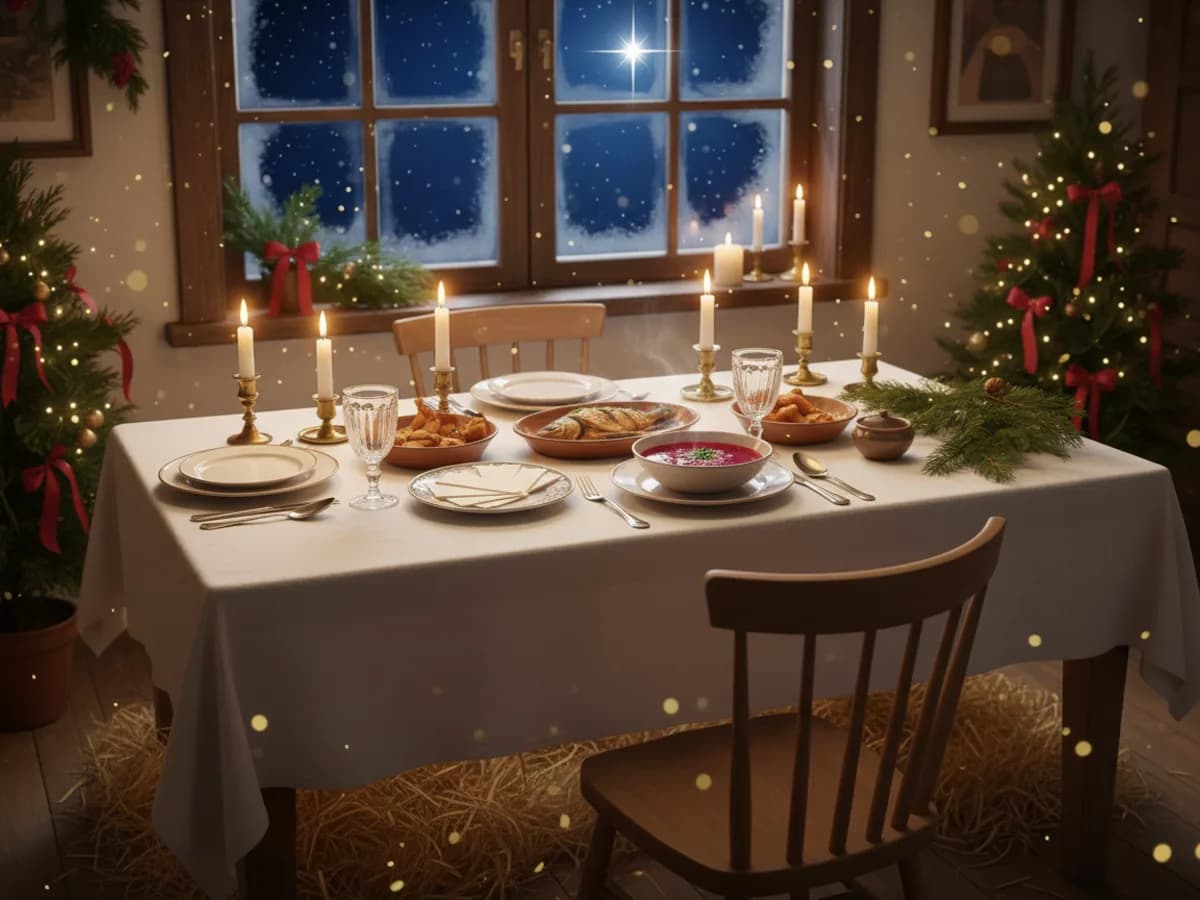
In Poland, the Christmas Eve supper, the Wigilia, doesn't start until the first star appears in the sky, the *Gwiazdka*, a reminder of the Star of Bethlehem. Children are put in charge of watching for it at the window, and the first one to spot it gives the signal.
- Everyone breaks and shares the opłatek, a thin wafer, exchanging good wishes before eating.
- A little hay goes under the tablecloth, in memory of the manger.
- One place is left empty at the table, for the Christ Child or a lonely traveler.
- Twelve dishes are served, for the twelve apostles, or an odd number depending on the family, with no red meat: carp is the most common fish.
- Presents are exchanged after supper, and the night ends with Pasterka, midnight Mass.
Watching for the star is one of the easiest rituals to borrow with young children. In December it gets dark early: a child posted at the window with a flashlight, in charge of announcing dinner, has a mission, a moment to be the hero, and a reason not to run around while you set the table.
Why do so many countries eat fish on Christmas Eve?
One thread ties together Polish carp, Mexican salt cod and the Provençal gros souper: in Catholic tradition, no meat was eaten on Christmas Eve. The evening meal stayed "lean," meatless, but it could be very generous, and fish took pride of place.
Italian families simply call it La Vigilia, the Eve. Mental Floss notes that the name "Feast of the Seven Fishes" was born in the United States among emigrants from southern Italy, a poor coastal region where fish was affordable. Nobody really knows where the number seven comes from, and baccalà, salt cod, is almost always on the menu.
In Provence, the gros souper on the 24th, a meatless meal of seven dishes according to France.fr, follows the same logic and ends with the thirteen desserts we describe in Christmas in France. In Mexico, the Nochebuena dinner stays loyal to bacalao, as told in Christmas in Mexico.
How do you mark the arrival of presents on Christmas Eve?
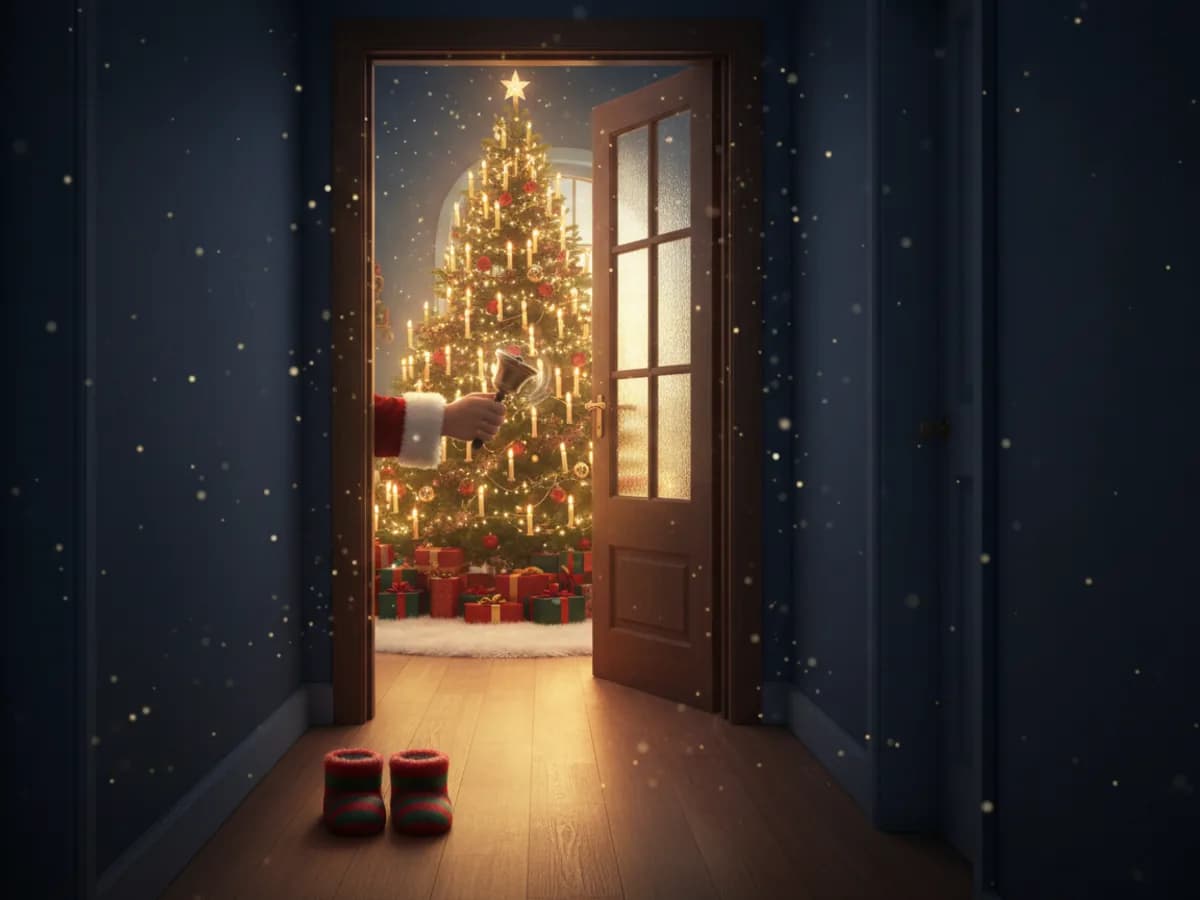
In Germany, the Bescherung comes with a sound cue. Children wait outside the room, and a little bell announces that the Christkind or the Weihnachtsmann has just left. Then they discover the lit tree and the presents. We describe that moment in Christmas in Germany.
In countries where presents arrive overnight, the evening is spent getting ready. In France, children used to set their shoes by the fireplace. In the US and the UK, families hang stockings and leave a snack for the visitor and his reindeer; each country's menu is in what to leave out for Santa. In Catalonia, children beat the Tió log while singing so that it will "poop" out treats, a custom covered in Christmas gift bringers around the world.
Many American families also read *A Visit from St. Nicholas* at bedtime, the 1823 poem that opens with "'Twas the night before Christmas." Its story is told in the history of 'Twas the Night Before Christmas.
'Twas the night before Christmas, when all through the house / Not a creature was stirring, not even a mouse.
What is a good Christmas Eve schedule with young children?
The Christmas Eve trap is the gap between the adults' dinner time and the children's bedtime. The American Academy of Sleep Medicine recommends 10 to 13 hours of sleep per 24 hours, naps included, for ages 3 to 5, and 9 to 12 hours for ages 6 to 12. A child who will be up at 7 a.m. on the 25th needs to be asleep between 8 and 9 p.m., whatever is on the menu.
- 3 p.m.A fixed appointment, Swedish style: a short movie, a song, a call to the grandparents.
- 4:30 p.m.Kitchen time: the dish or cookies the kids will serve tonight.
- 5:30 p.m.First-star watch, Polish style, then a look at the Santa Tracker.
- 6:30 p.m.Kids' dinner, or an early first course for the whole family.
- 7:30 p.m.Snack for Santa, stockings or shoes, one last check on the sleigh.
- 8 p.m.Pajamas, an Icelandic-style book, lights out. The grown-ups' evening can begin.
Shift the plan an hour later for 6- to 8-year-olds, who can stay for dessert. From around 9 or 10, many kids would rather step behind the scenes: setting out the little ones' presents, ringing the bell, taking a bite out of the reindeer's carrot. To follow the sleigh without losing track of time, see how to track Santa on Christmas Eve.
Sources
- Visit Iceland, The Christmas Book Flood
- Wikipedia, Christmas in Poland (Wigilia)
- Mental Floss, The forgotten Disney special that became a Swedish Christmas tradition
- Wikipedia, Christmas Peace (Turku)
- Mental Floss, The Feast of the Seven Fishes facts
- Wikipedia, Christmas in Germany (Bescherung)
- Wikipedia, Christmas in Mexico
- Academy of American Poets, A Visit from St. Nicholas
- Paruthi et al., Recommended Amount of Sleep for Pediatric Populations, American Academy of Sleep Medicine, Journal of Clinical Sleep Medicine, 2016
- France.fr (Atout France), Noël et traditions culinaires en Provence
- FrenchEntrée, Christmas Traditions in France