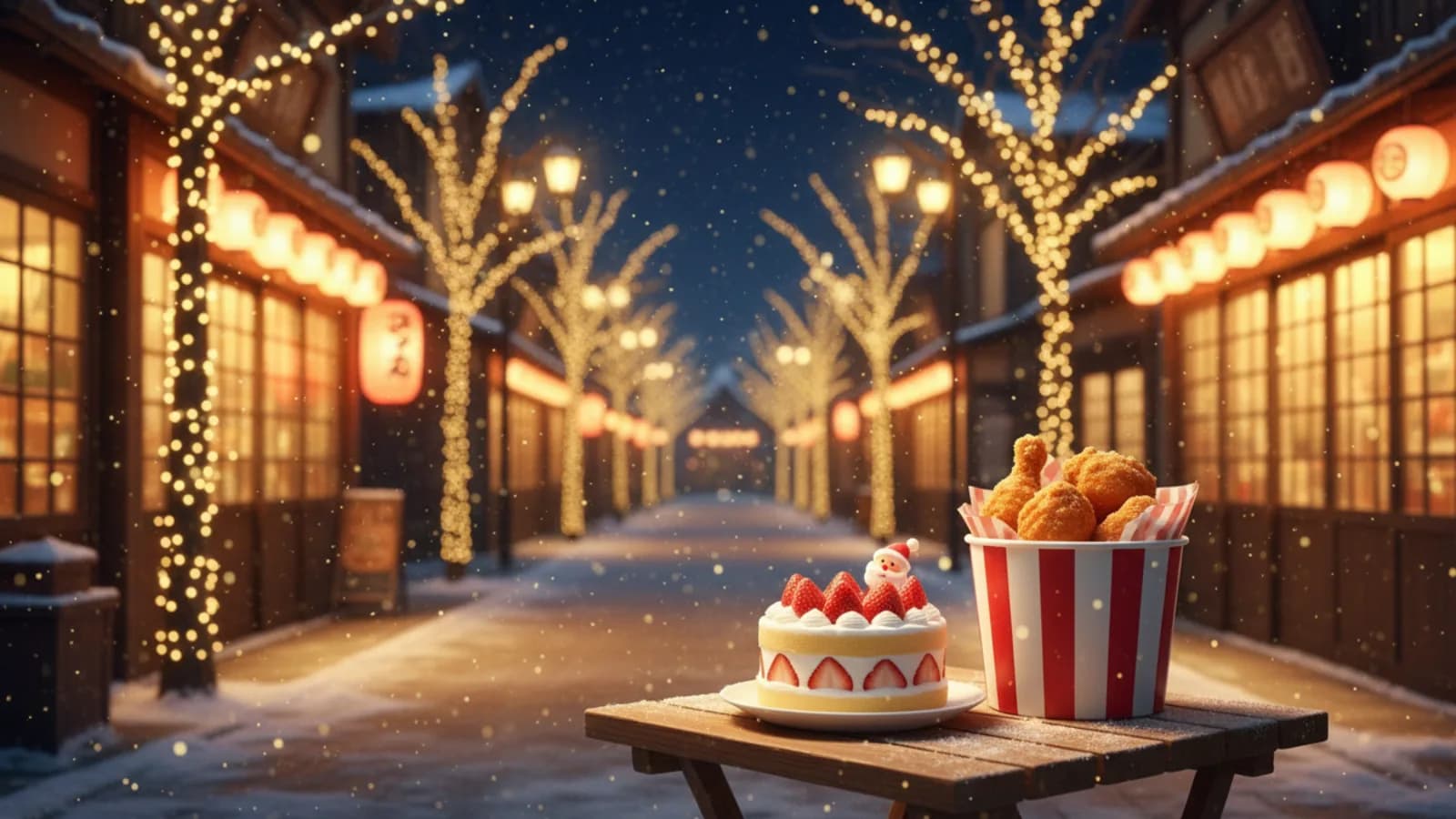
On the evening of December 24 in Tokyo, lines form outside Kentucky Fried Chicken restaurants. Customers are picking up a bucket of chicken they sometimes ordered two months earlier. In the pastry shops, white boxes pile up, each holding a sponge cake, whipped cream and strawberries. The next morning many children find a present waiting beside their pillow, and then everyone goes to work. December 25 is not a public holiday in Japan.
This holiday without a religious calendar was built over a single century, out of shop windows, slogans and songs. A tour of holidays around the world is on our Traditions page, and the other gift bringers have an article of their own. Here we follow the Japanese trail, from the Mass of 1552 to the chicken bucket of 1974.
Does Japan celebrate Christmas?
Yes, in its own way. According to Japan's Agency for Cultural Affairs, the country had about 1.9 million Christians at the end of 2021, or 1.1 percent of the population. Christmas, クリスマス (*kurisumasu*), is therefore almost entirely secular there: a season of shop windows and lights, with no day off. The real family gathering of the winter is New Year, お正月 (*o-shōgatsu*), which usually runs until January 4.
Christianity arrived early, then was wiped out of the country for more than two centuries. The Jesuit Francis Xavier landed in 1549 in what is now Kagoshima Prefecture. In 1552 his companion Cosme de Torres gathered Japanese believers in Suō Province, today's Yamaguchi, for a Christmas Mass regarded as the country's first. In 1587 an edict by Toyotomi Hideyoshi banned missionary work. After the Shimabara Rebellion of 1638, the Edo shogunate outlawed Christianity for over two hundred years; only a few “hidden Christians” kept practicing in secret around Nagasaki and in the Amakusa islands.
Santa, for his part, came in without going through the church. The Japanese call him サンタクロース (*Santa Kurōsu*), and more familiarly サンタさん (*Santa-san*), with the polite suffix that makes him sound like a friend of the family. Other names for him around the world are gathered in our article on Santa's names.
How did Christmas come to Japan?
Christmas returned when Japan opened up in the Meiji era, and it came in through the stores. According to Zoom Japan magazine, the imported-food grocer 明治屋 (Meidi-ya) put up its first Christmas decorations in 1900, after moving from Yokohama to Ginza, Tokyo's upscale shopping district. A photo from the Taishō era shows its storefront spelling out “MERRY XMAS,” topped with a sign that seems to show Santa Claus. Its founder, Isono Hakaru, had studied in England and wanted to recreate what he had seen there. The poet Masaoka Shiki, 正岡子規, had already written a Christmas haiku in 1892, at age 25. In the Taishō years, boys' and girls' magazines filled their December issues with Christmas stories and pictures, and in 1925 Japan issued its first Christmas seals, stickers given to donors to a campaign against tuberculosis.
Then a coincidence of the calendar fixed the date. Emperor Taishō died on December 25, 1926, and the holiday law was revised to create a day of remembrance on that date. For about twenty years, December 25 was a day off in Japan, for reasons that had nothing to do with Christmas. In 1928 the Asahi Shimbun newspaper could report that Christmas had become an annual event in Japan and that children loved Santa Claus. In December 1931 the Miyako Shimbun announced that Christmas would reach more than 7,400 cafés.
In 1948 the Taishō holiday was abolished and the 25th became an ordinary weekday again. It came close to being a holiday a second time: from 1989 to 2018, the birthday of Emperor Akihito, a national holiday, fell on December 23, giving many families a free day just before Christmas. Since 2020, Emperor Naruhito's birthday has been celebrated on February 23.
- 1549Francis Xavier lands in what is now Kagoshima Prefecture.
- 1552First known Christmas Mass, in Suō Province.
- 1638Christianity is banned for more than two centuries.
- 1900Meidi-ya puts up its first Christmas decorations in Ginza.
- 1926Emperor Taishō dies on December 25, which becomes a holiday.
- 1948December 25 becomes an ordinary day again.
- 1974KFC Japan runs its first Christmas campaign.
Why do Japanese people eat KFC at Christmas?
It all started with an ad campaign. In 1974 Kentucky Fried Chicken, which had arrived in Japan a few years earlier, launched its first Christmas promotion under the slogan “Kentucky for Christmas,” クリスマスにはケンタッキー (*Kurisumasu ni wa Kentakkī*). The offer paired a bucket of fried chicken with a bottle of wine for a grown-up Christmas party. According to the company's own account, the idea came from an employee who overheard a foreign customer at a Tokyo restaurant complain that he could not find turkey in Japan.
The bet paid off beyond anyone's expectations. Today December 24 is KFC Japan's busiest day of the year, with sales around ten times an average day. Preorders open as early as late October, and Japan's national tourism office notes that customers reserve weeks ahead and then wait in line for hours to collect their order. In 2018, according to Fortune, KFC Japan took in about 68 million dollars between December 21 and 25, close to 10 percent of its yearly revenue.
The party meal changes every year, with new side dishes, a decorated box and a commemorative plate. Outside the restaurants, life-size statues of Colonel Sanders, the chain's founder, are dressed as Santa for the season. Zoom Japan calls this habit of celebrating Christmas with fried chicken probably unique in the world, and it never fails to amuse visitors from the West.
What is a Japanese Christmas cake?
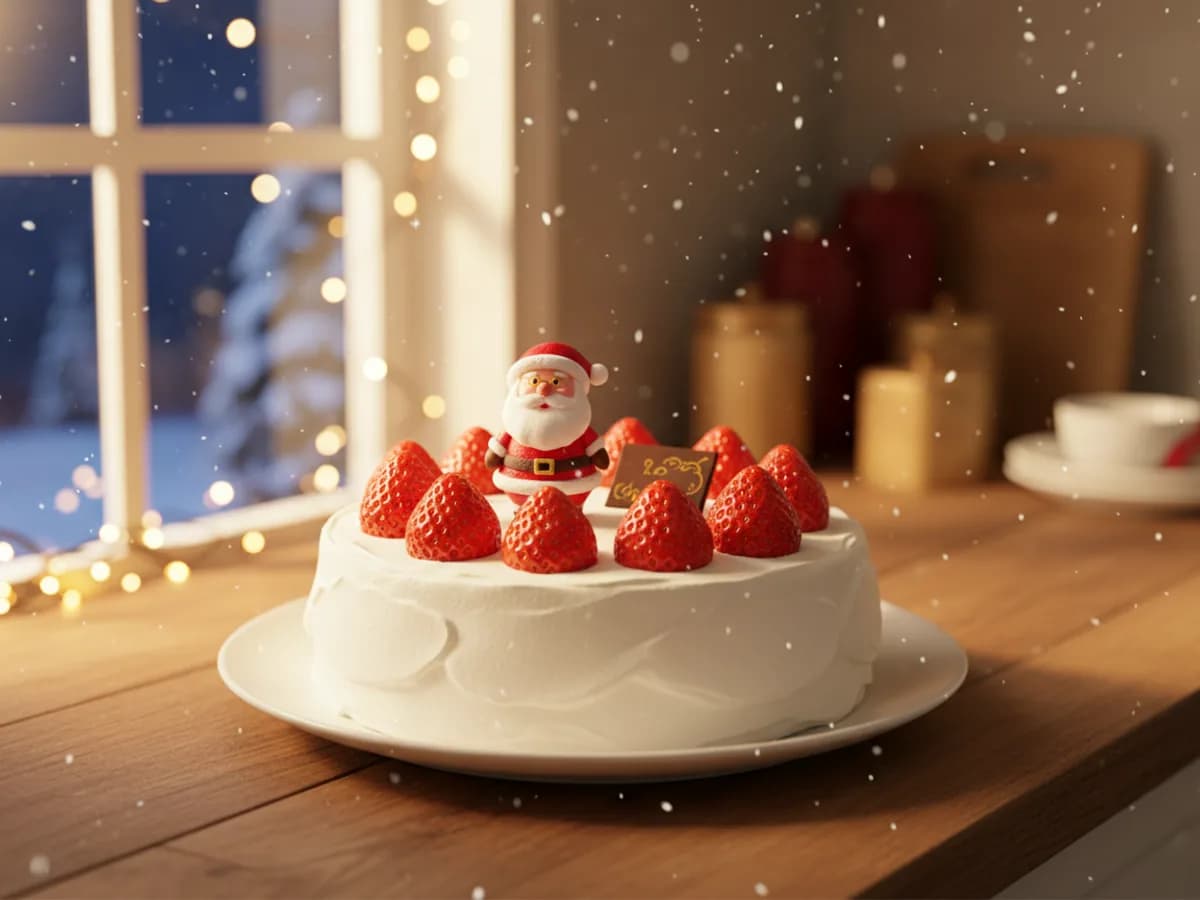
The Japanese Christmas cake, クリスマスケーキ (*kurisumasu kēki*), is neither a fruitcake nor a pudding. It is a very light sponge cake, filled and covered with whipped cream and topped with whole strawberries, often with a small sugar Santa or a little chocolate plaque. Red and white like the Japanese flag, it is ordered ahead and sold in every bakery in December.
Its story runs through 不二家 (Fujiya), a nationwide chain of confectioners. According to Japan's national tourism office, a Fujiya slogan from 1922, “Let's eat cake at Christmas!”, helped establish the tradition. The cake as it is known today spread mostly after the war: according to Zoom Japan, Fujiya created its prototype in the early 1950s, during the baby boom, when cream and strawberries became signs of returning prosperity.
The cake even gave Japanese a figure of speech. In the 1980s, unmarried women over 25 were nicknamed “Christmas cakes,” like the cakes that lose their value fast if they are still unsold after the 25th. According to Zoom Japan, the expression has become rare, because many Japanese women now marry later or not at all, and being single after 25 no longer carries a stigma. To bake a holiday cake with your kids, see our recipes.
Why is Christmas Eve a romantic night in Japan?
In Japan, December 24 looks more like Valentine's Day than a family dinner. Couples book a table at a restaurant, stroll under the light displays, visit German-style Christmas markets and swap gifts. One song serves as the soundtrack to these evenings: クリスマス・イブ (“Christmas Eve”) by 山下達郎 (Tatsuro Yamashita), first released on his album *Melodies* in 1983.
The song became famous through commercials for the rail company JR Central and its “Xmas Express” campaign. It topped the charts in 1990, has sold nearly two million copies and has come back into the top 100 every Christmas season for more than thirty-five years. Family has not vanished from the night, though: in 2009 a survey by the Printemps Ginza department store found that 53 percent of single people spent the 24th with their family, against 47 percent on a date.
The light displays are part of the scenery. The most moving may be the Kobe Luminarie, 神戸ルミナリエ, first held in December 1995 in memory of the victims of the Great Hanshin-Awaji earthquake that had struck in January of that year. In Hokkaidō, the Yukitoro festival at Jōzankei Onsen lights about 2,000 candles around Jōzankei Shrine.
How does Santa deliver presents in Japan?
Few Japanese homes have a chimney. By custom, presents arrive during the night of the 24th and are found in the morning beside the child's pillow, 枕元 (*makuramoto*). Japan's national tourism office reports that many children imagine Santa simply appears by magic, without coming down any flue. The same office notes that most winter gifts are exchanged at New Year instead, when families get together.
By then schools are already on their year-end break, and the country turns toward New Year. Along the way Japan keeps one last musical ritual: Beethoven's Ninth Symphony, 第九 (*daiku*), performed all over the country at year's end. In Osaka, a choir of 10,000 people sings it in German. If your child wants to send a list to Santa-san before the 24th, our letter page is open all year.

Sources
- Zoom Japan, Christmas in Japan (No. 100)
- Japan National Tourism Organization, Christmas in Japan: 5 Fun Facts, 2022
- KFC Global, How Kentucky for Christmas began in Japan
- Fortune, Christmas traditions: KFC in Japan since the 1970s, 2025
- U.S. Department of State, 2023 Report on International Religious Freedom: Japan (via ecoi.net)
- Nippon.com, Christianity in Japan
- Wikipedia, The Emperor's Birthday
- Wikipedia, Tatsuro Yamashita
- Wikipedia, Christmas in Japan
- SoraNews24, Japanese kid asks if Santa is real, gets a detailed, heartwarming response, 2020