The Christmas Eve route is a long one, and children all over the world have landed on the same idea: leave the visitor something to eat. What changes is the menu. A glass of milk in Ohio, a drop of sherry in Yorkshire, a bowl of rice porridge outside a Swedish front door, a carrot in a little shoe in Nancy, France.
The North Pole Archives have kept a record of these little plates for a long time, because Santa, for his part, remembers every one of them. Here is what gets left out, country by country, where those habits come from when anyone knows, and what the reindeer think about it.
What do you leave out for Santa on Christmas Eve?
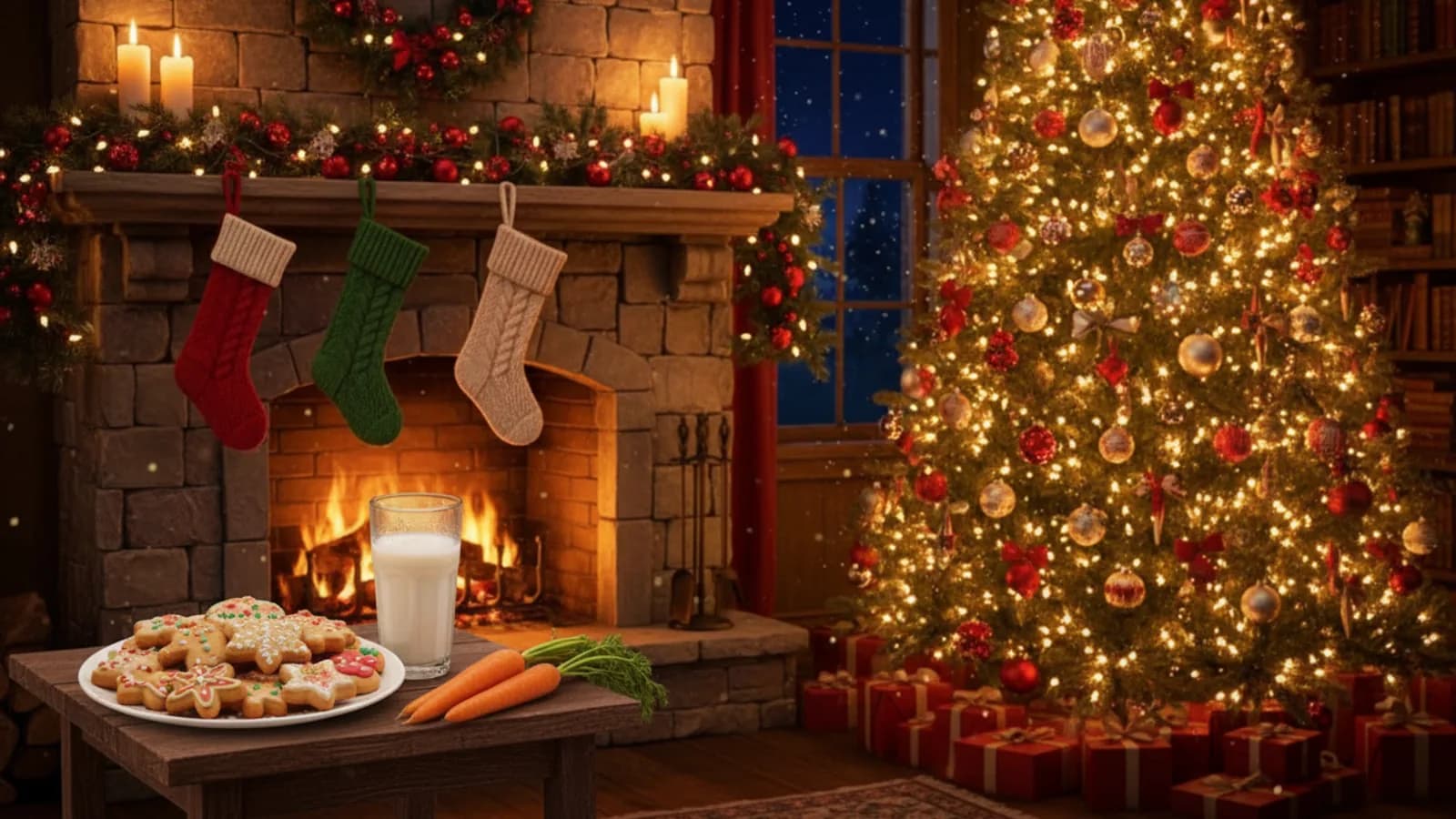
In the United States and Canada, the answer is almost always the same: a glass of milk and cookies, set near the tree or the fireplace. In 2017 NPR asked families and diplomats around the world about it. On the American side, the glass of milk might come with a chocolate chip cookie, or even a peanut butter and jelly sandwich.
The habit is younger than most people think. According to Mental Floss, the American milk-and-cookies custom took hold in the 1930s, during the Great Depression. Parents saw it as a way to teach children gratitude and generosity even when money was short: you thank the person who brings the presents by sharing what you have.
The rest of the world has its own menus, which you will find further down. One thing they share: the snack gets made last, right before bed, and for the youngest it is often the best part of the evening. The village cookies have a page of their own, too: our Christmas recipes.
What do kids leave out in the UK, Ireland and Australia?
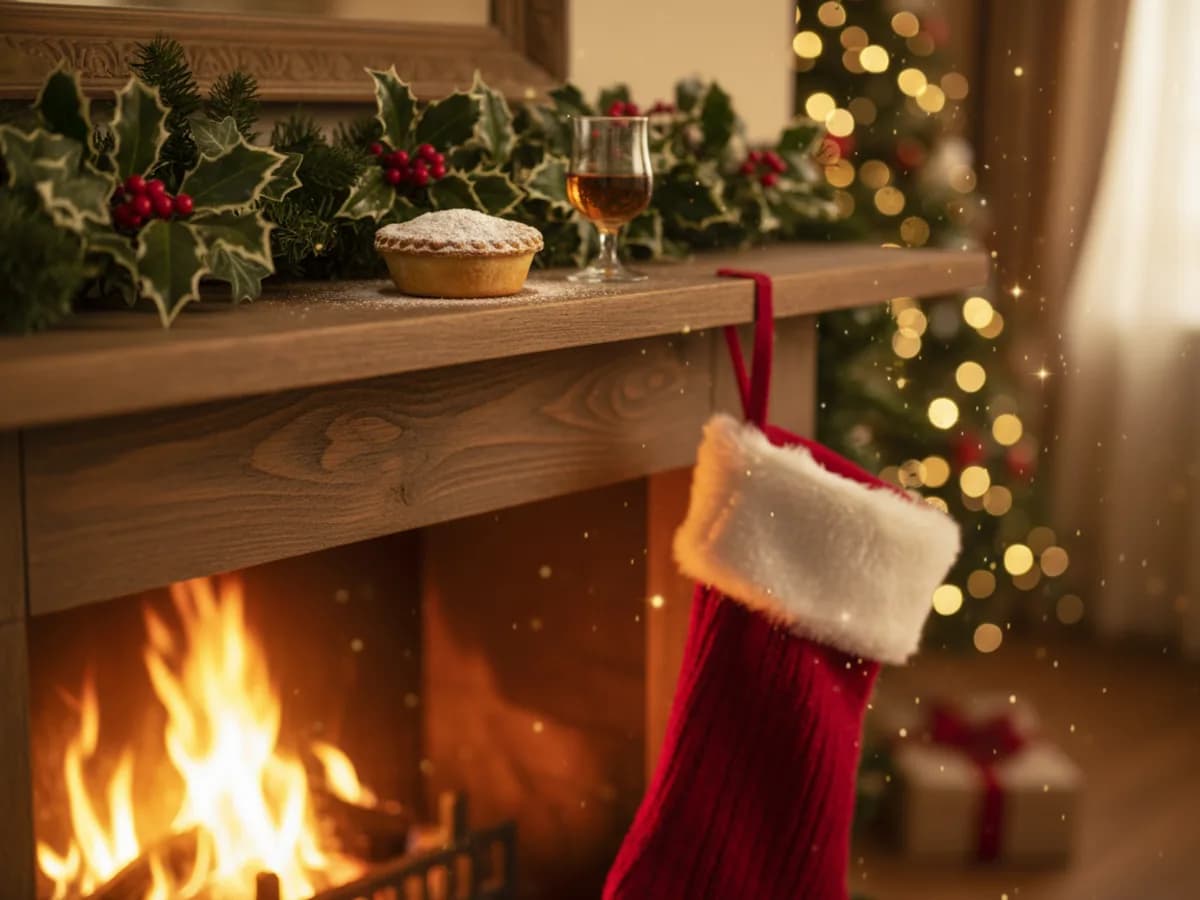
In the United Kingdom, Father Christmas gets a mince pie, a little pastry filled with spiced dried fruit, and a nip of sherry. A British diplomat, Andrew Overton, confirmed it to NPR in 2017. Mental Floss describes the same tradition in England: mince pies for Father Christmas, with sherry. According to the same magazine, some families prefer whiskey or brandy.
In Ireland the glass changes: kids often leave a pint of Guinness with the mince pies. NPR adds a detail we have not been able to check with the lady herself: Mrs. Claus reportedly keeps a splash of whiskey on the side. In Australia, where Christmas falls in high summer, food historian Barbara Santich of the University of Adelaide told NPR that milk often gives way to a beer, a glass of sherry or wine, sometimes with a slice of fruitcake.
Farther south, the menus follow the season. In South Africa, where Christmas also comes in summer, Mental Floss describes three habits side by side: American-style milk and cookies, British-style mince pies with a little drink, or something straight off the braai, the South African barbecue. The idea stays the same everywhere: give the visitor a little of what you are eating that night yourself.
- United States and Canada: milk and cookies.
- United Kingdom: mince pie and sherry, sometimes whiskey or brandy.
- Ireland: mince pies and a pint of Guinness.
- Australia: beer, sherry or wine, sometimes fruitcake, or cookies with lemonade.
- Chile: pan de pascua, a fruitcake, and a coffee drink called cola de mono.
- Nigeria: fufu and egusi, a melon-seed stew.
Should you leave carrots for the reindeer?
Yes, and plenty of families remember to. Mental Floss ties the carrots to the same Norse traditions as the milk and cookies: the reindeer need to get their strength back to haul such a heavy sleigh. Sweden's ambassador to the United States, Karin Olofsdotter, told NPR that when she was a child, her family left Santa a cheese and butter sandwich, plus a carrot for the reindeer.
Reindeer only joined Santa's story in 1821, with the poem “Old Santeclaus with Much Delight,” and there have been eight of them since 1823. Their names, and Rudolph's, are in Santa's reindeer names. To find out who feeds them the rest of the year, head to where did Santa's reindeer come from.
Why do kids put a carrot in their shoe for Saint Nicholas?
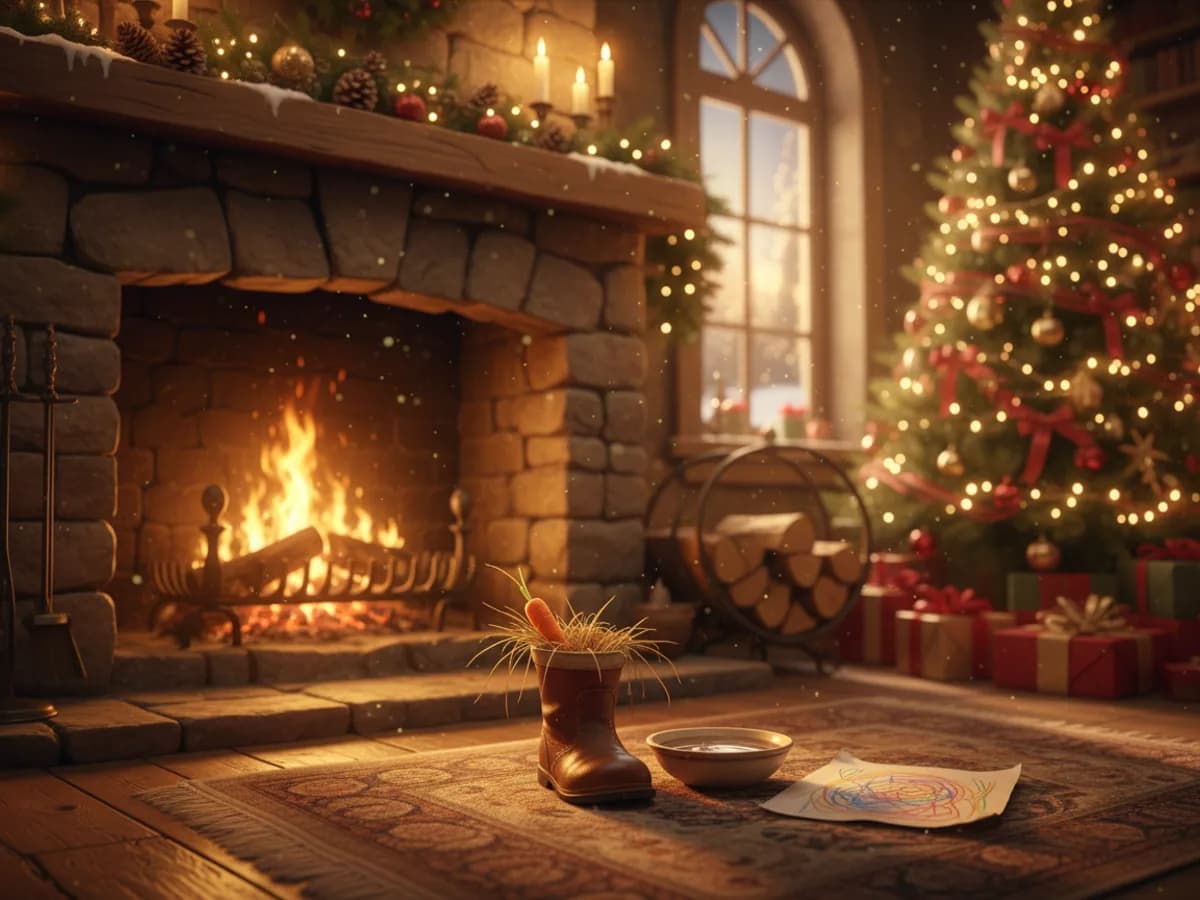
Because Saint Nicholas doesn't travel by reindeer. In Lorraine, in eastern France, the travel guide Le Routard reports that on the night of December 5, children leave a small glass of mirabelle plum brandy by the fireplace for the saint, plus sugar and a carrot for his donkey. The next morning they find treats, often an orange and a gingerbread shaped like the saint. Saint Nicholas has been the patron of Lorraine since 1477, after the Battle of Nancy.
In the Netherlands the custom is called “setting out your shoe.” Children put a shoe by the chimney, or these days by the radiator or the door, with a carrot or hay and a bowl of water for Sinterklaas's horse. They sing a song, and the next day the shoe holds candy or a small present. The horse was called Amerigo until 2019, when he retired and Ozosnel took over. In Belgium he has a weather-report name: “Slecht Weer Vandaag,” “bad weather today.”
In Alsace, according to France's official tourism site, Saint Nicholas stops by to see every well-behaved child with clementines and gingerbread. In Argentina, Mental Floss says, children set out their shoes with hay and water for the visitor's animals. Everywhere, the mount comes before the rider: it has the longest road to travel.
Iceland has its own version, with no carrot: children put a shoe on the windowsill, and the thirteen December visitors leave apples, oranges or other treats in it. The story of the chimney and the shoes set by the hearth is told in why does Santa come down the chimney.
What do people leave out in Scandinavia?
In Denmark and Sweden, the Christmas Eve dish is rice porridge, Danish *risengrød* or Swedish *risgrynsgröt*. Kate Reuterswärd, press officer at the Embassy of Sweden in Washington, told NPR that a bowl of it is left by the front door for the *tomte*. In Norway, according to the same report, the rice pudding comes with a jug of beer.
That bowl isn't exactly meant for Santa. It feeds the *nisse* or *tomte*, the little farm spirit who watches over the animals and became a gift bringer in the nineteenth century. The rule is an old one: he likes his porridge with a pat of butter on top. A much-retold tale has a farmer hiding the butter at the bottom of the bowl; the nisse, thinking he had been cheated, flew into a towering rage before finding the butter as he finished his supper. His story is in is Santa Claus an elf and his names in Santa Claus names around the world.
Where do kids leave a letter instead of a snack?
In several countries, Santa isn't the one who comes. In Germany, Switzerland and El Salvador, NPR notes, children mostly leave letters full of wishes. In Germany, Mental Floss adds, they write and decorate their letter for the Christkind, the Christ Child who brings presents, and leave nothing to eat.
In Latvia the present has to be earned another way: you recite a poem in front of the tree. According to NPR, the visitor may then help himself to a *piparkūkas*, a gingerbread cookie. In Italy the same source mentions a clementine and some hay for the donkey. The other winter visitors, from La Befana to the Christkind, are introduced in Christmas gift bringers around the world.
Everywhere, a letter is still the surest way to be heard. You can write yours on our letter to Santa page, then follow his route on the evening of the 24th on the Santa tracker, keeping one eye on the cookie plate.
Sources
- Mental Floss, “When and Why Do We Leave Cookies Out for Santa?”
- Mental Floss, Chelsea Thatcher, “Forget the Milk and Cookies: Here's What Kids in Other Countries Leave Out for Santa,” December 11, 2025
- NPR (via WWNO), “Whiskey and fufu: what kids around the world leave out for Santa,” December 22, 2017
- Wikipedia, “Sinterklaas”
- Le Routard, “Saint-Nicolas et Noël en Lorraine”
- Wikipedia, “Old Santeclaus with Much Delight” (The Children's Friend, 1821)
- Wikipedia, “Nisse (folklore)”
- France.fr (Atout France), “Où fêter la Saint-Nicolas en France ?”
- Fondation Napoléon, Napoleon.org, Pain d’épice et chocolat pour la Saint-Nicolas (in French: the donkey and its carrot)