Every December the same argument comes back around the dinner table: are we doing a child good by telling them Santa is real, or are we lying to them? One side sees a school for the imagination, the other a con run by grown-ups. Both sides like to cite “studies.”
Those studies exist, but they do not always say what people claim. This guide goes through what psychologists have actually measured, from Angeline Lillard’s 2013 review of pretend play to Jacqueline Woolley’s experiments on how children decide what is real. For the numbers on when belief ends and on trust in parents, see our article on what age kids stop believing.
What can research tell us about Santa?
Start with an honest limit: no study has followed children who believed in Santa and children who never did for twenty years, to compare their health, success or trust in their parents. Such an experiment would be close to impossible anyway, since nobody assigns a family’s traditions by coin toss.
What researchers have studied are pieces of the problem. How do children aged 4 to 8 tell the real from the imaginary? Does pretend play help them reason? Are imaginary friends a sign of loneliness? And how do children feel when they find out the truth? On that last point, the study by Candice Mills and Thalia Goldstein published in 2023 found no “drastic loss of trust” in parents.
Santa sits where all of these meet. He is a story told by trusted adults, backed by physical evidence (the empty glass of milk, the gifts under the tree), and one that children nearly always take apart themselves, around age 8 on average. Each piece of the research lights up one part of that experience.
Does believing in Santa build imagination?
This is the most common argument, and it deserves a close look. In 2013, Angeline Lillard and five colleagues at the University of Virginia reviewed dozens of studies on pretend play in the journal Psychological Bulletin. Their conclusion surprises many parents: existing evidence “does not support strong causal claims” about the unique importance of pretend play for development, and much more and better research is needed.
The authors do not say make-believe is useless. They weigh three possibilities: pretend play is crucial, or it is one of many routes to the same gains, or it simply goes along with development without driving it. For reasoning, the second option is “definitely supported”: pretending helps, but other activities help too.
A serious lead: “what if…”
In 2012, at the University of California, Berkeley, Daphna Buchsbaum and Alison Gopnik showed 52 children aged 3 and 4 a “Birthday machine” that played “Happy Birthday” when an object called a “zando” was placed on top. Children who kept the machine’s rule in a pretend game with a plain box and two blocks also did better on questions like “What if this one were not a zando?” The link held even after accounting for age and executive function.
In 2016, Rachel Thibodeau and colleagues randomly assigned children aged 3 to 5 to guided make-believe (an imaginary trip to the moon, for instance), non-imaginative play (songs, passing a ball) or their usual classroom routine, for 15 minutes a day over five weeks. The make-believe group gained more in working memory than the non-imaginative play group, but not clearly more than the regular classroom, and nothing changed on inhibition.
Does believing in Santa make kids gullible?
In a 1995 essay, the biologist Richard Dawkins proposed that children are credulous by nature, ready to believe almost anything, and that this credulity even gave them an evolutionary advantage. Jacqueline Woolley, a psychology professor at the University of Texas at Austin, has spent much of her career testing that idea. Her results contradict it.
In her lab, children heard about improbable animals. They were more likely to believe an animal existed when a zookeeper said so than when a chef did. From age 4, they judged a made-up animal, the “surnit,” as more likely to be real when it was introduced in a scientific setting than in a fairy tale. Children weigh who is talking, and in what context.
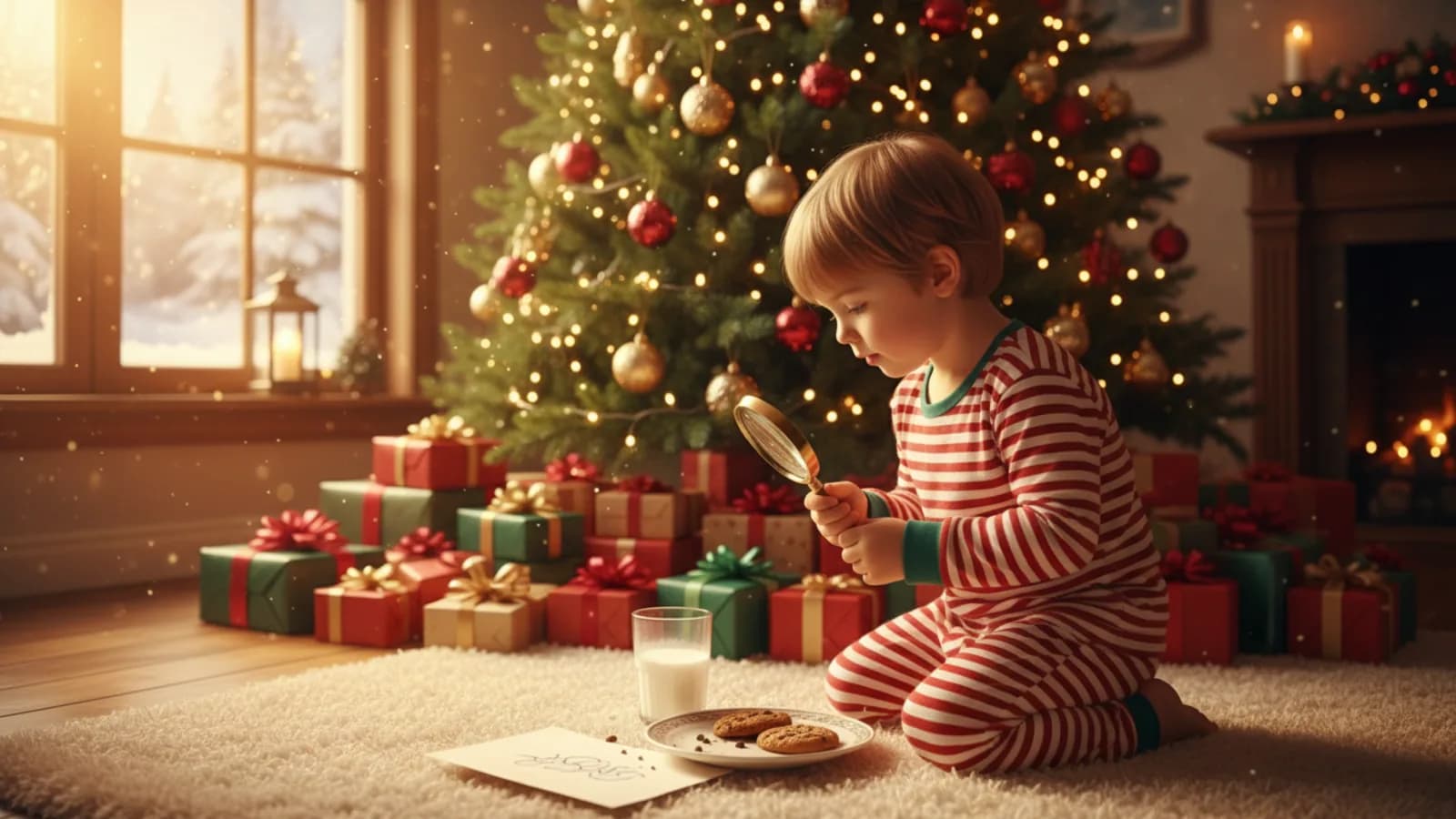
With Santa, every signal points the same way. The adults a child trusts most say he is real, television agrees, and on Christmas morning the glass of milk is empty and the cookies half eaten. Woolley reports that 83 percent of the 5-year-olds in her studies think Santa is real. With that much evidence, she writes, disbelief would be the irrational choice.
In believing in Santa Claus, children, in fact, exercise their scientific thinking skills.
The same logic explains how belief ends. In 2009, Ansley Tullos and Woolley showed that 6-year-olds can use clues to judge that an unfamiliar animal is real and treat missing clues as a reason for doubt, something 4-year-olds do not yet do reliably. The child who finally works out how many chimneys one night would require is using exactly the tool they sharpened while believing.
Is a child who still believes in Santa too much of a dreamer?
Many parents worry that an 8 or 9 year old who still believes is “living in a bubble.” Research on imaginary friends puts that in perspective. In 2004, Marjorie Taylor (University of Oregon) and Stephanie Carlson (University of Washington) followed 100 children first seen at 3 or 4 and interviewed again three years later. By age 7, 65 percent had had an imaginary companion at some point.
These companions were not just for toddlers: 31 percent of school-age children were playing with one at the time of the study, against 28 percent at preschool age. About 27 percent described a companion their parents knew nothing about. Carlson summed it up: having an imaginary companion is normal for school-age children, and it shows up across all personality types.
The study even found the opposite of what parents fear. Children who rarely or never pretended to be someone else scored lower on understanding other people’s emotions. Make-believe, Carlson said, lets children practice social situations, conflict for example, at low risk.
Is telling kids about Santa lying to them?
This is the heart of the ethical debate. In November 2016, psychologist Christopher Boyle (University of Exeter) and researcher Kathy McKay (University of New England, Australia) published a short essay in The Lancet Psychiatry titled “A wonderful lie.” Their argument: every child will eventually find out they were lied to for years, and may wonder what else adults have told them is worth.
The morality of making children believe in such myths has to be questioned.
It is an opinion piece, not a study, and both authors grant that lying to a child can sometimes be right, for instance to comfort them after a pet dies. Woolley answers that no evidence shows belief, and then discovery, damages trust in parents in any significant way. The surveys carried out since, covered in our article on when belief ends, tend to support her.
There is another way to see it. In 1952, in his essay “Le Père Noël supplicié” (Father Christmas Executed), the anthropologist Claude Lévi-Strauss observed that adults do not believe in Santa but encourage children to believe, and saw in that a kind of shared rite rather than an ordinary deception. Many families experience it that way: a game whose backstage the child discovers one day, and often keeps playing.
Should you use Santa to get kids to behave?
“If you’re not good, Santa won’t come.” The line is old enough to be in the songs, from “Santa Claus Is Comin’ to Town” in 1934, which warns he knows if you’ve been bad or good, to the stern companions of Saint Nicholas in Europe. Yet no experimental study has measured whether the threat actually makes children behave better, or for how long.
Parents themselves do not put this reason first. In the survey of 486 American parents published in 2025 by Karl Rosengren’s team, the reasons most often given for encouraging belief in Santa were that it is “a normal part of childhood” and that it is fun. “Prosocial behavior” came far behind, named by about 12 percent of the parents surveyed.
Boyle and McKay noted for their part that a North Pole agency sorting children into naughty and nice looks unsettling through adult eyes. The criticism targets Santa used as a watchman more than Santa himself. The same debate surrounds the Elf on the Shelf, which gets its own guide for parents.
- Keep the nice list as part of the game, not a daily threat through December.
- Talk to your child directly about what you expect, without a magical go-between.
- Use our nice detector as a moment of shared laughter, not a verdict.
What about families who skip Santa?
They exist, and they have their reasons. In the 2025 survey by Rosengren’s team, 85 percent of parents encouraged belief in Santa. Among those who did not, the reasons named most often were not wanting to lie, then religion, then the idea that children should not be encouraged to believe in things that are not real. One parent interviewed by the same team put it simply: “we don’t want to lie to her.”
The religious objection has a long history. On December 23, 1951, an effigy of Father Christmas was burned in front of Saint-Bénigne Cathedral in Dijon, France, before an audience of children: part of the clergy accused him of “paganizing” Christmas. That is the episode Lévi-Strauss analyzed the following year.
Nothing in the research suggests that a child raised without Santa will be less imaginative. Lillard’s review is a reminder that pretend play is only one route among several, and these families have others: storybooks, dress-up, Saint Nicholas Day on December 6, nativity scenes. The tricky part lies elsewhere, at school.

How do you do Santa in a healthy way?
If research does not settle the “whether,” it says a good deal about the “how.” The Mills and Goldstein study found that very strong promotion of the myth by parents went with more negative feelings at the moment of discovery. Belief goes best when the child stays in charge of their own reasoning.
- Leave questions open: “What do you think?” respects the budding detective, as Woolley’s work suggests.
- Avoid an escalating stream of fake proof: sooty boot prints, staged phone calls, ever more elaborate setups once your child starts to doubt.
- Lean on what stays true after the reveal: writing a letter to Santa, following his route with our Santa tracker, opening the advent calendar each morning.
- Keep Santa on the side of generosity rather than surveillance.
- Plan ahead: our guide on how to tell your child the truth about Santa offers lines for each age.
When the question finally comes, the work is already done. A child who was invited to think, not to obey, finds out the truth the way you solve a puzzle. Between 87 and 95 percent of the adults surveyed by Mills and Goldstein wanted to pass the tradition on to their own children: for most people, the memory stayed a good one.
Sources
- Lillard et al., “The impact of pretend play on children’s development: A review of the evidence,” Psychological Bulletin, 2013
- Buchsbaum, Bridgers, Skolnick Weisberg and Gopnik, “The power of possibility,” Philosophical Transactions of the Royal Society B, 2012
- British Psychological Society, Research Digest, on Thibodeau et al., Journal of Experimental Child Psychology, 2016
- Jacqueline Woolley, “Why children believe (or don’t) that Santa Claus exists,” The Conversation, reprinted by the Bangor Daily News, 2016
- Tullos and Woolley, “The development of children’s ability to use evidence to infer reality status,” Child Development, 2009
- University of Washington, Two-thirds of school-age children have an imaginary companion by age 7, 2004
- University of Exeter, Should parents lie to children about Santa?, 2016 (Boyle and McKay, The Lancet Psychiatry)
- Yoo, Jiang and Rosengren, “Why Santa but not witches?,” Frontiers in Developmental Psychology, 2025
- Bernard Quaritch, catalogue note on “Le Père Noël supplicié,” Claude Lévi-Strauss, Les Temps modernes, 1952
- University of Texas at Dallas, “Yes, Virginia, About Santa…”: Expert Explores Shifts in Belief, 2023 (Mills and Goldstein)