Your child has mailed the letter, or left it by the fireplace, and now they are waiting. You could hand the job to the post office. You could also pick up the pen yourself, the way a famous American novelist, an Oxford professor and a village postmistress in Normandy all did before you. A letter written at home has one advantage no other letter will ever have: you know what your child lived through this year.
This guide draws on those old letters, kept and later published, to pull out a few simple rules: what to say, what to avoid, how to disguise your handwriting, when to hand over the envelope. The three sample letters further down were written by our team for you to adapt freely. If your child has not written yet, start with our letter to Santa page.
Who wrote letters from Santa before you?
On December 25, 1875, in Hartford, Connecticut, Samuel Clemens, known to the world as Mark Twain, wrote to his daughter Susy, who was three. The letter is headed “Palace of St. Nicholas, In the Moon, Christmas Morning” and signed “Your loving Santa Claus.” Santa explains that he has received the letters from Susy and her baby sister, that he came down the chimney at midnight with the presents, and that a few items were out of stock.
I can read your and your baby sister’s jagged and fantastic marks without any trouble at all.
That one line says it all: Twain’s Santa can read a three-year-old’s scribbles, and he makes sure she knows it. The rest of the letter is a treasure hunt. For the trunk of doll’s clothes Susy ordered, he stages a whole production involving George, a member of the household staff, a speaking tube and a whistle. He also warns that if he leaves any snow in the hall, it should be swept into the fireplace, and asks that the mark of his boot on the marble be left alone.
In 1920, in Oxford, J. R. R. Tolkien answered his three-year-old son John, who wanted to know where Father Christmas lived. He kept writing every year until 1943, when his youngest, Priscilla, was fourteen. His illustrated letters describe life at the North Pole, the blunders of the North Polar Bear and, from 1932, goblin attacks. According to Catherine McIlwaine, Tolkien archivist at the Bodleian Library, the letters grew longer and more thrilling as the children got older.
- 1875Mark Twain signs a letter from Santa for his daughter Susy, sent “from the Moon.”
- 1920Tolkien writes his first Father Christmas letter to his son John, age three.
- 1943Tolkien’s last letter, for Priscilla, age fourteen.
- 1962The French postal service starts answering children, with a reply drafted by Françoise Dolto.
What should a letter from Santa say?
The power of a homemade letter lies in the detail only Santa should know. Magdeleine Homo understood that in the 1950s: she quizzed the mail carrier so she could write to each child about their real life. You do not need anyone, you have the whole year in front of you: the bike without training wheels in April, the first sleepover at Grandma’s, the tooth that fell out during snack time.
- Answer their letter: pick up a sentence, a drawing or a question they sent. Twain opens exactly that way in 1875.
- Mention two or three specific moments from their year, with a name, a place or an object.
- Praise effort rather than results: “you kept going even when it was hard” beats “you’re the best.”
- Share news from the North Pole: a reindeer with a cold, a scatterbrained elf, last night’s snowfall.
- Close on a warm note and a handwritten signature.
The setting matters as much as the compliment. Tolkien invented a whole life for his Father Christmas, with a clumsy North Polar Bear who doubled his master’s work. You can borrow from our Santa’s village and our page on the elves: an elf whose name comes back from one year to the next quickly becomes part of the family.
Finally, answer the questions. A six- or seven-year-old often wants to know how reindeer fly or how Santa gets into a house with no chimney. A playful, slightly vague answer keeps the mystery better than a long explanation. Twain’s Santa never explains how he gets through the house: he just asks that someone sweep up the snow he left behind.
What not to write in a letter from Santa
The first temptation is to promise. A letter announcing “you’ll get the game console” commits Santa to a gift that may sell out, arrive damaged or not fit the budget. Twain got out of it with humor: some items were simply out of stock in Santa’s storerooms. Try “I have your list right here” or “the elves have been working hard for you” instead.
The second temptation is to lecture. Songs have long told children that Santa keeps a list of who is naughty or nice, and it is tempting to make him speak in the same tone. A letter that threatens (“if you don’t clean your room…”) turns a gift into a warning. Twain’s only reminder is a boot mark on the marble, left so Susy would remember to be good: a wink, not a list of complaints.
- No comparisons with a brother, a sister or a classmate.
- No specific scolding about something that happened this year, even if it was deserved.
- No detail your child knows they told only you, if they are starting to doubt: they will connect the dots.
- No long letter for a young reader: a few lines are enough before age 6.
Sample letters from Santa by age
The three letters below are examples written by our team, not historical texts. Swap in your child’s name, places and memories: that swap is what gives the letter its value.
Sample letter for ages 3 to 5
“Dear Lily, I got your beautiful drawing with the purple reindeer. I hung it in my workshop, right above my desk. Comet, my reindeer, says it looks just like him. This year you learned to sleep all by yourself in your big-girl bed, and that is very brave. Here it is snowing a lot and the elves are sliding everywhere. I think of you often. Big hugs, Santa.”
Sample letter for ages 6 to 8
“Dear Jack, thank you for your letter, your handwriting has come a long way since last year. I know you took the training wheels off your bike in April and fell a few times before you got it. That kind of stick-to-it attitude is exactly what I like to see. You asked how I get into your apartment without a chimney: that is a trade secret, but I can tell you the elves help a lot. Up here, Pippin, our youngest elf, knocked over a crate of marbles in the workshop yesterday. We are still finding them. Merry Christmas, your friend Santa.”
Sample letter for ages 9 or 10
“Dear Maya, your letter made me smile: three pages, a map of your street and a numbered list of questions. You think like a real detective. I won’t answer question 4, a Santa has to keep a few secrets. Mostly I want to tell you that I noticed how you helped your little brother learn to read this fall. That is exactly what my best elves do: they help without being asked. Keep this letter, one day you’ll understand why. With all my friendship, Santa.”
Notice how they build. The letter for little ones fits in a few simple sentences and celebrates one achievement. The one for 6 to 8 year olds answers a practical question with a twinkle. The one for older kids recognizes the child’s cleverness, and lays the groundwork for the day they know. Tolkien did the same: his letters got longer and more intricate as his four children grew.
How do you disguise your handwriting and choose the paper?
Your child knows your handwriting better than you think: the grocery list, the note to the teacher, the tags on the presents. Tolkien found the perfect workaround. His Father Christmas wrote with a trembling hand befitting a very, very old man, and his other characters each had their own script. Handwriting that changes depending on who holds the pen makes the story believable.
- Change tools: a dip pen, a gold marker or a pencil will not produce the same handwriting as your everyday ballpoint.
- Change the shape: all capitals, a strong slant, or shaky and uneven like Tolkien’s Father Christmas.
- Try your non-dominant hand for the signature only: it is slow, but unrecognizable.
- Have someone else address the envelope, a grandparent or a friend, if your child knows your writing well.
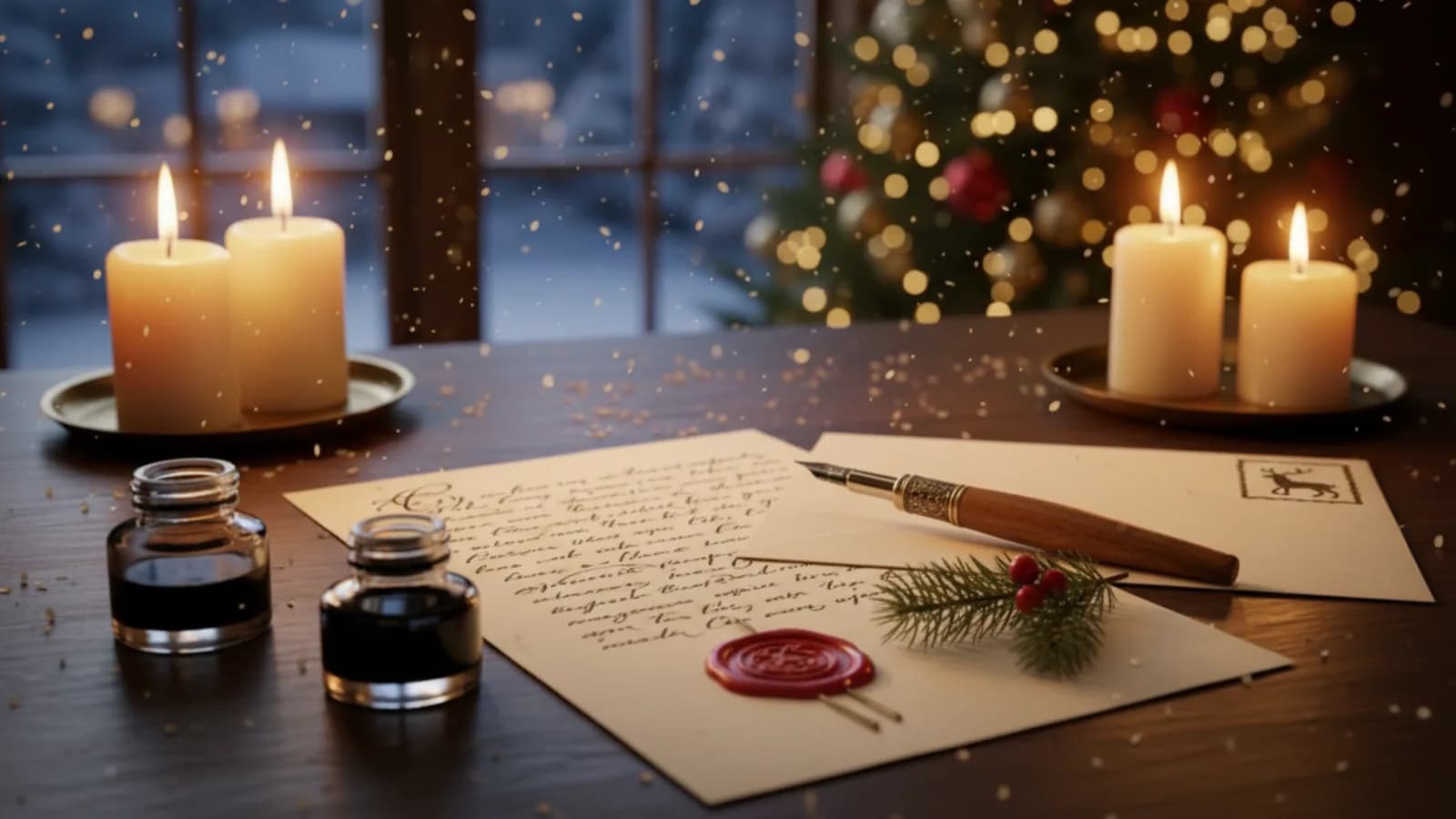
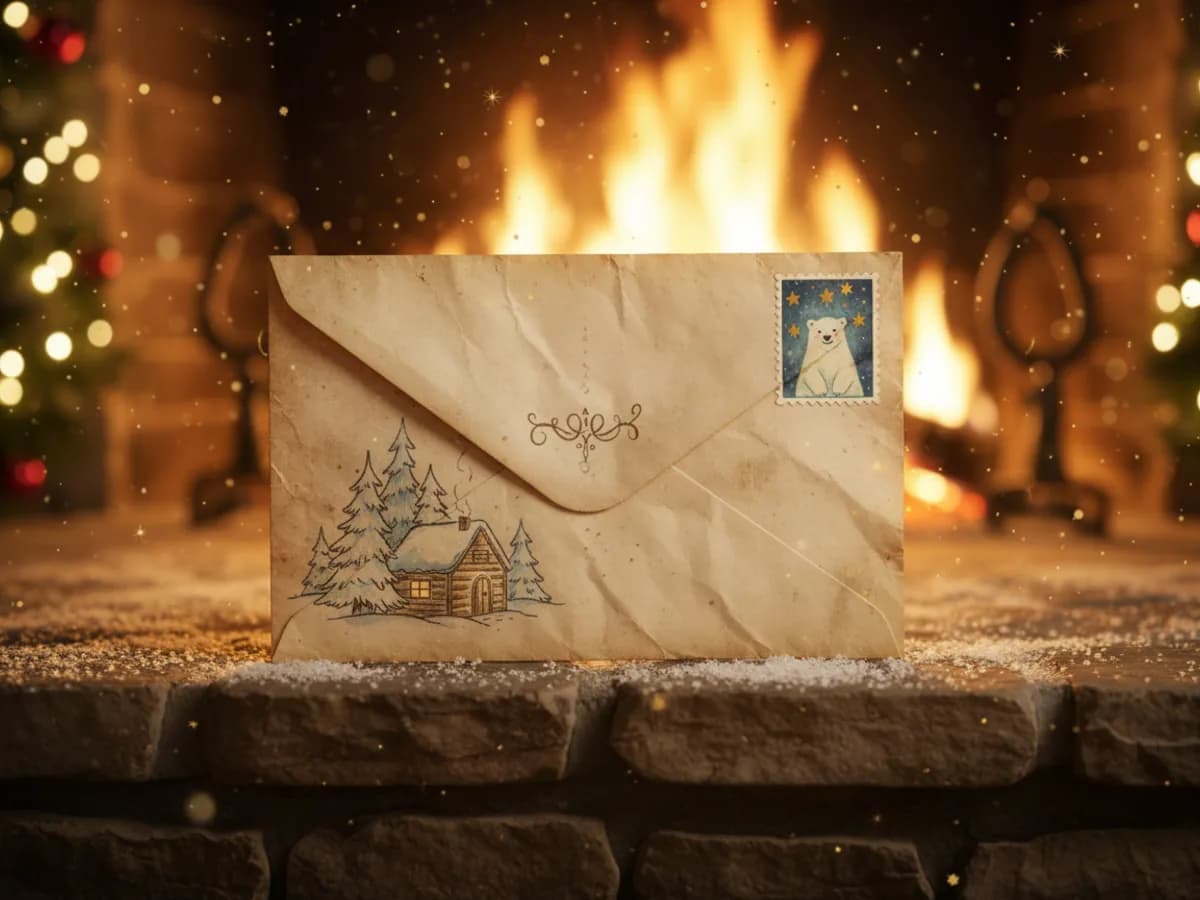
For paper, heavy cream or kraft stock makes more of an impression than printer paper. Slightly torn edges, a cinnamon fingerprint or a snowflake drawn in white ink add texture. Tolkien drew his own North Pole stamps, and the postage marked on some of them was “2 kisses.” Magdeleine Homo, for her part, reused old stamps and added the word “airmail.”
In the United States you can even get a real North Pole postmark. The Postal Service invites parents to write the reply themselves, put it in an envelope addressed to the child with “Santa Claus, North Pole” as the return address, add a First-Class stamp, then mail it inside a larger envelope to the postmaster in Anchorage, Alaska. The letter comes back with a North Pole postmark. The deadline changes from year to year, around mid-December.
When and how should you give your child the letter?
There are two possible moments, and they tell different stories. Before Christmas, the letter is a reply: it arrives in the mail a week or two after your child’s letter and builds the anticipation. On Christmas morning it becomes proof of a visit: it waits by the tree, in the stocking or on the mantel, next to the empty cookie plate.
Tolkien used both. Some letters turned up on the hearth, others came with the day’s mail: he had talked the postman into delivering them with the rest of his round. You can do the same by mailing your letter, stamped and addressed to your child. A child who gets mail with their own name on it is already having a small adventure.
Other countries run official replies too. In France, Santa’s Secretariat in Libourne takes letters until December 20 for a reply before Christmas, according to La Poste’s 2025 announcement, and guest writers such as the filmmaker Nicolas Vanier now lend their pen, as Françoise Dolto did in 1962. Canada has its own famous address, covered in where Santa lives. You can also pair your letter with a personalized video message from Santa in which he says your child’s name.
Should you keep the letters from Santa?
Yes, and the Tolkien story makes the case better than any argument. His children kept the letters they received over twenty-three years. They were published in 1976, three years after his death, as The Father Christmas Letters, then shown in Oxford in the Bodleian Library’s 2018 exhibition Tolkien: Maker of Middle-earth. A family correspondence became a book read around the world.
At home, a box will do. Each year, put in your child’s letter and Santa’s reply, both dated. You will watch the handwriting go from scribbles to sentences, and the requests go from toys to questions. The day your child learns the truth, the box changes meaning: it becomes proof that someone thought about them, every single year, with care.
That day, the pen can also change hands. Inviting your child to write a reply from Santa for a little cousin is a lovely way to bring them onto the team, as we explain in our guide on how to tell your child the truth about Santa.
Sources
- Mark Twain Project Online, Samuel L. Clemens to Olivia Susan Clemens, December 25, 1875 (UCCL 01290)
- Wikisource, Mark Twain, A Letter from Santa Claus (full text)
- Bodleian Libraries (GLAM, University of Oxford), Tolkien’s magical letters and illustrations bring Father Christmas to life
- Mental Floss, J.R.R. Tolkien’s Letters From Father Christmas
- Wikipedia, The Father Christmas Letters
- Antoine Georget and Valérie-Inés de La Ville, La Poste History Committee, history of the Santa service (in French), 2013
- Groupe La Poste, Le Secrétariat du Père Noël rouvre ses portes, press release (in French), November 18, 2025
- USPS Link, To the North: Greetings from the North Pole Post Office, 2019
- The Mark Twain House & Museum, Twain’s Children (birth dates of Susy, 1872, and Clara, 1874)