At 3 p.m. on December 25, millions of Britons put down their forks to listen to the King. Before that, they have pulled paper tubes that go off with a snap, put on tissue-paper crowns and brought out a pudding made back in late November. The next day they will go to a football match or hit the sales: it is Boxing Day, a public holiday since 1871.
Most of this Christmas was assembled in the nineteenth century, between the first Christmas card of 1843, the engraving of the royal tree in 1848 and Tom Smith's cracker. The figure who comes down British chimneys is Father Christmas, and his story is told in our article on Santa's names around the world. For a quick tour of holidays in other countries, see our Traditions page. Here we open the British cupboard one object at a time.
Father Christmas or Santa: who visits British children?
British children say Father Christmas and Santa interchangeably. The first is an old English figure, more a spirit of the holiday than a bringer of gifts, already speaking on stage in a Ben Jonson masque of 1616. The second crossed from America with the sleigh and reindeer in the 1860s, and the two merged in the 1870s. How the green robe turned into the red suit is in our article on Santa's suit.
For a long time the letter did not go in the mailbox but up the chimney. Children held it over the fire and let the draft carry it up toward the North Pole. A librarian at the University of Oxford recalls doing exactly that every year as a girl. Some letters never made it: in 1996, workers found one stuck in a bedroom chimney, dated December 8, 1911. A girl named Mabel asked for a storybook, a postcard album, a box of chocolates and a rattle for her baby sister.
Between the two world wars, in Oxford, J. R. R. Tolkien's children left their letters by the fireplace. For twenty years they received illustrated replies signed by Father Christmas and posted from the North Pole, later published as *The Father Christmas Letters*. Today British children write to a well-worn postal address: Santa's Grotto, Reindeerland, XM4 5HQ. You can also write to him from our letter page.
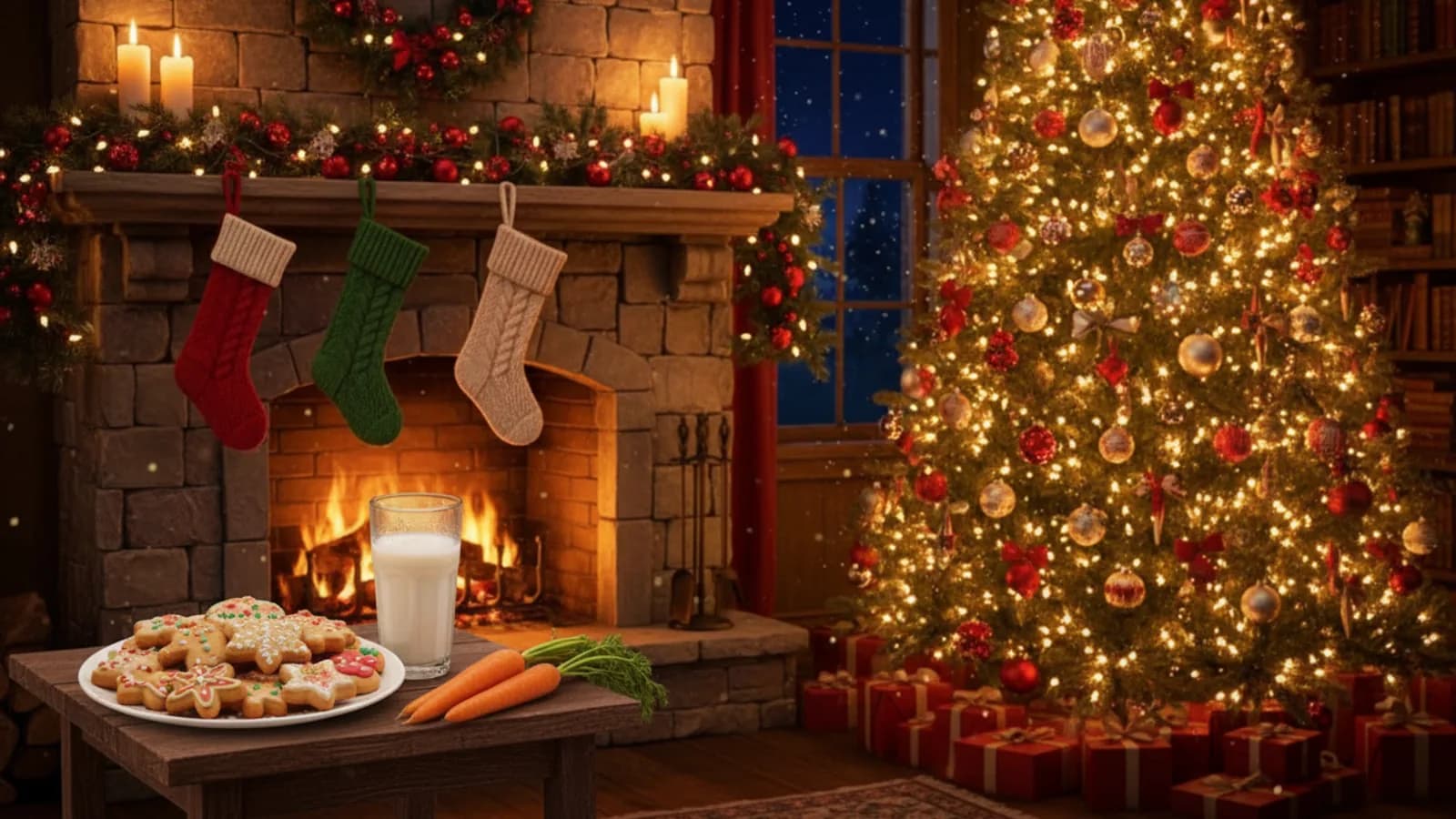
On the night of the 24th, he gets a snack. According to a HelloFresh survey published in December 2025, 53 percent of households that leave a treat choose a mince pie, about 1.68 million households add a glass of alcohol, usually sherry, and 36 percent put out a carrot for Rudolph. Other countries' versions are gathered in our article on what to leave out for Santa.
Who invented Christmas crackers?
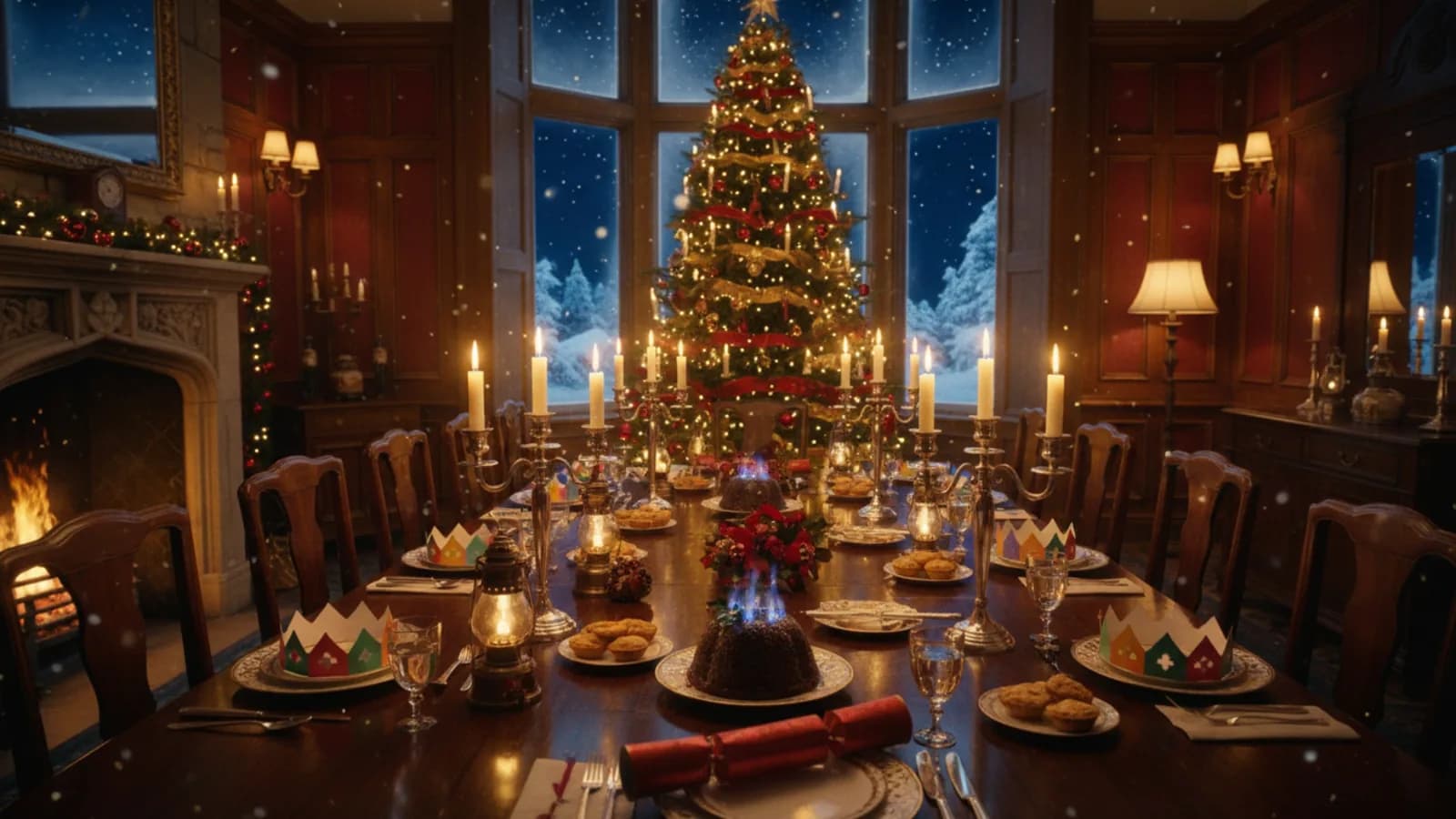
A cracker is a tube of shiny paper twisted shut at both ends like a wrapped candy. Two people each pull one end, the tube tears with a small bang, and whoever ends up with the larger half keeps what is inside: a paper crown, a joke and a small trinket. Crackers are pulled at the start of Christmas dinner, and the crown stays on until the pudding.
The traditional inventor is Tom Smith (1823 to 1869), a confectioner and baker who opened a shop on Goswell Road in Clerkenwell in the 1840s. According to the Victoria and Albert Museum, he saw the French bonbon wrapped in twisted paper in Paris and slipped a small love motto inside the wrapper to sell sweets outside the holiday season. The idea for the bang supposedly came from a log crackling in the fireplace. The Oxford English Dictionary records the pulling of crackers from 1847, the year tradition gives for the invention.
The mechanism was perfected in the 1860s: two strips of paper, one coated with silver fulminate and the other rough, which pop when rubbed together. Tom's son Walter added the fancy paper hats and sourced small gifts from Europe, America and Japan. Based in Finsbury Square in the City of London, the company employed about 2,000 people by the 1890s, many of them women, who pasted, folded and packed everything by hand.
Crackers followed every craze: jazz, Tutankhamun, motorcars, Charlie Chaplin, the wireless. The brand still makes luxury crackers for the Royal Household, with designs and contents kept secret. The largest cracker ever made was 63.1 meters long: it was pulled on December 20, 2001, at a school in Chesham, Buckinghamshire.

Why do Britons listen to the King at 3 p.m. on Christmas Day?
The sovereign's Christmas message began as a BBC idea. Its director-general, John Reith, first proposed it in 1922; King George V said no. Ten years later he agreed. On Christmas Day 1932, he spoke on the radio from a small office at Sandringham, his Norfolk home, to launch the BBC Empire Service, forerunner of the World Service. The script is credited to Rudyard Kipling. The address lasted two and a half minutes and reached about 20 million listeners.
I speak now from my home and from my heart to you all.
It did not become a fixture right away: there was no message in 1936 or 1938. The war settled it, with George VI's broadcast of 1939. Elizabeth II gave her first message in 1952, also from Sandringham, ten months after her father's death. In 1957 it was televised for the first time, live. From 1960 it was recorded in advance so it could be sent to Commonwealth countries.
Since the war only one year has gone without a message: 1969, when the address gave way to a repeat of the documentary *Royal Family*. In 2003 it was filmed entirely on location for the first time, at Combermere Barracks in Windsor. King Charles III recorded his first message in December 2022, three months after his mother's death, in St George's Chapel at Windsor. It became the most watched royal Christmas address on record. The message airs every year at 3 p.m. London time, between the main course and dessert in many homes.
Who brought the Christmas tree and the Christmas card to England?
Prince Albert, Queen Victoria's German husband, usually gets credit for the tree. Mostly he made it famous. According to English Heritage, the first known Christmas tree in England belonged to Queen Charlotte, the German wife of George III, set up at Queen's Lodge in Windsor in December 1800. Albert imported several spruce trees from Coburg in December 1840. But an engraving changed everything: in 1848 the *Illustrated London News* showed the royal family around a tree hung with ornaments. The first advertisements for tree decorations appeared in 1853, and by about 1860 the tree was common in middle-class homes.
The Christmas card was born in London in the same decade. In 1843 Henry Cole, later the first director of the Victoria and Albert Museum, asked his friend the painter John Callcott Horsley to design one. His diary notes that he received the design on December 17. A thousand copies were printed and sold for a shilling each, expensive for the time, and the venture was judged a commercial flop. One of those first cards sold at auction for £22,000 in 2013.
The country's most famous tree comes from Norway. Since 1947, the people of Norway have given Londoners a spruce every year to thank Britain for its support during the Second World War. The tree, 50 to 60 years old and more than 20 meters tall, is chosen in the forests around Oslo, where foresters call it “the queen of the forest.” It crosses the sea by ship, stands in Trafalgar Square with vertical strings of lights in the Norwegian style, and choirs sing at its base all through December. It comes down just before Twelfth Night and is chipped into mulch.

Mince pies and Christmas pudding: what do Britons eat at Christmas?
A mince pie is a small covered tart filled with *mincemeat*: raisins, candied peel, apples, spices and suet. The name means minced meat, and that is what it once held. A cookbook from 1390, *The Forme of Cury*, gives a recipe for “tartes of flesshe” made with minced pork, figs, raisins and spices. In 1615 Gervase Markham published “minc't pies” of mutton and suet, baked in a thick pastry case called a *coffyn*. The meat faded away over time; the spices stayed.
A stubborn legend says Oliver Cromwell banned mince pies. In fact, the ordinance of 1647 abolished religious festivals, Christmas included, but banned no food at all; the food historian Sam Bilton calls the ban a myth. Another custom says to eat one on each of the twelve days of Christmas, every pie promising a happy month in the year ahead. Britons got through about 175 million of them in 2025.
Christmas pudding descends from *plum pottage*, a stew of meat and dried fruit that turned sweet in the eighteenth century. The boiled cake of flour, fruit, suet, sugar and spices, topped with holly, clearly appears in the 1830s. Charles Dickens set it ablaze with brandy in *A Christmas Carol* in 1843, and Eliza Acton was the first, in 1845, to call it “Christmas pudding” in a cookbook. The idea that it has thirteen ingredients, for Christ and the twelve apostles, is a legend nobody has backed up.
It is made weeks in advance, on *Stir-up Sunday*, the fifth Sunday before Christmas. The name comes from the day's prayer in the Anglican Book of Common Prayer, which opens with the words “Stir up,” and the late Victorians turned it into the day the whole family stirs the mix. A small silver coin went inside, a threepence or a sixpence, promising wealth to whoever found it. For a version to make with kids, see our recipes.
Why is December 26 called Boxing Day?
Boxing Day has nothing to do with boxing. The name comes from the *Christmas box*, a gift of money attested from the seventeenth century: on the first working day after Christmas, tradespeople and workers called on their customers to collect a tip as thanks for the year's service. Samuel Pepys mentions it in his diary on December 19, 1663. In large households, servants who had worked on the 25th received a box of gifts or leftovers the next day, and time off to visit their families.
Another explanation points to the church alms box, sometimes opened and shared out on the 26th, the feast of Saint Stephen. In Ireland, in fact, the day is usually called St Stephen's Day. The Bank Holidays Act of 1871 made December 26 a public holiday in the UK outside Scotland. Today it is a day for football, with a full program of matches traditionally played against nearby rivals to keep travel short, and for the sales: in 2009, up to 12 million Britons went shopping that day.
And Scotland?
Scotland long kept Christmas at arm's length. In 1640 the Scottish Parliament made the celebration of Yule illegal. The ban was lifted in 1712, but the Presbyterian Church went on frowning on the holiday, and Christmas Day only became a public holiday there in 1958. Scots shifted their celebrations to New Year's Eve and the two days after it, which is why Hogmanay, their New Year, matters so much.
- 1640The Scottish Parliament bans the celebration of Yule.
- 1843Henry Cole has the first Christmas card printed.
- 1847First known record of crackers being pulled.
- 1848The Illustrated London News prints the royal family's tree.
- 1871Boxing Day becomes a public holiday.
- 1932George V gives the first royal Christmas message.
- 1947Norway's first gift tree stands in Trafalgar Square.
- 1958Christmas Day becomes a public holiday in Scotland.
Sources
- Victoria and Albert Museum, The Christmas cracker
- Wikipedia, Christmas cracker
- Victoria and Albert Museum, The first Christmas card
- Victoria and Albert Museum, Victorian Christmas traditions
- The Royal Family, The Christmas Broadcast
- Wikipedia, Royal Christmas message
- English Heritage, A Short History of Christmas Greenery
- Mayor of London, Christmas at Trafalgar Square
- Bodleian Libraries, Dear Santa, 2014
- Retail Times, Sherry, mince pies and 72,000 times the legal limit, 2025
- Wikipedia, Mince pie
- Wikipedia, Christmas pudding
- Wikipedia, Boxing Day
- Historic Environment Scotland, A timeline of Christmas in Scotland, 2016